
Transition Finance: How It Funds Decarbonization
Explore transition finance, how it funds emissions cuts in high-emitting industries, how it differs from green finance, and what makes plans credible.

– 7 min read
Explore transition finance, how it funds emissions cuts in high-emitting industries, how it differs from green finance, and what makes plans credible.
Transition finance funds measurable emissions cuts in businesses and assets that are still high emitting. A steelmaker replacing a fossil-fuel process or a freight operator electrifying vehicles needs money before those cuts appear. The investment must reduce emissions on a credible timetable without prolonging the old high-emitting model.
Project owners must pay for equipment and infrastructure before they see the benefit. Investors want to know whether the expected cuts are achievable and whether the company intends to keep cutting emissions elsewhere. The financing case has to make both points clear.
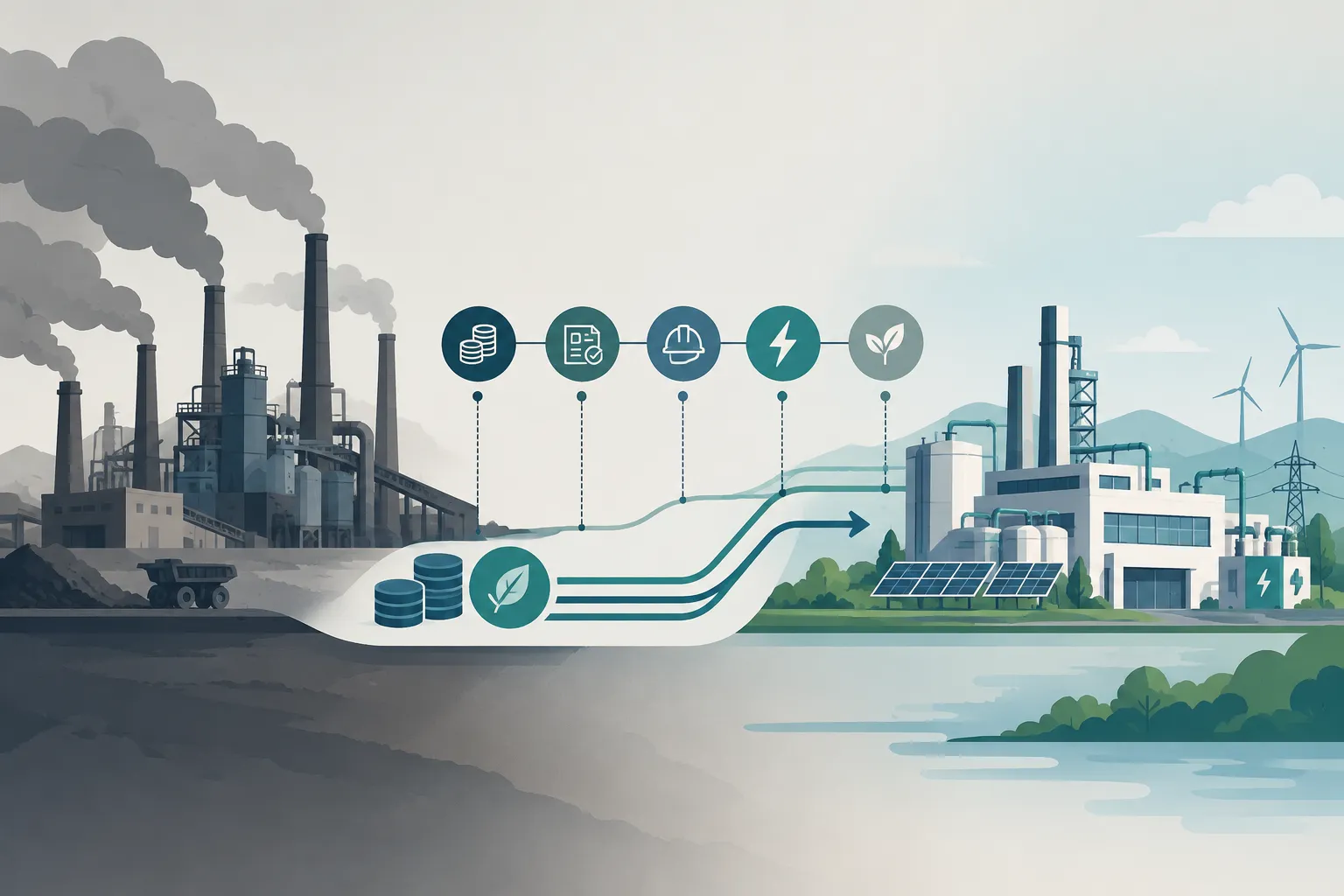
Transition finance pays for changes that lower emissions in high-emitting activities. Institutions and jurisdictions define its boundaries differently. In a specific deal, ask: what changes in the physical operation, when will emissions fall, and how will you measure the change? A high-emitting borrower can make a credible investment here. One low-emissions asset, though, tells you little about its remaining operations.
"Steel and cement together account for 14% of global energy- and process-related emissions, measured on a direct basis." - International Energy Agency
Typical candidates include:
The same equipment can have different emissions effects depending on its power supply, utilization, asset life and the pathway for its sector. Companies weighing the wider funding choices can start with energy transition financing for corporates. A “transition” label cannot stand in for a clear use of funds and a coherent investment plan across the company.
Green finance generally backs an activity with an identifiable environmental benefit, such as a renewable-energy installation. A company can also finance changes to operations that remain emissions-intensive during the changeover. It may need both types of funding at once.
Question | Green finance | Transition finance |
|---|---|---|
What is the central financing case? | A defined green activity or asset | A credible change from a high-emitting baseline |
What is assessed? | Eligibility and environmental benefit of the financed activity | Emissions pathway, execution plan, spending and outcomes, often at both project and company level |
When do benefits arise? | Often from an already low-emissions asset once operating | Frequently over staged upgrades and later operating periods |
Main integrity risk | Proceeds do not deliver the claimed green benefit | A weak plan or new asset locks in emissions despite the transition label |
The financing purpose determines which approach fits. A cement producer building a solar array may have a green project while still needing a credible plan for process emissions. A transition-labelled retrofit still needs to pass tests of cost, feasibility and measured impact.
Suppose a factory wants to replace a combustion-based heat process with electric equipment. Its sponsor needs a fuel and emissions baseline, an engineering design, expected electricity demand, a workable grid-connection schedule, and operating-cost and emissions forecasts for the new setup. If grid capacity or cleaner power arrives late, the financing and emissions forecasts both need revision.
The capital can take several forms:
Instrument | What it finances or rewards | Key evidence for an investor |
|---|---|---|
Use-of-proceeds transition loan or bond | Specified eligible upgrades | Project budget, allocation records and resulting emissions |
Sustainability-linked loan or bond | Company-wide performance against agreed targets; proceeds are not necessarily tied to one project | Material KPIs, credible targets and terms for missed targets |
Project debt or infrastructure equity | A defined asset or portfolio with a repayment or return case | Construction risk, contracted revenue, cash flows and risk allocation |
Blended or concessional capital | Part of a project’s risk or funding gap where commercial finance alone is insufficient | Clear additionality, defined risk-sharing and a route to viable operations |
Lenders need to know who pays for the asset, whether contracts support the projected cash flows and what happens if commissioning or emissions performance falls short. The financing label cannot answer those questions. For company-wide instruments, missing a target should have a meaningful consequence.
The International Capital Market Association’s transition-finance debt-market paper examines transition activity across bond categories. The bond does not have to carry “transition” in its name for its proceeds to support a transition activity.
For a closer look at debt terms and cash-flow risks, see energy project finance explained.
A transition plan should show which assets a company will change, what it will spend and who is responsible. Financiers can then test the emissions claim against the company’s ability to deliver.
Show existing emissions and activity levels, the measurement boundary and which emissions the investment will change. Set interim milestones alongside the longer-term target. A relevant sector and regional pathway can reveal whether a reduction against the company’s own baseline is fast enough.
At the factory, separate emissions from on-site fuel combustion from those associated with purchased electricity, and document the assumptions behind each estimate. Switching to electricity may shift emissions between accounting categories without delivering the expected real-world reduction.
Name the equipment, the retirement or conversion steps, the expected capital spending and the order of decisions. Include dependencies such as grid access, permitting, procurement and customer demand. A small pilot offers little reassurance if most future spending goes to long-lived, high-emitting capacity.
Compare the proposed asset’s operating life with the emissions pathway. Will it make the legacy process harder to retire or create demand for a high-emitting input after the promised transition date? Account for workers, affected communities and material environmental trade-offs. A company that cannot manage these effects may struggle to deliver the plan.
Assign someone to own the plan, set a reporting schedule and define the response to missed milestones. Track operating and emissions results against the baseline alongside the amount disbursed. Compare those results with the reductions estimated at financial close.
Give investors the same project assumptions in the emissions model and the credit model. Capital partners can screen a consistent package faster, then investigate the risks that a score cannot settle.
Evidence to assemble | Why it matters |
|---|---|
Asset description, ownership, site and schedule | Establishes what is being financed and who can deliver it |
Baseline, boundaries, forecast reductions and assumptions | Makes the climate claim testable |
Capex, operating forecast, contracts and repayment source | Shows whether the project can support the proposed capital |
Company transition plan and remaining asset pipeline | Reveals whether the funded activity fits the wider direction |
Permits, technology dependencies and delivery risks | Exposes schedule and performance constraints |
Milestones, reporting method and responsible team | Enables monitoring after capital is committed |
An investor can then separate three questions: Is the project technically able to cut emissions? Is the company committed to the wider transition? Can this transaction carry its risks and repay its capital? A yes on one does not answer the others. Investors might choose a different structure, stage financing against milestones or decline the proposed activity.
Once the package is ready, finding climate project investors means looking for mandates that fit the project’s size and risk, rather than sending it to the longest list available.

Even a strong transition plan can stall when project data is scattered or the financing request reaches the wrong investors. Zero Circle works on that gap between project readiness and capital. Its energy-finance platform standardizes project information, applies AI-driven fundability scoring, matches investors by mandate, geography and deal size, and supports underwriting, capital structuring and human-reviewed outreach. Capital partners get more relevant, reviewable deal flow; sponsors get a clearer route to suitable conversations.
Those workflows help organize evidence and speed engagement. They do not certify that a project is Paris-aligned, guarantee investment or replace independent technical, emissions and credit diligence. A sponsor still needs a defensible baseline, bankable commercial case and a transition plan that survives scrutiny.
Transition finance earns its name when an investment cuts emissions in a high-emitting activity and avoids extending the life of the old process. Start with the asset, its baseline and its operating life. Tie the emissions milestones to spending and repayment, then report what happens after financing. If you have that foundation and need access to suitable capital, Zero Circle can help present the case to investors in a structured, reviewable form.
Transition finance funds changes that reduce emissions in high-emitting companies or activities, particularly where they cannot become low carbon overnight. Credibility depends on a measurable baseline, an executable plan, meaningful milestones and evidence that the investment will not lock in emissions.
A green bond restricts proceeds to eligible green uses, so it may not suit an industrial upgrade that cuts emissions but does not meet the relevant green criteria. Issuers also need to document allocation and impact; a transition loan, bond or other financing structure may better fit a credible staged retrofit. No label removes the need to test the project’s economics and emissions claims.
Green finance generally backs an activity with an identifiable environmental benefit, such as a renewable-energy installation. Transition finance funds a credible change from a high-emitting baseline, often through staged upgrades, and is assessed on the emissions pathway, execution plan, spending and outcomes. A company may need both types of funding at once.
A transition plan should show which assets a company will change, what it will spend and who is responsible. Financiers can then test the emissions claim against the company's ability to deliver: establish the baseline and target, tie spending to physical changes, test for lock-in and harm, and monitor results against the baseline after capital is committed.
Capital can take several forms, including a use-of-proceeds transition loan or bond for specified eligible upgrades, a sustainability-linked loan or bond tied to company-wide performance targets, project debt or infrastructure equity for a defined asset, and blended or concessional capital where commercial finance alone is insufficient. The financing label cannot answer who pays for the asset or what happens if commissioning or emissions performance falls short.