
Climate Investor Matching: What Determines Fit?
Explore climate investor matching: what determines fit by mandate, geography, stage, ticket and instrument, with a practical shortlist scorecard.

– 6 min read
Explore climate investor matching: what determines fit by mandate, geography, stage, ticket and instrument, with a practical shortlist scorecard.

Climate investor matching: what determines fit? The financing request comes first. A project sponsor needs capital for a particular asset, market, stage, instrument and amount. Remove investors whose mandates rule out that request, then rank the rest by fit and the work still needed to make the deal investable. Even the highest-ranked investor has made no funding commitment.
Financing an energy asset calls for a different search from funding the company that develops it. A climate-tech startup may raise equity to build a product and grow a business. A solar, storage or resilience project may need development equity, construction debt or long-term financing backed by the asset's contracts and expected cash flows. Interest in a technology does not mean an investor can lend to its deployment.
"The IEA estimated that USD 2.2 trillion would go to clean energy technologies in 2025, compared with USD 1.1 trillion for fossil fuels." - IEA, World Energy Investment 2025
The IEA's investment outlook measures capital flows across technologies; it cannot tell you whether a given investor will fund your project.
Before searching, pin down the borrowing or issuing entity, use of proceeds, tranche amount, funding date, and the instrument's rights and repayment source. Call a construction-debt request what it is. For the mechanics of asset-level financing, see energy project finance explained.
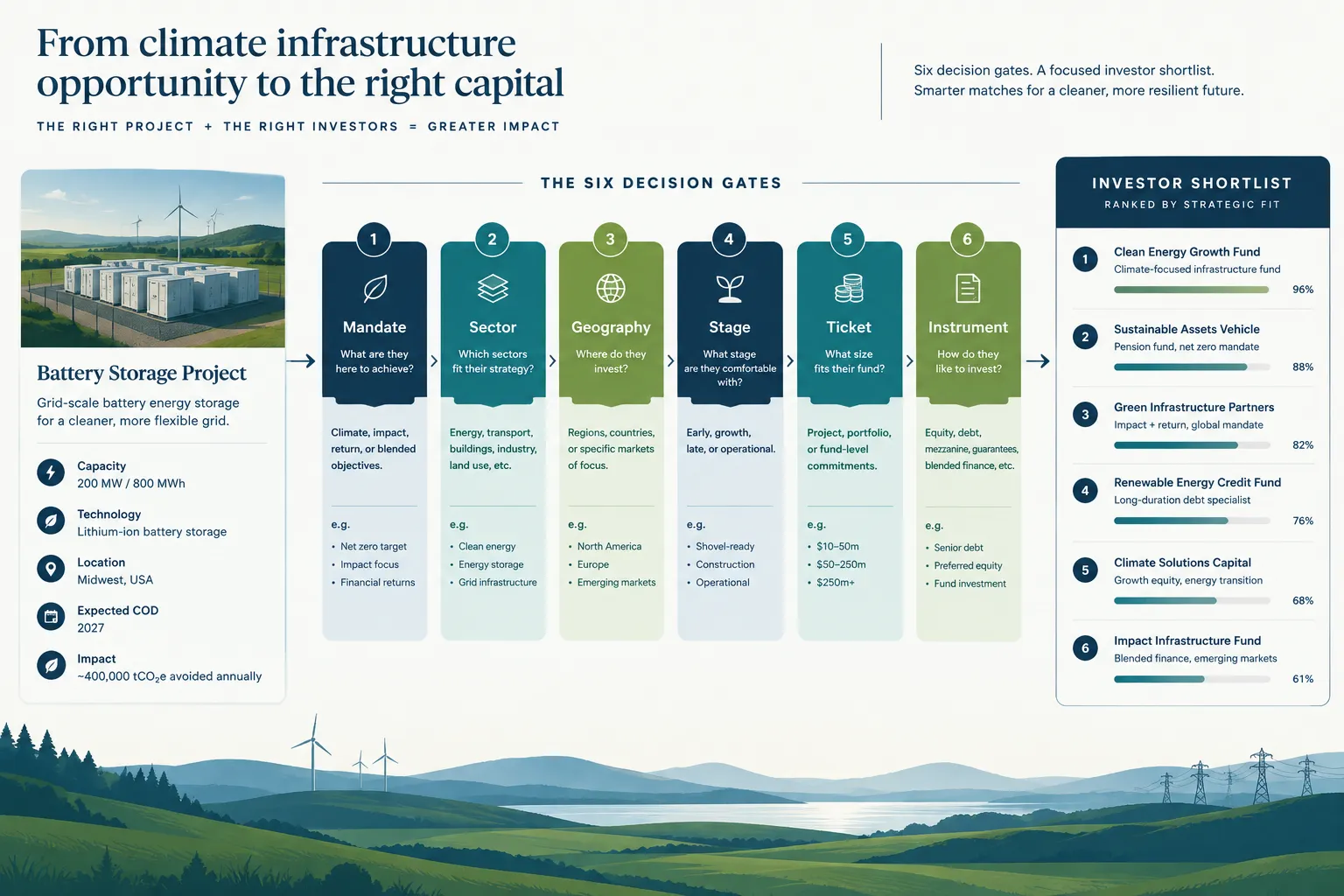
The investor's mandate determines which criteria are deal breakers. Exclude a name when its published or directly stated rules rule out the request. If a criterion remains unclear, keep the investor on a lower-priority list until someone clarifies it.
Criterion | Disqualify when | Lower or raise priority when |
|---|---|---|
Mandate and sector | The investor excludes the technology or asset class, or invests only in companies rather than projects. | The asset is permitted but falls outside the investor's core sector focus. |
Geography | The project jurisdiction is outside the investor's eligible markets. | The market is eligible but new to the investor or requires a local partner. |
Project stage | The investor funds only operating assets and this project still needs development capital. | It can consider the stage, but key milestones are outstanding. |
Deal size | The required investor allocation is below a firm minimum or above a firm maximum, with no workable aggregation or syndication. | The allocation is within range but at the edge of the investor's usual comfort zone. |
Financing instrument | The investor provides equity only and the request is for senior debt, with no alternative tranche to offer. | The instrument is possible, but security, tenor or return terms need negotiation. |
Risk and readiness | A non-negotiable policy or underwriting requirement cannot be met. | Site control, permits, interconnection, offtake or contractor arrangements are progressing but incomplete. |
Separate missing documents from mandate conflicts. A lender that requires contracted revenue may be worth approaching once the sponsor signs an offtake contract. Mark it “revisit after milestone.” A geographic prohibition or incompatible instrument, on the other hand, removes the investor from the current shortlist regardless of sector fit.
Name the asset type precisely. Generation and storage, for instance, can fall under different mandates, as can grid infrastructure and mobility. Record the country and, where relevant, the subnational market; legal eligibility, currency exposure and local execution requirements may differ. An investor's prior deal can show familiarity with adaptation or emissions reduction, but it does not establish a current allocation. Use the stated mandate for the screen.
Use the project's current stage. Pre-permit, construction-ready and operating assets carry different risks and need different capital. State whether the requested amount is the full budget or one investor's allocation. If you plan to split a large project into tranches or bring in a syndicate, show that structure before treating a ticket-size mismatch as resolved.
Tranche sizing deserves its own analysis before treating a too-small or too-large allocation as a hard stop.
Equity takes residual risk and upside. A debt investor needs a credible repayment path and enforceable terms, so expect questions about revenue contracts, completion risk and the developer's ability to deliver. If the request is debt only, an equity-only investor is ineligible even when its sector focus fits.
Suppose a hypothetical battery-storage project needs $12 million in construction debt in Market A. The sponsor has site control and a draft offtake agreement; final permits and interconnection remain open. The labels, amounts, weights and investor profiles in this example are invented. They represent neither real investors nor Zero Circle's algorithm.
Investor D funds storage in Market A but offers growth equity only to companies. Remove it from this debt shortlist. Investors A, B and C allow storage projects in Market A, construction-stage deals, a $12 million lender allocation and debt. Rank them, while recognizing that none has agreed to issue terms.
Score each eligible investor from 0 to 5 on each criterion, with 5 indicating the clearest fit. Multiply each score by its weight, divide by 5 and add the results for a score out of 100. These illustrative weights reflect the sponsor's priorities, not an investment standard:
Priority factor | Weight | Why it matters for this request |
|---|---|---|
Sector focus | 15 | Familiarity with storage assets |
Geography experience | 15 | Ability to execute in Market A |
Construction-stage appetite | 20 | Tolerance for outstanding milestones |
Ticket comfort | 15 | Capacity for the proposed $12 million allocation |
Debt structure fit | 20 | Alignment on security, tenor and repayment |
Readiness and risk fit | 15 | Appetite for draft offtake and open permits |
Illustrative investor | Sector | Geography | Stage | Ticket | Instrument | Readiness | Weighted score | What changes the conversation |
|---|---|---|---|---|---|---|---|---|
A, construction lender | 5 | 5 | 4 | 5 | 5 | 3 | 89/100 | Share the permit path and offtake status early. |
B, infrastructure credit fund | 5 | 3 | 5 | 4 | 4 | 4 | 84/100 | Address local execution and proposed security. |
C, flexible project lender | 4 | 5 | 3 | 4 | 4 | 5 | 82/100 | Discuss whether financing waits for permits. |
Investor A scores (5×15 + 5×15 + 4×20 + 5×15 + 5×20 + 3×15) ÷ 5 = 89. It leads on sector, market, allocation and debt appetite, though its readiness score is weaker. If A requires permits before engaging, B may be the better first call. C's tolerance for the current documents could become decisive as the financing deadline approaches. The numbers show why you might change the order; they cannot predict a credit decision.
Put a status beside each number: eligible now, revisit after milestone, or excluded by mandate. Record evidence and a date for each screen. If you do not know an investor's ticket or jurisdiction policy, mark it unconfirmed rather than assigning a favorable score.
Give each shortlisted capital partner the same project snapshot so that it can judge the actual request:
Use the same fields across introductions so the request does not drift as the team contacts investors. Have a person review the mandates, the effect of any proposed tranche change, and the difference between signed documents and proposals in the outreach draft. Lead with the investor's mandate and the project's most consequential open item; send detailed diligence after an expression of interest. For more on identifying and approaching capital partners, read how to find climate project investors.
Zero Circle connects verified energy and climate projects with relevant capital partners through project scoring, matching and human-reviewed outreach workflows. A sponsor juggling several structures or counterparties can review the reasons for each suggested match instead of sorting names by hand. An investor still has to confirm interest, underwrite the project, negotiate terms and approve the deal before committing capital.
Remove clear mandate conflicts, then rank the eligible names by stage, allocation, instrument and readiness. Keep the reason for each position so that a new permit, signed offtake or revised structure can change the order. If your team needs a reviewable, project-specific financing pipeline, try Zero Circle: its scoring and human-reviewed outreach can help turn qualified matches into conversations without mistaking a shortlist for committed capital.