How carbon-credit developers finance a project before credits are issued
Explore compliance carbon market financing before credits are issued. Compare advances, offtakes, debt and equity with an investor-readiness checklist.
Carbon-credit developers pay for design, fieldwork, monitoring and verification before a registry issues saleable credits. Buyer advances, future-delivery offtakes, project debt and equity can cover those costs. Choose among them based on cash timing, under-delivery risk and access to eligible buyers. Future credit revenue is uncertain, not a guaranteed repayment source.
Start with the market the credits can actually enter
In a compliance carbon market, regulated entities meet obligations under a particular rulebook. An emissions allowance permits emissions within an emissions trading system; a project-based carbon credit accounts for a verified reduction or removal under a crediting program. Some compliance systems allow certain project credits, subject to eligibility and use limits. Others require allowances instead. Voluntary buyers use their own purchasing criteria.
"Offset Credits issued by CARB, subject to the quantitative usage limits" are among California's listed compliance instruments. - California Air Resources Board
Identify the instrument the project will generate and the methodology, registry, geography and vintage rules that govern its sale. An investor cannot assume a compliance-market premium merely because the project plans to issue credits. Show which buyers can use the output.
California lists both allowances and qualifying offset credits as compliance instruments, with limits on offset use. An independently issued voluntary credit does not gain eligibility from that rule. Underwrite the specific program and buyer rather than a label such as “compliance grade.” Projects aimed at voluntary demand need a buyer case built around that demand.
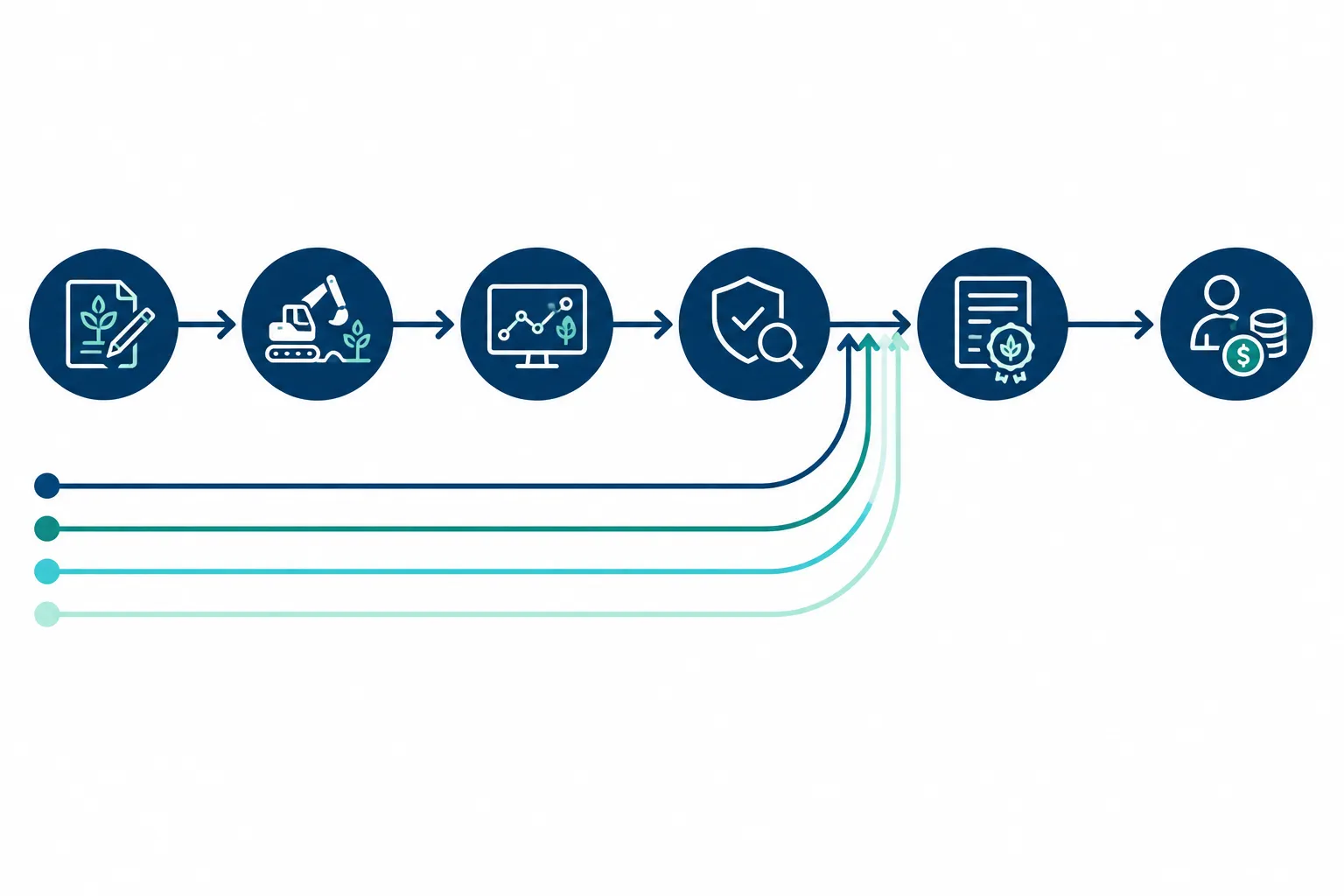
The project team selects an applicable methodology, establishes the baseline and design, implements the activity and monitors the outcomes. It then obtains independent validation or verification as required before seeking registry issuance. A forecast volume is not an issued asset; registration alone does not prove future verified volume.
"Once Verra approves the project’s verification request, the project proponent may submit an issuance request to receive Verified Carbon Units (VCUs) in the Verra Registry." - Verra
Price the pre-issuance cash gap
Break the budget into milestones so funders know when you need cash. Include:
Development: feasibility, rights to land or equipment, baseline work, methodology assessment, legal setup and community agreements where relevant.
Implementation and operations: equipment, staff, maintenance and delivery of the underlying emissions-reduction or removal activity.
Monitoring and assurance: data collection, independent validation and verification, registry-related work and any corrective actions.
Delivery: issuance, transfers, transaction expenses and the time between credit delivery and buyer payment.
Build a monthly cash model with a base case and a delayed-issuance case. Date the expenses and expected receipts. If monitoring takes longer or verified volumes fall, you still need to pay staff and verifiers. Name the funding source for that shortfall; projected sales cannot pay today's bills.
Future credits or contractual remedies if delivery fails
Delivery obligations may exceed eventual issuance; price upside may be sold early
A buyer wants specific supply and the project has a credible delivery plan
Offtake agreement
At delivery unless the contract includes an advance or milestone payment
Right or obligation to buy specified future credits
Contracted volumes and terms may constrain later sales
A bankable buyer commitment supports planning or separate financing
Project debt
Draws as conditions and milestones are met
Repayment with interest, often backed by contracts or other security
Debt service persists even if credit issuance is delayed or reduced
Contracted cash flow and downside coverage support borrowing
Equity
At investment closing or in staged tranches
Ownership and a share of future project returns
Dilution and shared control
Early or high-risk projects without predictable cash flow
Advance purchases: cash now against future delivery
Under an advance purchase, a buyer pays some or all of the price before issuance. The developer can fund development or operations with that payment, while the buyer expects eligible credits later. Define the credit type, vintage, registry, delivery window, quantity, payment milestones and remedies for a shortfall.
Advance cash can replace some borrowing. It may also lock in the sale price before the parties know the credits' quality, eligibility or final volume. Buyers need a workable remedy if issuance misses the target, such as a refund, replacement credits or more time to deliver.
Offtakes: a sales contract is not automatically funding
An offtake agreement is a contract for a buyer to purchase a project's future credits on agreed terms. It identifies a route to sales. If payment comes only on delivery, the developer must find another way to pay today's invoices: an upfront payment, a milestone prepayment, or a lender or equity investor willing to rely on the contract.
State whether volume is fixed or tied to verified output. Price can be fixed, indexed or bounded by a floor and ceiling. Allocate losses from late issuance, ineligible credits and project failure, then test exclusivity, replacement and termination clauses against the downside case. The buyer must also be able and willing to pay the contracted price.
Project debt: use it only when downside cash flow can service it
Debt preserves ownership, but lenders need a repayment schedule that works even when credits arrive late. They may consider a signed offtake, sponsor support, other operating revenue or security in project assets. Model interest and principal against conservative collectible cash flow, rather than gross forecast volume at an optimistic spot price.
If first verification slips past a debt payment, the developer needs liquidity from elsewhere or a schedule tied to later receipts. Set covenants, reserves and draw conditions around the monitoring and issuance calendar. Straight debt is a poor first instrument when credit sales are the only prospective cash source and neither volume nor buyer is dependable.
Equity: pay for uncertainty with ownership
Equity can cover the years spent proving a methodology, securing rights and generating monitoring data. Investors take development and issuance risk in exchange for ownership and governance rights. At this early stage, founders may prefer that flexibility to a debt payment, though they give up a share of future returns and may need consent for later contracts.
Set out credit ownership, future fundraising rights, approval of offtake terms and the distribution of proceeds. Equity can pay for the work that gives a buyer or lender enough evidence to commit. At that point, the developer can negotiate later financing with a clearer project plan.
Investor-readiness checklist: show the evidence behind the forecast
Give buyers the evidence to test delivery and investors the evidence to test cash recovery, using the same underlying assumptions.
Item
What to provide
What it answers
Project costs
Itemized development, implementation, operating, monitoring, validation, verification and delivery budgets; dated cash needs and contingencies
How much must be funded before first cash receipts?
How much could actually be sold, and how sensitive is the forecast?
Verification plan
Monitoring protocol, data ownership, assurance milestones, independent verifier pathway and registry process
What evidence supports issuance, and who will examine it?
Delivery timing
Start date, monitoring periods, planned verification, likely issuance windows, buyer delivery dates and a delay case
When might a contracted buyer pay, and what happens if dates move?
Buyer risk
Intended market, credit eligibility, buyer identity or target buyer profile, contract status, payment terms and concentration
Is there a usable demand route and a creditworthy payer?
Rights and obligations
Project and credit ownership, local permissions, stakeholder arrangements, existing liens and prior sales commitments
Can the developer legally deliver unencumbered credits?
Keep the technical issuance forecast, contract schedule and cash-flow model consistent on eligible credits, delivery dates and allocation of proceeds. A buyer may reject a registry-issued credit under its own quality criteria; a lender may reduce the value it assigns to a contracted receipt if the buyer has broad termination rights.
Run a downside case with lower verified volume, later first issuance and a weaker sale price. Show the funding gap and how you would cover it. Map every advance and offtake commitment to its promised units so two buyers do not claim the same credits. A lender also needs to see which credits or sale proceeds a buyer already controls.
To estimate net volume, start with expected monitored output. Subtract applicable methodology or program deductions and units promised under existing contracts, then compare what remains with the buyer's committed quantity. Separate advances already received from payments due on delivery in the cash model. Counting both as future income overstates repayment capacity.
Match capital to the next verifiable milestone
Set the capital ask by project stage. Early feasibility and rights work may call for risk-bearing equity. With a documented monitoring plan, permissions and cost base, a buyer advance could fund implementation in exchange for part of future supply. A credible offtake may support later-stage debt if repayments can tolerate verification delays. Projects with other revenue may take a different route.
An untested volume estimate is a weak basis for borrowing to fund a full buildout. A smaller first tranche can pay for the work needed to produce a reviewable delivery forecast. Condition the next tranche on a rights package, monitoring setup or buyer contract, depending on the risk the capital partner needs resolved.
Zero Circle helps developers prepare for that financing conversation. Its standardized project data and fundability scoring support capital structuring, while investor matching considers mandate, geography and deal size. Buyers and investors still assess eligibility, delivery and downside risk. Zero Circle's role in this process is project readiness and capital matching, not buying or issuing credits.
Use equity where uncertainty is highest, buyer advances when you can define the future supply, and offtakes to establish demand. Add debt only if repayment can survive a credible delay or shortfall. First establish credit eligibility and the cash schedule. Zero Circle can help developers turn those records into an investor-ready case and connect with capital partners whose mandates fit the project.
FAQ
What are the different types of carbon credits?
Project-based credits can represent emissions reductions or removals under an applicable methodology. A credit's program, project type, vintage and eligibility rules affect who can use it; an emissions allowance in a cap-and-trade system is a different instrument.
How much is 1 ton of carbon credit worth?
There is no universal price. Value depends on the credit's methodology, quality, vintage, eligible market, buyer terms and delivery risk; a forecast credit has not yet been issued and should not be valued as guaranteed cash.
Who can I sell my carbon credits to?
Potential buyers include enterprises with voluntary purchasing programs and entities that can use the specific credits in an applicable compliance system. Confirm the project credits' eligibility and buyer requirements before committing future units in an advance sale or offtake.