
Climate Resilience Funding: Grants vs. Private Capital
Compare climate resilience grants, private capital and blended finance to choose funding by eligibility, repayment, scale and project risk.

– 14 min read
Compare climate resilience grants, private capital and blended finance to choose funding by eligibility, repayment, scale and project risk.
Climate resilience projects need funding that matches their benefits to a payment source. A grant can pay for flood-risk mapping or a public cooling center without demanding repayment. A utility may use private capital for an upgrade if tariffs or a contract can cover the cost. Blended finance can fill a defined gap between the two. Start with who pays, rather than the size of the climate benefit.
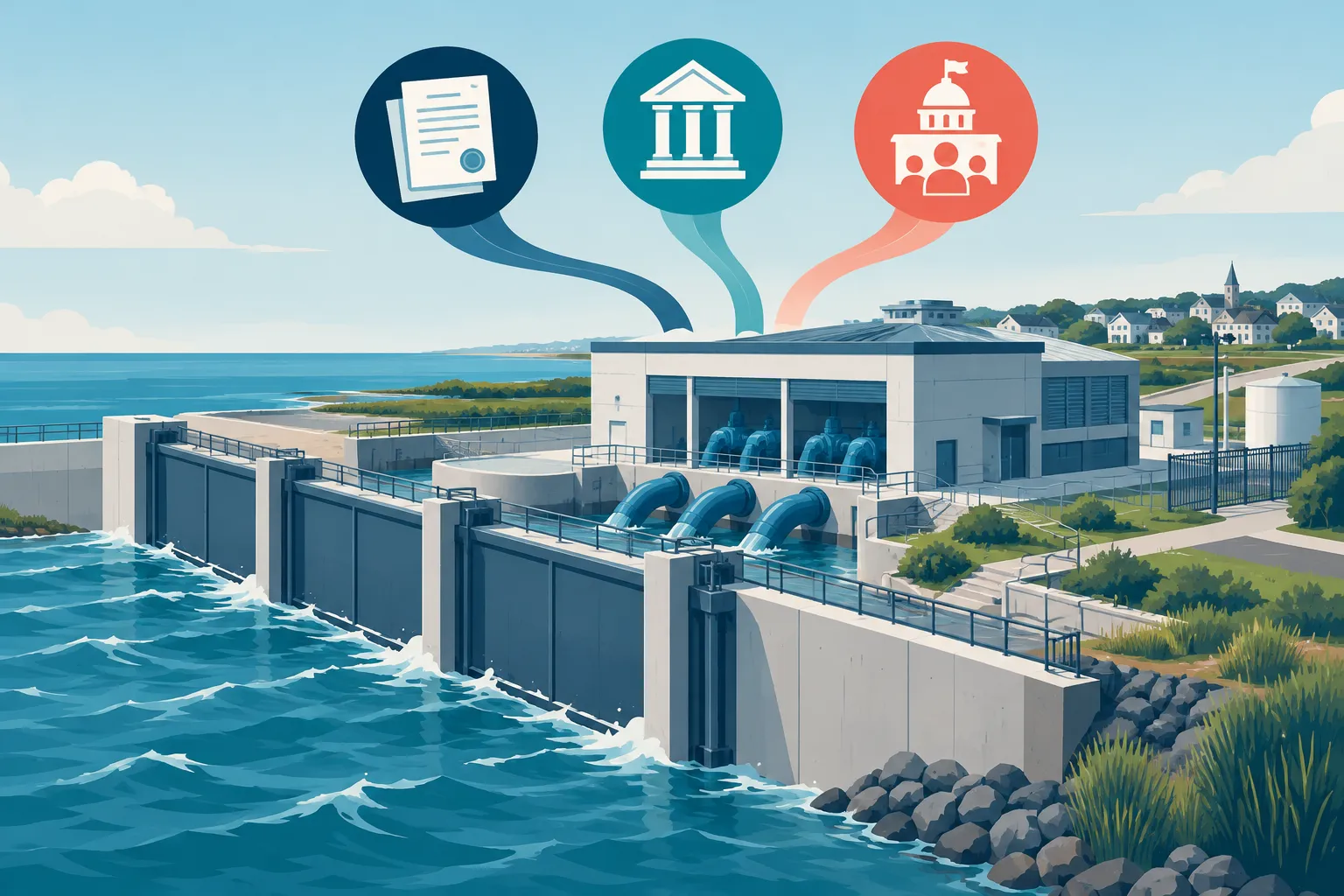
Climate resilience means preparing for heat, flooding and drought, withstanding the damage they cause and adapting so essential services keep running. A stronger substation, restored wetland and flood warning system all help, but they have different ways of getting paid for.
An estimate of avoided damage helps show impact, but it puts no money in the project account. A lender needs cash for debt service, an equity investor needs a route to returns, and a grantmaker needs an eligible purpose and accountable delivery. Before seeking funding, pin down:
An asset that benefits both its owner and the wider public may need more than one funding source.
Funding is not financing. Grants, taxes, tariffs and appropriated budgets can ultimately pay for an asset. Loans and bonds advance money that must be repaid from those sources; equity expects a return from future cash flows or asset value. Guarantees and insurance shift particular risks, but do not normally pay construction bills. A capital stack is the combination of these resources, claims and risk protections used to move a project from preparation through construction and long-term operation.
"The report estimates adaptation finance needs of developing countries will be US$310 to US$365 billion per year by 2035." - UN Environment Programme
The UNEP adaptation finance assessment describes those figures as annual needs in developing countries, not a pool of cash available to any individual project.
Decision factor | Grants | Private capital | Blended finance |
|---|---|---|---|
Best fit | Public goods, feasibility work, benefits without a reliable payer | Assets with enforceable revenues or a creditworthy payer | Projects with a real payment base but a cost or risk gap commercial terms cannot absorb |
Eligibility | Funder mandate, location, eligible costs, application and reporting rules | Investor mandate, geography, deal size, risk and return requirements | Eligibility and conditions for each public, philanthropic and commercial layer |
Repayment | No financial repayment, but obligations to deliver and report | Debt requires scheduled payment; equity seeks returns and shares ownership economics | Grants do not repay; repayable tranches still need a payment source |
Scale and speed | Limited by awards, budget cycles and application windows | Can support larger or repeatable investments if the economics and pipeline work | Can mobilize additional capital, but coordinating parties and documents takes time |
Main trade-off | No debt burden, but restricted use and uncertain award timing | More capital potential, but financial covenants, diligence and investor control or reporting expectations | Tailored risk sharing, but more complex governance and no cure for an absent payer |
Cost alone will not settle the choice. A grant restricted to construction may leave maintenance unfunded. Commercial debt can pay for a build if the repayment schedule holds up under a realistic downside case.
A capital stack is not a fixed ladder that every project must climb. For a public warning system it may consist entirely of appropriations and grants. For a utility microgrid it might combine sponsor equity, a planning grant, senior debt and a contracted service payment. The question is which source covers each cost, who receives payments first, and who absorbs a loss if the project underperforms.
Capital or support | Role in resilience | Payment or return | Key constraint |
|---|---|---|---|
Public grants and appropriations | Planning, shared protection and costs without a billable beneficiary | No repayment on grants; budgets require authorization | Program eligibility and ongoing operating budgets |
Philanthropic grants and recoverable grants | Community participation, pilots, technical assistance and early project preparation | Usually none; recoverable awards follow their own terms | Mission fit and limited, often time-bound funding |
Sponsor equity and private impact equity | Early development costs, construction risk and residual ownership | Variable return after senior claims | Return expectations and governance rights |
Senior bank or institutional debt | Construction and long-lived assets backed by reliable payment | Scheduled interest and principal | Credit quality, covenants and debt-service coverage |
Concessional and subordinated debt | A defined affordability or risk gap below commercial terms | Repayment, possibly at lower rates or later priority | Provider mandate and demonstrable additionality |
Municipal bonds and public borrowing | Public infrastructure paid from authorized taxes, fees or utility revenues | Bondholder repayment from pledged sources | Legal authority, debt limits and disclosure |
Guarantees, insurance and reserves | Credit, disaster or liquidity risks that discourage lenders | Fees, premiums or committed contingency funds | Coverage limits, exclusions and claims rules |
Contracts, tariffs and dedicated revenues | Recurring cash to operate the asset and repay financing | Payment for services or through authorized charges | Affordability, enforceability and collection risk |
The stack should change over the project life cycle. Preparation money can be high risk because there is not yet a permitted design. Construction finance depends on executable contracts and cost controls. Once the asset operates, refinancing may replace expensive early capital with longer-term debt, but only if performance and payment history support it. Keep an operations and maintenance reserve in the model rather than assuming someone else will maintain the protection.
Grants can pay for hazard assessments, engineering and community engagement before construction. They also suit public protection, such as an early-warning system or neighborhood flood barrier, where the sponsor cannot reasonably charge each beneficiary.
The funder's rules still shape the project. Eligibility can depend on applicant type, geography, project stage and allowable costs. An award may require procurement steps, matching funds, milestones and impact reports. Some grants also arrive after the sponsor has had to commit resources.
Budget for the asset's full life before applying. Name who will operate the flood barrier or maintain the wetland after the award ends. Without a maintenance budget, the grant pays for construction while the asset's protection may deteriorate.
A grant is a strong choice if the project has no billable revenue or needs preparation funding before anyone can decide whether to invest.
Local, regional and national budgets can fund resilience directly through capital improvement plans, utility investment programs or dedicated appropriations. Transfers from another level of government may cover part of an eligible project, often with a local match. These are funding sources rather than automatic financing facilities: the sponsor still needs appropriation authority, procurement capacity and a plan to maintain the asset.
Public money is particularly important for floodplain restoration, evacuation routes and protection of vulnerable households because the gains reach beyond one payer. Before combining sources, check whether eligible costs overlap, whether match can come from another award and whether the spending deadlines align. A project that wins construction funding but not operating authority is not fully financed over its useful life.
Foundations and donor-advised funds can make grants for local risk mapping, community-led design, project preparation and demonstration projects. Some philanthropic investors offer program-related loans, recoverable grants, guarantees or first-loss commitments. Those instruments are not interchangeable: a recoverable grant may become repayable under specified conditions, while a guarantee pays only when a covered obligation defaults.
Philanthropy can pay for work that a lender cannot underwrite, such as equitable engagement before a cooling network is designed. It can also reduce a well-defined early risk so a later financing round becomes possible. The test is whether its involvement changes project feasibility or access, rather than simply subsidizing a commercially viable investment. Define who decides priorities, who owns the resulting asset and what happens when donor funding expires.
For a neighborhood heat program, a foundation might pay for household outreach and cooling-center planning; the city covers staffing and utilities; a building owner funds the retrofit. That is a practical stack even if no conventional project-finance loan appears in it.
Debt or equity works better when an asset earns predictable revenue or a creditworthy organization has committed to pay for its service. A utility with established revenues, for example, may be able to borrow to protect a flood-exposed pump station. A service contract or public availability payment can provide another route to repayment.
Lenders examine payment coverage, construction risk, operating costs, contracts and climate exposure that remains after construction. Equity investors take more performance risk, but expect returns and a say in major risk decisions. The social value of avoided losses cannot stand in for collected revenue.
Private capital can finance projects larger than a single grant award and support repeatable portfolios. In return, sponsors face due diligence, financial reporting, possible restrictions on further borrowing and, with equity, ownership dilution. Do not borrow against a project's climate benefit if no one can pay the bill.
For the mechanics of lender claims and repayment, see energy project finance explained.
Private capital fits when contracted revenue, tariffs or a committed sponsor budget can pay for construction and operation, even under a credible downside case.
Equity absorbs losses before lenders and takes the residual upside after contracted expenses and debt service. A developer may contribute its own capital to advance a resilience project through permitting, while an infrastructure fund invests at construction once risks are better defined. Impact investors may accept a different time horizon or require evidence of community outcomes, but they still need agreed economic terms. Do not treat an impact label as a promise of below-market capital.
Equity is most useful where the asset can generate a return, such as a microgrid with paying customers or a resilient industrial facility with contracted use. It is less suited to a free public flood warning system. Clarify control rights, exit options, distribution priorities and who pays if adaptation standards change after construction.
Senior debt has first claim on pledged cash flows and generally costs less than equity because the lender's upside is limited and its repayment priority is higher. A project loan may be repaid from a ring-fenced asset and its contracts; a corporate loan may rely on the broader borrower's balance sheet. Neither structure turns avoided losses into cash unless a creditworthy party has committed to pay.
For a water utility, a long-lived pump-station upgrade can align with a loan repaid through authorized rates. For a commercial facility, a corporate borrower might finance floodproofing through its capital budget. Match the loan tenor to the asset's useful life and stress-test revenues, interest rates, construction delays and maintenance costs. If a storm exceeds the design standard, identify who bears the residual damage.
Municipal or other public bonds spread the cost of a public asset across years, backed by legally available taxes, fees or utility revenues. A bond described as a resilience or green bond is still debt; the label can communicate use of proceeds and reporting commitments but does not create a repayment source. General-obligation and revenue bonds have different pledges, and rules vary by jurisdiction.
Bonds can fit a portfolio of drainage, coastal defense or grid-hardening investments with established public payment authority. Smaller projects may be bundled to justify issuance costs. Confirm voter approval requirements where relevant, debt limits, disclosure obligations and whether recurring maintenance has its own budget. Public debt is not free money merely because the benefits are public.
Development finance institutions, public funds, green banks and mission-driven investors may offer longer tenors, lower rates or more flexible repayment than commercial lenders. A subordinated loan sits behind senior lenders in the payment or loss order. Either feature can make an otherwise credible project affordable or reduce risk to a commercial lender, provided the terms and seniority are explicit.
Suppose a utility can repay most, but not all, of a necessary flood upgrade at market rates. A concessional tranche could lower annual debt service; a subordinated tranche might absorb defined losses ahead of senior lenders. First test whether a smaller grant, design change or tariff decision would address the gap more directly. Concessional funding is most defensible when it mobilizes a project with demonstrable public benefits rather than replacing available commercial capital.
A guarantee can cover a specified share of payment default or other defined risk; it is not a grant and often has a fee and a cap. Insurance can compensate for covered losses after an event but may exclude certain hazards or require deductibles. Parametric insurance pays when an agreed trigger is met, which can speed liquidity, but the payment may not equal actual damage. A debt-service reserve holds cash for temporary shortfalls rather than transferring the loss to an outside party.
These tools matter when a bankable payment source exists but lenders worry about interruption, counterparty credit or disaster recovery time. Read coverage and exclusions alongside the engineering standard. A policy that funds rapid repairs can support continuity; it cannot replace investments that prevent avoidable damage in the first place.
Revenue is the base beneath repayable capital. Utility tariffs, power-purchase or service agreements, availability payments and committed facility budgets may pay for resilience if they are authorized, durable and collectible. Where a protected district benefits from an upgrade, a legally authorized special assessment or other value-capture mechanism may help allocate costs to beneficiaries. These arrangements depend on local law and political acceptance, and they must be tested for affordability.
Avoid double-counting benefits. Lower expected insurance losses, reduced outages and protected property values can strengthen an investment case, but they cannot all be pledged as separate cash flows unless a contract or lawful charge converts them into actual payments. A verified insurance saving might improve a sponsor's budget; it does not automatically become revenue available to a lender.
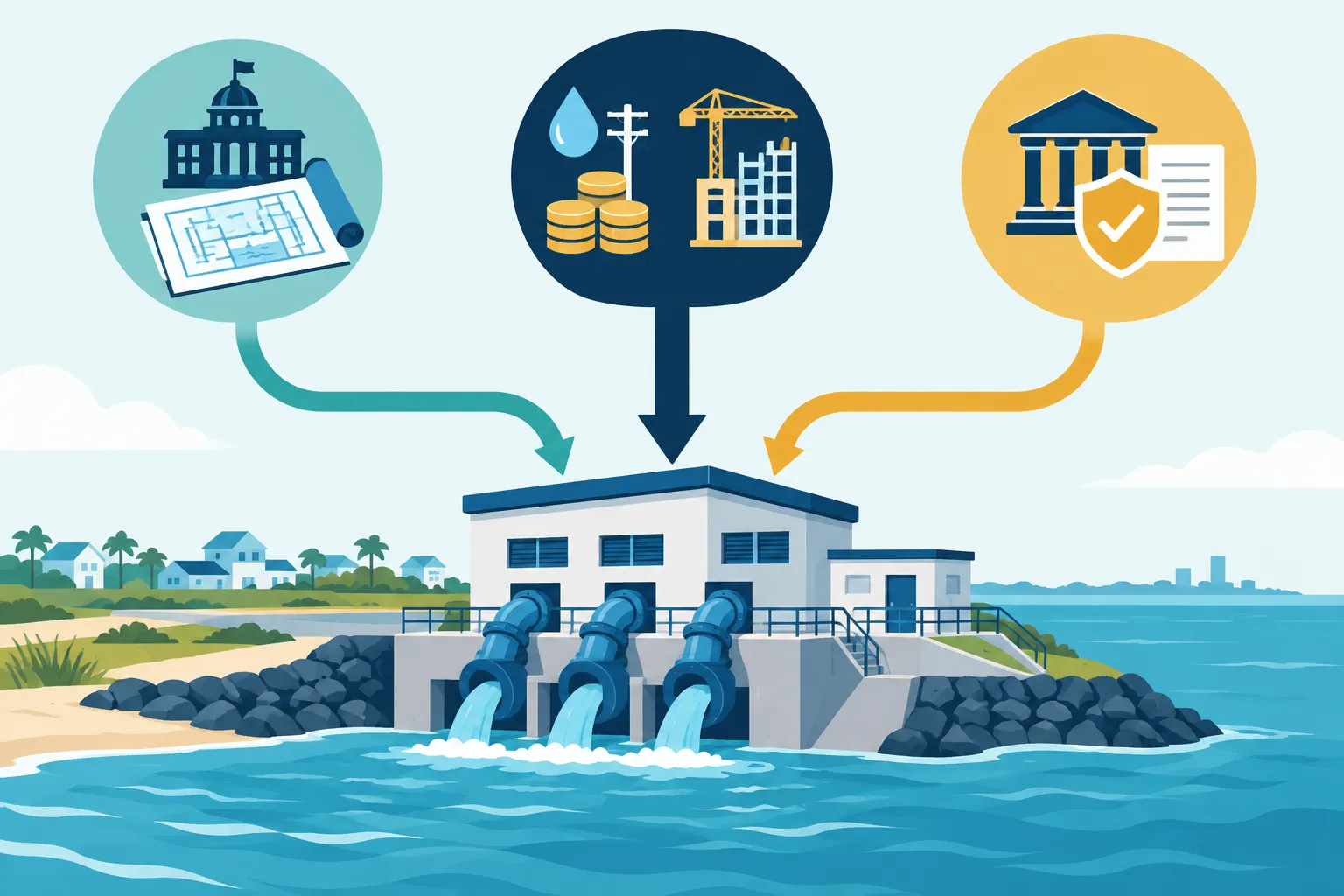
Blended finance brings public or philanthropic support into a deal alongside private investment. Each piece should tackle a barrier: a grant can pay for design and permitting, a concessional loan can ease financing pressure during construction, and a guarantee can cover a defined credit risk. Commercial debt or equity finances the portion the project can support.
Take a coastal water utility protecting a pump station. A grant pays for flood modeling and engineering; the utility then puts in its own funds and borrows what its revenues can support. If lenders still cannot finance the necessary protection on commercial terms, a targeted concessional tranche or guarantee can address the documented gap. The utility remains responsible for operations and debt payments. Avoided flood losses still cannot pay a loan installment.
Document the roles before assembling the stack: who supplies each tranche, which costs it covers, where losses fall, how payments flow and who maintains the asset. Scarce catalytic funding should resolve a financing barrier, not merely raise an investor's return.
If a project needs a different mix of instruments, explore seven ways to fund climate adaptation.
A blend fits a project with a real payer and a measurable resilience benefit when a specific preparation, affordability or risk barrier blocks commercial financing on its own.
Public cooling and early warning: A city budget pays staff and ongoing operations; a public grant funds equipment; philanthropy pays for outreach to residents who face the highest heat risk. The primary outcome is continued public service, not an investor distribution. If a vendor is paid to provide equipment, its contract is a project cost, not evidence that the warning system generates revenue.
Utility flood protection: A preparation grant funds hazard modeling; the utility contributes capital; senior debt pays for construction against approved rates; a reserve addresses temporary disruption. If the affordability gap remains, a concessional loan can reduce debt service. Model who pays for maintenance and how rates perform after an extreme event.
Community-serving microgrid: A sponsor and an impact investor supply equity; contracted electricity or resilience-service payments support a senior loan; a public grant pays for a specifically eligible community shelter component. Insurance and a reserve may help manage interruption. If the contracted payments end before the loan matures, the stack needs redesign, not a more optimistic resilience valuation.
These are structures to test, not templates to copy. For each layer, record the provider, eligible use, amount, payment priority, maturity, decision rights and loss exposure. Check whether the combination complies with grant rules, public procurement and any restrictions on pledged revenues.
Funders need to see what the project protects and how the sponsor will pay for it over time. Bring these elements into one project file:
Evidence | What it establishes |
|---|---|
Site-specific hazard and exposure assessment | Which assets and people face the risk, and under what conditions |
Scope, engineering design and cost estimate | What will be delivered, when and at what cost |
Baseline and outcome measures | What change in disruption, damage or service continuity the project aims to achieve |
Revenue, contracts or budget commitment | Whether anyone can pay for construction, debt and maintenance |
Risk allocation and downside case | Who absorbs delays, shortfalls and losses outside the design assumptions |
Reporting and operations plan | How results will be measured and who keeps the asset working |
Tailor the case to the funding source. A grant proposal needs eligibility, public benefit and delivery capacity. A lender package needs payment obligations and downside protection up front. For a blended structure, quantify the financing gap before proposing a subsidy.
This progression reflects the useful distinction in the Duke University and ICLEI USA Resilience Finance Guidebook for Local Governments: a project may be stuck not because a finance tool is missing, but because value, proof, authority or repayment structure has not yet been established. Its local-government focus makes it especially useful for public sponsors and their capital partners; private developers should adapt its diagnostic questions to their own contracts and balance sheets.
Start with the guidebook's diagnostic questions, then create a one-page sources-and-uses table and a separate annual cash-flow model. Confirm current program rules and local legal authority with the relevant funder or adviser before presenting any illustrative stack as an executable transaction.
Zero Circle helps energy and climate project owners organize fundability information, consider capital structures and approach investors whose mandates fit the project's geography, size and risk. That matching becomes useful once the sponsor can explain who pays. Engineering diligence and grant eligibility still need separate work.
For practical outreach preparation, see how to find climate project investors.
If no one can be billed for the protection, start with grants. If project revenues or a committed payer support returns, consider private capital; use a blend when a targeted subsidy can close the remaining gap. For an infrastructure project with a defined hazard, payer and financing gap, Zero Circle can help build the capital case and start conversations with relevant investors.
Climate resilience means preparing for, withstanding and adapting to climate hazards while maintaining essential functions. In project finance, that could mean protecting a utility asset from flooding or keeping a service running through extreme heat.
Examples include flood barriers, more resilient substations, water storage, early-warning systems and restored wetlands. Their funding differs: a public warning system may need a grant, while a utility upgrade with a payment source may support private debt.