

Capacity Markets and Storage: What Investors Miss
Understand capacity market payments for battery storage, including accredited MW, contract terms, penalties and how to stress-test financeable revenue.

– 7 min read
Understand capacity market payments for battery storage, including accredited MW, contract terms, penalties and how to stress-test financeable revenue.

For a battery project, a capacity market pays for a qualified commitment to be available when the grid needs capacity. The market can credit fewer MW than the battery can export, and its payment period can be shorter than the loan. Miss a performance obligation and receipts can fall further. Before booking auction revenue, put the accredited MW and the agreement's delivery terms into the model.
Grid operators and other buyers procure electricity supply ahead of a delivery year so they can meet peak demand, even during extreme weather or power plant outages. Eligible participants may include existing generators, new energy sources and demand response. The energy market pays for electricity sold; a battery with a capacity obligation must also be ready to discharge when its market requires it.
The payment path runs from procurement to settlement:
In Great Britain, suppliers fund Capacity Market settlement and the settlement body pays capacity providers. In New York, load-serving entities purchase capacity to meet reliability requirements. Neither funding arrangement fixes the battery's energy sales.
Revenue line | What is monetized | Main underwriting question |
|---|---|---|
Capacity | Qualified, deliverable availability | How many MW qualify, for which period, and with what performance exposure? |
Energy arbitrage | Buying and selling electricity at different prices | Can dispatch capture spreads after charging costs and losses? |
Ancillary services | A defined grid service | Can the same physical capability meet overlapping commitments? |
The three revenue lines draw on the same battery. Use one dispatch schedule when you combine them.
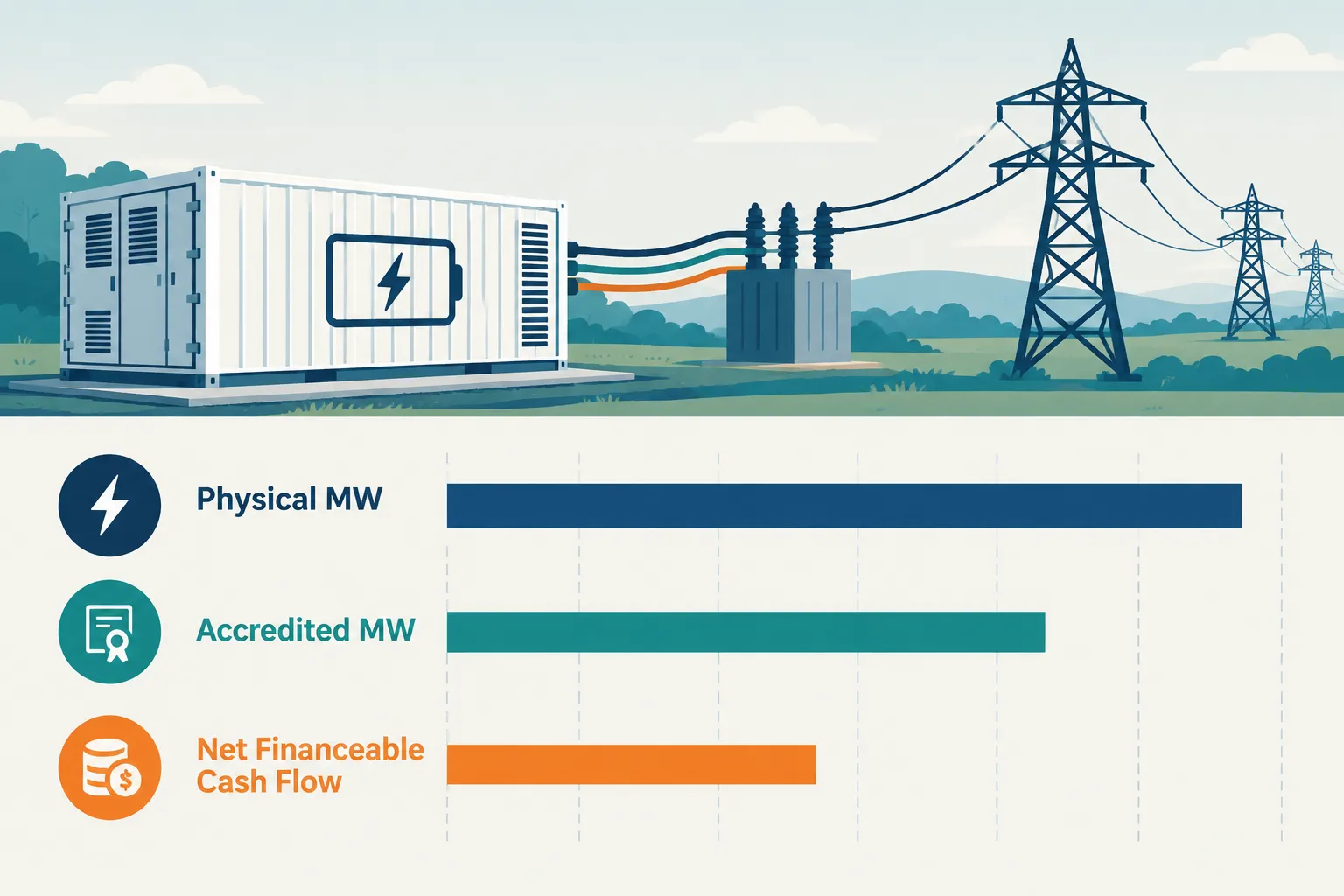
Rated output tells you what the equipment can produce. Accredited capacity tells you how many MW the market counts toward reliability. The number can change with discharge duration, location, connection status, availability and the weather conditions behind scarcity risk. Great Britain's Capacity Market Rules use an equivalent-firm-capacity approach for duration-limited storage classes. A battery that runs out of usable energy cannot sustain the obligation on rated power alone.
In the project model, start with the export limit and usable MWh at the delivery point. Add discharge duration at the offered MW, expected degradation and operating reserves. If an arbitrage trade drains the battery before a reliability event, capacity revenue is at risk. Any augmentation needed to maintain output needs a funded timetable.
For battery configuration and operating fundamentals, read Battery Storage Projects Explained. For a capacity bid, establish how much dependable output the project can commit for the required event window.
Qualification may involve interconnection, metering, testing, registration, credit support and proof of deliverability. The bid, agreement and connection documents should identify the same asset, location and committed MW. A market may offer different terms depending on whether it classifies the project as new or existing capacity.
You cannot establish qualified MW with a generic percentage from another market. PJM's Manual 21B revisions describe a loss-of-load-probability analysis for calculating accredited capacity for eligible resources. Date the accreditation input and keep the rule or award notice beside the physical and qualified MW in the model.
An auction win sets a price for a specified delivery period. The agreement's term, start date, inflation treatment and termination rights tell a lender how much of that income is secure. Once the award expires, the project faces future capacity prices.
Great Britain awards agreements through auctions ahead of delivery, with a stated obligation and payment level. New York's seasonal market auctions set prices for installed capacity by season. A project model needs the payment dates and repricing exposure of the specific market.
Document or input | What to extract | What can go wrong in the model |
|---|---|---|
Auction award or executed agreement | Awarded MW, clearing price, delivery dates, payment terms | A forecast bid is mistaken for contracted revenue |
Qualification and accreditation record | Eligible technology, location, credited MW, tests | Revenue is calculated on installed MW rather than qualified MW |
Market rules and credit terms | Collateral, substitution, termination and default mechanics | Obligations survive while assumed revenue does not |
Debt case | Tenor, coverage requirements, reserve assumptions | A short award is projected as fixed income for the full loan |
If the award expires before the debt matures, split receipts into contracted, recontracting and uncontracted periods, each with its own price and volume assumptions. Only an enforceable agreement gives a forecast a contractual floor.
The battery may need to hold charge and deliver its committed output during a call or market-defined stress period. Failed tests, outages, low state of charge and missed delivery can reduce payments or trigger penalties. The terms depend on the scheme.
"Resources that fail to perform to their expected performance are subject to Non-Performance Charge." - PJM, Guide to Billing
Read the operating rules for four exposures:
Assign dispatch priority during stress periods and budget for charging and maintenance. Include downtime, degradation and penalty exposure in the downside case. A merchant optimizer that assumes unrestricted access to price spikes may double count flexibility already committed to capacity.
If the market quotes a daily price per accredited MW, the calculation starts here:
Gross annual capacity receipts = accredited MW × price per MW-day × paid days.
Consider a hypothetical 100 MW battery accredited for 60 MW, paid a hypothetical $100/MW-day for 365 days. Gross receipts are 60 × $100 × 365 = $2.19 million. A model using its nameplate rating would show $3.65 million, overstating receipts by $1.46 million. The figures illustrate the calculation; they are neither an auction price nor a project forecast.
Subtract fees, readiness costs and any scenario-specific payment deductions or penalties. Then reconcile net receipts with merchant dispatch revenue, charging costs, operating expense and debt service. A market with different price units or settlement conventions needs a different formula.
Case | Change the input | Financing implication |
|---|---|---|
Base | Use awarded terms for awarded periods, evidence-backed assumptions thereafter | Separates secured cash flow from merchant projections |
Lower accreditation | Reduce recognized MW while retaining the actual technical system and cost base | Shows sensitivity to a derating or duration constraint |
Delayed start | Shift first eligible delivery and payment dates | Exposes construction-to-revenue and liquidity gaps |
Repricing | Lower price after the current award expires | Tests refinancing and debt-service coverage after recontracting |
Performance event | Apply the relevant payment reduction or penalty and charging response | Shows whether reserves and covenants absorb a bad delivery period |
Keep a base case beside the single-variable sensitivities and a combined downside whose assumptions can occur together. Stacking unrelated worst cases would obscure rather than clarify the risk. Energy Project Finance Explained covers wider financing assumptions; the capacity worksheet needs to remain tied to payment evidence and delivery obligations.
A lender should be able to trace revenue cells to the qualification decision, accreditation result, executed award, rules, connection rights, metering plan, operating strategy or penalty terms. The offtake or optimizer contract should identify who controls dispatch and who pays for a shortfall. Pending qualification means conditional revenue; show the gap if it does not arrive.
Great Britain and New York both pay resources to help meet demand in stressed demand periods, but their procurement and settlement differ. PJM capacity auctions have their own delivery-period and performance rules. Other electricity markets may use a different route to maintain reliability. Eligibility in one region does not establish eligibility in another.
For a cross-market investment memo, use a consistent comparison sheet:
Question | Record for each project |
|---|---|
Is there a capacity payment route? | Market, buyer or counterparty, and procurement channel |
What quantity is paid? | Qualified or accredited MW, method and effective date |
How long is it paid? | Award period, start date and next repricing date |
What must be delivered? | Event duration, testing, availability and dispatch priority |
What is the downside? | Deductions, penalties, collateral, replacement and default terms |
Keep each jurisdiction's rules in its own column. Without a comparable auction framework, a project's reliability revenue may come through another contract, or it may have none.
A capacity award can support storage financing when you can document the credited MW, delivery duty and agreement term, then demonstrate an operating plan that meets them. Treat future auction prices as projections, and allocate the battery's energy budget only once.
Zero Circle helps project owners organize that evidence into standardized financing materials and find investors by mandate, geography and deal size. Its AI-assisted fundability scoring and human-reviewed outreach give capital partners a clearer view of the assumptions; structuring support helps separate conditional capacity revenue from contracted cash flow. Zero Circle cannot qualify a project for a market or guarantee an auction result. If you are ready to raise capital, bring the accreditation record, award terms and stress-tested model into a Zero Circle financing conversation so investors can trace grid obligations through to distributable cash.
A capacity market pays qualifying resources to be available to support grid reliability when demand is high or supply is tight. For a storage project, the paid quantity is determined under the relevant market's qualification and accreditation rules, not simply its nameplate rating.
It is PJM's process for procuring capacity to meet reliability needs for a specified delivery period. A storage investor should use the actual awarded quantity, price and applicable performance obligations, rather than projecting one auction result across the whole project life.
Capacity payments compensate a qualified commitment to be available; energy-market revenue comes from electricity sold. A battery can earn both, but its charging and dispatch plan must satisfy the capacity obligation before assuming it can capture a separate energy opportunity.
The funding route depends on the market. In Great Britain, suppliers fund the Capacity Market settlement mechanism; in New York, electricity providers purchase capacity to meet reliability requirements. The cost ultimately sits within the electricity system, but the contract and settlement path matter to project cash flow.
A market sets a reliability requirement, qualifying resources commit capacity, and procurement determines payment and delivery obligations. The resource then has to satisfy the relevant availability and performance rules to retain the expected receipts.