

Climate Project Ticket Size: Match Deals to Capital
Improve climate investor matching by sizing each project tranche, screening capital mandates and using a hypothetical matrix to spot deal-size mismatches.

– 7 min read
Improve climate investor matching by sizing each project tranche, screening capital mandates and using a hypothetical matrix to spot deal-size mismatches.

For climate investor matching, specify how much you need from each investor, at what stage and through which instrument. A renewable energy or resilience project may struggle to attract capital if its equity ask falls below a fund’s workable ticket, its construction debt request goes to a buyer of operating assets, or its geography falls outside an investor’s mandate. A precise ask lets both sides spot those mismatches before underwriting begins.
Ticket size is a filter, not a universal minimum. The same project may fit one capital partner as a development equity investment, another as a construction loan after permits and contracts are in place, and a third as an operating-asset acquisition later.
This capital-stack explainer shows where debt and equity sit in a financing structure:
The cost to develop and build an asset is its project size. The funding need is what remains to be raised, while the ticket size is what one investor would put into a particular tranche. A $30 million project can therefore present a $3 million ticket to an equity investor.
A capital provider’s investment range reflects its mandate and economics. A small, bespoke transaction still requires legal, technical and credit work. One large position, meanwhile, may breach concentration limits. Size alone also says nothing about whether the region, technology, return profile or tenor fits.
Climate Policy Initiative estimates the annual clean-energy equity investment gap in emerging-market and developing economies at $215 billion by 2035. That gap says little about whether an individual project fits a fund’s mandate:
"Projected annual equity investment of USD 160 billion versus USD 375 billion needed for a net-zero pathway." - Climate Policy Initiative
Stage changes the pool of potential investors. Early development funding pays for work done before the project has predictable cash flows. Construction lenders focus on whether the asset can be completed on schedule and on the protections in its contracts. Once it operates, long-term capital may become available. Tailor the request to the risk each investor is being asked to take.
Start with a sources-and-uses schedule, then show the amount and terms of the tranche you are offering. The following figures are hypothetical and for illustration only, not market norms or suggested minimums:
| Hypothetical project uses and sources | Amount |
|---|---|
| Total project cost, including development and construction | $30 million |
| Committed sponsor equity | $3 million |
| Proposed senior construction debt | $21 million |
| Equity still sought from capital partners | $6 million |
Here, $3 million plus $21 million plus $6 million equals the $30 million cost. The equity opportunity is $6 million. If the sponsor wants two equity investors to split that remaining tranche equally, each would take a proposed $3 million ticket. The investors still have to agree to the governance and control terms.
The table describes a target capital stack. The sponsor still has to arrange $21 million in debt and $6 million in outside equity. A lender will compare projected cash available for debt service with principal and interest due, using the debt service coverage ratio (DSCR). An equity partner will examine its residual return if the debt terms change. Give each party a downside case for its own tranche alongside the project-wide return.
The request could read: “Seeking $6 million of project equity for a hypothetical $30 million battery storage project at pre-construction stage, alongside $3 million of committed sponsor equity and $21 million of proposed senior debt.” Calling the debt proposed makes the closing dependency clear. Identify the borrower too: one asset, an SPV holding several assets, and a corporate developer give investors different exposures. For the mechanics behind the financing layers, read how energy project finance works.
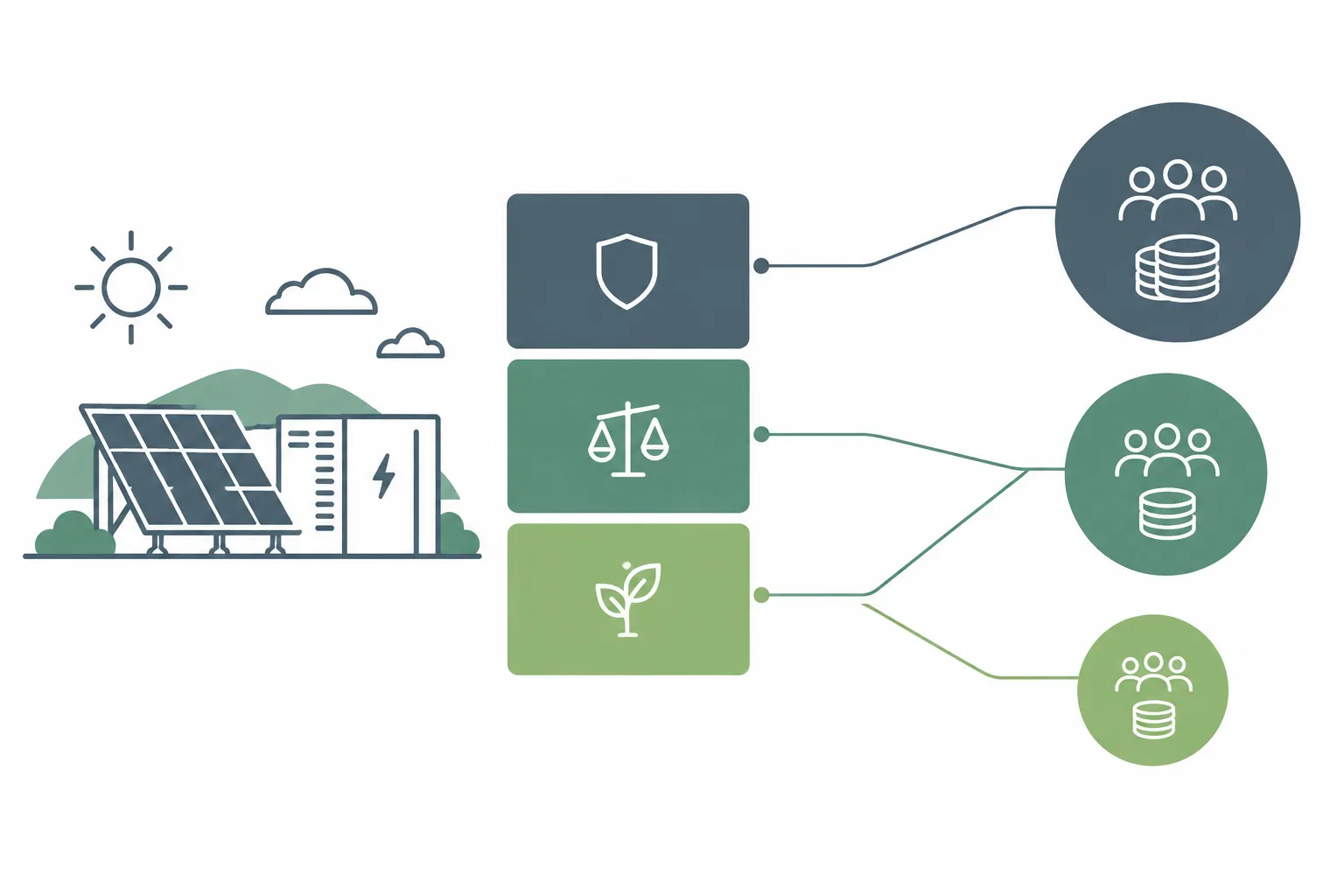
All ticket ranges and asks below are hypothetical. They illustrate the screen; none is a Zero Circle criterion, a published investor mandate or a market-wide minimum.
| Illustrative capital partner | Hypothetical ticket range | Mandate and stage | Hypothetical ask | Initial fit |
|---|---|---|---|---|
| Development equity partner | $0.5m–$2m | Single-asset development equity, eligible geography | $1m for permits and interconnection work | Size and stage align; assess development rights and milestones |
| Construction lender | $10m–$25m | Senior debt once required contracts and approvals are ready | $21m proposed construction debt | Size aligns; financing remains conditional on credit and completion risk |
| Operating infrastructure fund | $15m–$50m | Equity in cash-generating assets | $6m pre-construction project equity | No stage fit, even if a larger pooled transaction reached its size range |
| Small-project credit provider | $1m–$4m | Senior loans for individual projects | $6m project equity | Neither instrument nor size fits |
Screen in sequence: instrument → stage → geography and technology → ticket → timing and risk. A range overlap warrants a conversation, not an approval. An investor willing to commit $3 million to a larger equity round may decline a $3 million deal it must originate and manage alone.
Developers can reduce wasted conversations by preparing a short investment brief with evidence behind every field:
For a construction-stage request, a lender may also need to see the engineering, procurement and construction contract, contingency allowance and insurance arrangements. Those materials do not turn a ticket match into a credit decision; they tell the lender which risks remain with the project and which have been allocated to another party.
The brief helps an investor decide whether to revisit the project after a milestone or pass because the deal falls outside its mandate. For a broader view of the asset universe, explore renewable energy investment opportunities; here, focus on the capital provider for this tranche.
Investors and sponsors should use the same fields but ask different questions. A sponsor should capture what a capital partner can invest in now, not just what its website says about climate ambition.
| Screening field | Sponsor’s question to the investor | Investor’s question to the sponsor |
|---|---|---|
| Ticket and role | What is your workable commitment range for this instrument, and do you lead or follow? | How much of the tranche are you asking us to take, and who fills the balance? |
| Stage and timing | Do you fund development, construction or operation, and when can you decide? | Which approvals, contracts and financing commitments exist today? |
| Instrument and terms | Do you provide equity, senior debt, mezzanine or a guarantee? | What security, governance, tenor, target economics and exit are proposed? |
| Mandate | Which technologies, locations, currencies and counterparties are eligible? | Is the project located and structured within those limits? |
| Process | Who approves the deal, and what are the initial diligence requirements? | Who can provide the data room, model and decision-ready answers? |
Record a reason for every pass: “ticket too small,” “construction exposure excluded,” “currency outside mandate,” or “revisit after executed offtake.” This creates a useful pipeline instead of a contact list. The lead decision-maker, co-investor requirement and time to approval also matter: a perfectly sized ticket will not close if the investor cannot reach its investment committee before the project’s deadline. See also how to find climate project investors for building that outreach pipeline.
Do not inflate a deal to meet a stated range. Change the financing design only if the resulting transaction makes operational and legal sense.
Each path has costs: more counterparties can complicate consent and closing; an aggregated portfolio needs consistent governance; a staged raise creates refinancing or follow-on risk. If no structure can put the project within a credible mandate, fix the project’s readiness or economics before sending more introductions.
One page is enough to determine whether to open a data room. Lead with: asset and geography; stage and next milestone; total cost; committed capital; capital sought by instrument; proposed ticket per investor; expected decision date; revenue basis; three material risks; and links to supporting documents. Clearly mark proposals versus signed commitments.
For capital partners, the reciprocal profile should specify accepted asset types and countries, stage, instruments, workable ticket range, willingness to lead, concentration or portfolio constraints, diligence requirements and a realistic approval timeline. Date the profile and update it when capacity or mandate changes.
Zero Circle uses project scoring, standardized data and matching by mandate, geography and deal size to narrow outreach to plausible capital partners. Human-reviewed outreach and underwriting support help both sides prepare for the first conversation. Investors still need to approve the deal, and sponsors still need a financeable project.
The investor worth approaching can write the required check in the right instrument, at the right stage, and decide in time for the project’s deadline. Define the tranche before building the outreach list, and label every uncommitted source honestly. Sponsors and capital partners can try Zero Circle to score project readiness and identify relevant matches before full diligence begins.