

Renewable Energy Marketplace Guide
Evaluate a renewable energy marketplace by deal type, project verification, investor fit, fees, and diligence needs before choosing a sourcing route.

– 7 min read
Evaluate a renewable energy marketplace by deal type, project verification, investor fit, fees, and diligence needs before choosing a sourcing route.

A renewable energy marketplace connects parties seeking project finance, renewable electricity contracts, or the environmental attributes of generation. Each transaction calls for a different kind of platform. Start with what you need to buy or fund, then assess verification, counterparty fit, and the work the platform handles after an introduction.
For a developer raising capital, a searchable listing gets a project noticed; evidence of buildability and financing prospects gets an investor into diligence. A corporate buyer faces another choice: investing in a solar project, signing a power purchase agreement (PPA), and buying renewable energy certificates (RECs) serve different purposes.
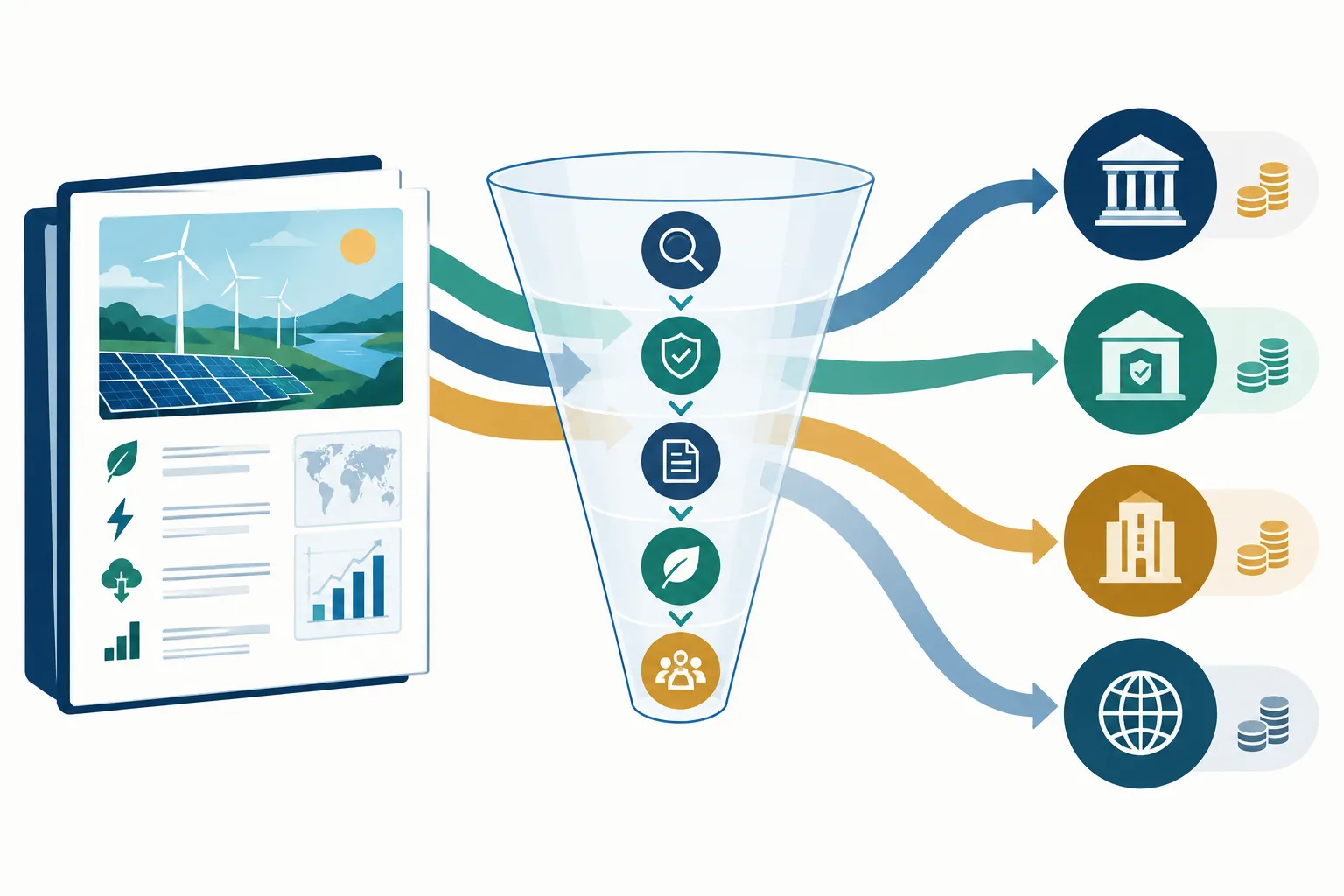
A marketplace organizes counterparties and information around a potential deal. Sponsors present financing opportunities to lenders and equity investors; enterprises compare electricity offers; certificate buyers source attributes from eligible generation. The deliverables, risks, and claims vary with the model.
A listing alone does not establish bankability, commit a lender, or complete procurement. Ask what the platform verifies before publication and which parts of data collection, matching, diligence, negotiation, and closing its team supports.
| Model | Who meets whom | What changes hands | Main diligence question |
|---|---|---|---|
| Project finance marketplace | Sponsors and lenders, infrastructure funds, strategic investors, or other capital partners | Access to a potential debt, equity, or blended-finance transaction | Is the project ready for this capital provider's mandate and underwriting? |
| Renewable power procurement marketplace | Generators, developers, utilities, retailers, and electricity buyers | Proposals for physical or virtual PPAs, green tariffs, or supply arrangements | Does the commercial structure fit the buyer's load, location, risk tolerance, and contract term? |
| Energy attribute marketplace | Certificate sellers, intermediaries, and buyers | RECs or other tracked environmental attributes, subject to the applicable program | Can the buyer substantiate ownership, eligibility, retirement, and the claim it intends to make? |
These models can intersect. A developer may seek construction financing before offering a PPA; a corporate offtake commitment may improve a project's financing case. A REC inventory platform, though, may have no capacity to underwrite a storage project. Deal sourcing also leaves the question of electricity delivery open.
In project finance, the sponsor seeks capital for development, construction, acquisition, or refinancing. The capital partner assesses revenue contracts, costs, permits, grid connection, counterparties, and downside scenarios. Transaction structure and actual performance determine its return; projected generation alone cannot do that.
In power procurement, the buyer seeks a contract that meets its energy and financial needs. A PPA may involve physical delivery or financial settlement; green tariffs and retail offerings work differently. Certificate procurement addresses rights to make specified renewable electricity claims. Read the delivery and attribute provisions separately before treating one agreement as a substitute for another.
"do not include the underlying electricity" - U.S. Environmental Protection Agency, Green Power Pricing
“Interested in solar” is too broad to support a financing introduction. A developer raising development equity has little reason to contact a lender that funds only operating assets. Capital partners may exclude certain technologies, stages, countries, ticket sizes, instruments, or risk profiles.
| Match variable | Sponsor's question | Capital partner's question |
|---|---|---|
| Stage and use of proceeds | Is this capital available before notice to proceed, during construction, or only after operation? | Is the development risk inside our mandate? |
| Instrument and size | Do we need debt, equity, guarantees, or a layered structure, and for how much? | Does the proposed amount and seniority fit our allocation? |
| Geography and technology | Does this investor fund this market and asset class? | Can our team underwrite this jurisdiction and technology? |
| Revenue and counterparties | Is there an offtake path or another credible revenue case? | Are cash flows, contracts, and counterparty risks understandable? |
| Timing | Can the capital process meet project milestones? | Is the data room ready for a decision within our process? |
Matching narrows the field before a financing decision. Ask for the reason behind each suggestion, a way to correct bad assumptions, and a clear distinction between investors the platform recommends and those that have expressed interest.
“Verified” needs a scope. For a project listing, find out whether someone checked the sponsor's identity, site control, permits, interconnection status, development schedule, revenue arrangements, model assumptions, and supporting documents. Early-stage projects belong on a platform too, provided buyers can see what remains unresolved.
Investors can screen standardized profiles faster when claims link to dated evidence and missing items appear in plain sight. Enterprise buyers also need to know who holds the generation or attributes, what will be delivered, and which contractual obligations they retain.
Ask the platform to show a sample match filtered by geography, technology, investment size, stage, return and risk requirements, and preferred capital instrument. Counterparties should be able to set exclusions. Without mandate data, a long contact list mostly means more unsuitable outreach.
For each name on the shortlist, you should be able to see why it belongs there and what information would strengthen the introduction. You should also see which parties are poor fits. If software assigns a score, humans need access to its inputs and reasons.
Who builds the data room and answers the first diligence questions? Who coordinates feedback, negotiates terms, and tracks the deal? An introduction-only directory may be enough for two established deal teams. Sponsors still assembling a capital stack may need underwriting support and structuring advice before outreach; Zero Circle's Foundry offers advisory and execution support for that work.
Pin down the platform's role. It may introduce parties, advise on structure, broker a regulated transaction, or execute a purchase; each role carries different duties and permissions. Ask how it earns fees and whether it represents one side, both, or neither.
Request the fee schedule and a sample engagement agreement before submitting a live deal. Identify listing or subscription charges, success-based compensation, and advisory fees separately, along with payment triggers and any exclusivity that limits parallel outreach. If you buy electricity or certificates, establish which entity signs the contract, settles payments, and handles a failed delivery.
Project models, customer contracts, land rights, and investor preferences need controlled access. Ask who can see a profile before a nondisclosure agreement and who grants document access. You also need a way to update or withdraw files and a clear account of what happens to uploads after the deal ends. Request a preview of a redacted listing to see those controls in practice.
| Route | Best when | Trade-off |
|---|---|---|
| Marketplace-led discovery | You need to screen multiple opportunities or capital mandates using consistent data | The quality of results depends on verification, current listings, and fit signals |
| Direct sourcing | You know a small set of counterparties and have an established route to their decision-makers | The search is narrower and can depend heavily on your team's network |
| Advisory-led outreach | The deal has an unusual risk allocation, multiple funding layers, or unresolved structuring questions | More hands-on work is needed before broad distribution |
You can combine routes. A sponsor might build a shortlist on a marketplace and ask an adviser to shape terms. An institutional investor can originate deals on a platform and underwrite them independently; an enterprise can compare procurement offers before negotiating a bespoke PPA directly.
Prepare an investment case before asking for introductions. State the technology and location, stage, use of proceeds, capital need, milestones, revenue path, and principal risks, with evidence for each claim. Keep documented facts distinct from financial-model assumptions. A useful platform will match the project's size and stage to capital mandates instead of sending it to every available contact.
Zero Circle works with sponsors on project readiness and investor outreach. Its Climate Exchange supports project discovery; the wider platform brings fundability scoring, standardized project information, investor matching, underwriting support, and human-reviewed outreach into the financing workflow. This is a fit for sponsors who need help preparing and directing outreach as well as a place to list. Investors and lenders still perform their own diligence, and a match does not guarantee funding.
Set your mandate before opening a deal feed: geography, technology, stage, check size, instrument, required returns, and exclusions. Review source documents and missing information alongside any score. Standardized fields help you compare projects, but you still need to underwrite economics, legal rights, counterparties, and execution risk.
A platform should save analysts time by filtering unsuitable deals and making the remaining ones easier to assess. If you cannot inspect a score's drivers, use the score to frame questions, not to make a decision. The U.S. Department of Energy's loan due diligence, for example, uses an independent engineer to assess risks that could affect repayment.
Start by deciding whether you need power supply, environmental attributes, an investment, or financing for your own infrastructure. Document the facilities and markets, expected load or capital requirement, internal approvals, acceptable contract terms, and who bears performance risk. Select a platform for that transaction. Zero Circle's enterprise-facing finance and structuring work fits a need for decarbonization or resilience capital; it is not a retail electricity plan.
Choose a renewable energy marketplace based on the deal it can help you complete. Sponsors and capital partners need evidence, mandate fit, and a route through diligence; electricity and attribute buyers need clear delivery terms and defensible claims. If your obstacle is financing a climate or energy project, consider Zero Circle for project scoring, investor matching, and capital structuring support. Your team and its capital partners retain responsibility for the final investment decision.
It can be, but a sector label does not tell you whether a particular project fits your mandate or offers an acceptable risk-adjusted return. Assess its development stage, contracts, capital structure, counterparties, and downside cases before committing capital. A marketplace can surface and organize opportunities; it cannot substitute for independent underwriting.