

Solar Panels for Commercial Buildings: Finance First
Assess solar energy for commercial buildings using site, load and tariff checks, then compare ownership, loans, leases and PPAs before seeking capital.

– 8 min read
Assess solar energy for commercial buildings using site, load and tariff checks, then compare ownership, loans, leases and PPAs before seeking capital.
Solar energy for commercial buildings makes financial sense when the property can host it for the life of the agreement and the business can use or sell the power at a worthwhile rate. A big roof is no guarantee. Before choosing funding, establish property rights, roof or land condition, interval load and the utility tariff.
Building owners can put solar on a roof, above parking or on adjacent land. The aim here is to serve the facility and manage its energy costs. A stand-alone solar farm built to sell to the grid requires a different analysis.
Work through these questions before requesting financing:
Resolve uncertain answers before asking for a proposal. A proposed solar panel system for commercial buildings cannot support a long-term financing agreement if the right to use the site expires early or a looming roof replacement would force array removal.
A viable commercial solar project can cut purchased electric power and make part of the energy budget more predictable. Generating renewable energy onsite may also support carbon-footprint goals. The site survey and bill model should show how much of each benefit the business can expect.
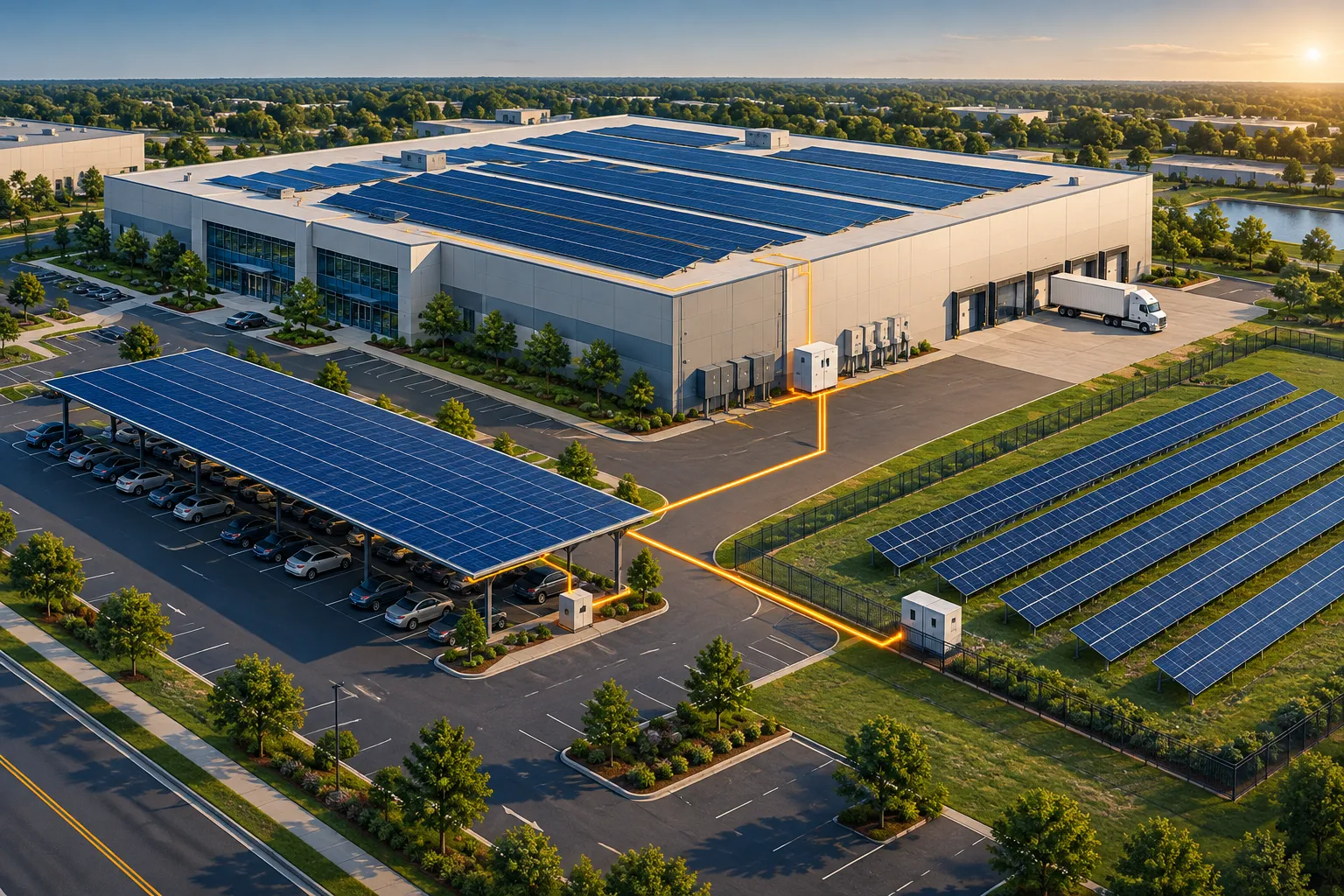
Solar panels for commercial buildings can use the roof, parking area or adjacent land. Choose based on usable space, construction demands, access and property rights.
Location | Works best when | Main early constraint | Financial implication |
|---|---|---|---|
Rooftop | A suitable roof has clear usable area and a life compatible with the solar contract | Structure, waterproofing, equipment access and future reroofing | Repair or removal costs can change the economics |
Carport | Parking space can serve generation and shading or charging needs | Foundations, traffic circulation, clearance and construction disruption | The canopy is part of the capital scope, not just the modules |
Ground mount | The site controls suitable adjacent land | Land use, shading, grading, distance to electrical service and interconnection | Civil work and longer electrical runs can outweigh extra generation |
Get a structural review and roof condition report. Plan for drainage, fire access and maintenance. Mechanical equipment, skylights, setbacks and shade can shrink the available area. If a major reroof is due, compare doing both jobs together with the cost of later removal and reinstallation. In a multi-tenant building, identify the bill payer and the party authorized to grant roof access.
Map parking stalls, drive aisles, accessible routes and underground utilities. Include EV charging plans. A canopy leaves the roof untouched but adds foundations and work in an active parking area. Show lighting, charging and parking disruption as separate costs or benefits rather than assigning them all to power generation.
Review land rights, terrain, drainage, environmental restrictions and the route to the electrical service. For onsite ground-mounted solar serving a commercial facility, use the facility's load and tariff to assess value. A project built mainly for grid sales needs its own revenue and capital-stack analysis.
For grid-sale development rather than onsite building supply, see Solar Farm Financing: Options, Risks and Capital Stack.
Solar power for commercial buildings saves most when the business uses the electricity as it is produced. Annual kilowatt-hours conceal timing. A warehouse with night shifts needs a different model from one with steady daytime operations.
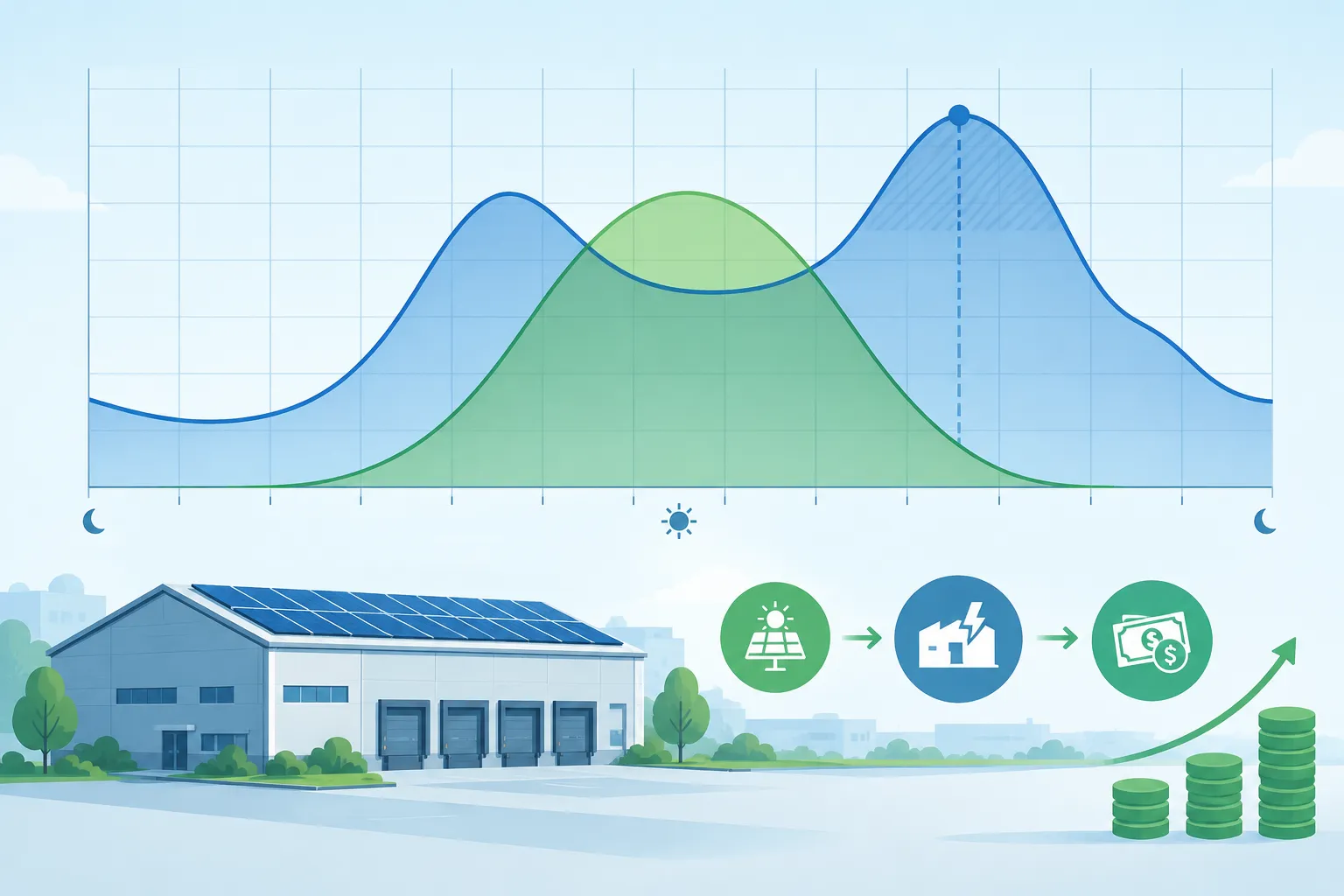
Use interval meter data and recent bills to separate energy, demand and fixed charges, along with time-based pricing. Compare the solar output estimate with consumption for the same periods. Price exports under the applicable tariff. If a facility's peak grid draw occurs after sunset, solar may cut energy charges while barely changing demand charges.
Use the applicable net metering or export compensation rules. A facility with high daytime energy consumption can use more generation onsite; a site with lower daytime energy demands may rely on exports. A commercial solar system can appear cost effective against an average unit price yet perform poorly under the actual tariff.
"Utility costs depend on both how much electricity a site uses and when it uses it." - U.S. Department of Energy
Build a base case using the current tariff and expected operations. Add a low-value case with less daytime use or export compensation, plus a high-cost case with roof, electrical or interconnection work. Show capital cost, annual production, self-consumption, bill savings, maintenance, replacement reserves and cash flow through the proposed contract. Assign production, price and maintenance risk to named parties.
Calculate storage separately. It can move solar power to expensive periods or serve specified loads. Ordinary grid-tied solar will not supply backup power during an outage; that requires islanding capability and controls. Add a battery only if its own costs and benefits hold up.
For a deeper look at the role of storage, see how battery storage works in energy projects.
Before comparing financing offers, decide who will own the equipment, receive any eligible benefits, operate the system and absorb poor performance. Use the same production estimate, tariff, site-work budget and contract period for each offer.
Arrangement | Who generally owns the system | Building owner's payment | Key questions for finance and legal teams |
|---|---|---|---|
Self-funded ownership | Building owner | Upfront capital plus ongoing operating costs | Does the return beat other uses of capital, and who manages the asset? |
Debt-funded ownership | Building owner | Debt service plus operating costs | What security, covenants and downside coverage does the lender require? |
Equipment lease | Lessor, subject to contract | Contracted lease payments | What are the maintenance, buyout, early termination and roof-access terms? |
Onsite power purchase agreement (PPA) | Third-party provider, subject to contract | Payment for delivered electricity under the agreement | How do price escalation, minimum purchases, end-of-term rights and site access work? |
Ownership gives the business more control over the asset. It also requires capital, asset management and a review of its ability to use any applicable incentives. Under a lease or PPA, a third party may take on upfront funding and operating duties; the building owner commits the site for the contract term. Read assignment, change-of-control and removal clauses alongside the bill model if a sale or tenant change is possible.
For an onsite PPA, compare the price of delivered solar power with the portion of the electric bill that solar can avoid. Check the annual price increase against a range of future energy prices. The contract should also say who bears underproduction risk and how the provider can access the site during a roof replacement. Look closely at assignment and termination terms before assuming the PPA will survive a sale or renovation without cost.
Keep assumed federal tax credits, accelerated depreciation and other tax benefits out of the investment committee case until tax advisers establish eligibility in the relevant jurisdiction. The transaction structure and applicable rules determine who could receive an incentive. Document the project's operating case separately.
For a broader view of funding structures beyond onsite solar, see Clean Energy Financing Options.
Give finance partners a packet they can use without visiting the site. They need to understand your property rights, proposed system, expected savings and outstanding approvals.
You do not need final engineering for an initial discussion. Label preliminary estimates and open questions; a lender or third-party owner will require firmer evidence before committing capital.
Set aside sites with unresolved property rights or major physical conflicts. Validate the load and tariff model, then commission enough engineering to narrow the cost and production estimates. Assign risks in a draft ownership and operating plan before comparing financing proposals.
For a portfolio, collect the same data from each building. Rank properties by usable area, load match, property rights, interconnection complexity and downside cash flow. Even a promising portfolio may contain sites that need different financing structures or timetables.
That screening can sit within a wider enterprise energy transition financing strategy.
Zero Circle uses project scoring, standardized data, investor matching and capital-structuring support to connect energy projects with relevant capital partners. Enterprise teams can use that process to identify financeable sites and the missing documents or risks to address before outreach. Site engineering, utility approval and legal and tax advice remain separate requirements.
Choose the solar location by what the site can support and the power bill can justify. Once you know the value of the electricity, compare ownership, debt, a lease and a PPA against your capital limits and risk appetite. With site rights, load data and an approval path in hand, bring the project to Zero Circle for structuring support and access to relevant capital partners.
Both use photovoltaic technology, but commercial projects are assessed against a building's larger and more complex electrical load, property rights, utility tariff and procurement process. A commercial decision may also involve multiple tenants, a carport or land, and a third-party ownership contract.
For a commercial site, five potential drawbacks are limited usable space, variable generation, upfront or contracted long-term cost, interconnection or electrical upgrades, and roof or land-use conflicts. The size of each drawback depends on the property and load, so model them before choosing a financing structure.
It can lower part of a commercial electricity bill if the facility uses the output when it is produced and the full system or contracted power cost is below the value of displaced grid purchases. Fixed charges, demand charges and exports can leave a substantial utility bill even after installation.
Tax treatment depends on the jurisdiction, who owns the system and the applicable rules. A building buying electricity under a PPA is in a different position from one that owns the asset. Do not count a deduction or credit in the financing case without a transaction-specific tax assessment.