

Resilient Energy Systems Guide
Optimize resilient energy systems to keep critical loads powered during outages with storage, generation, and clear finance planning.

– 6 min read
Optimize resilient energy systems to keep critical loads powered during outages with storage, generation, and clear finance planning.

Resilient energy systems keep essential operations powered during a disruption and restore normal service on a defined timetable. An enterprise choosing a battery or setting a solar target first needs to know which loads must run, for how long, under which failures, and what that continuity is worth.
A workable plan brings grid-side measures together with local generation, storage, controls and operating procedures. It also accounts for who pays for the assets and what they deliver on an ordinary day and during an outage.
Reliability measures the consistency of power supply under normal conditions. Resilience concerns what happens after a feeder fails, a substation floods, fuel delivery stops or a wider grid outage persists. Even a site with excellent annual uptime can lose a critical process during a prolonged outage.
Set an explicit service standard before selecting equipment:
Measure success in critical load served over time. An oversized generator that depends on an inaccessible fuel supply can fail that test; a smaller system with workable load controls may meet it.
Map the electrical network alongside the work it supports. Cooling at a data center, clinical loads at a hospital and process controls at an industrial site have different restart constraints. The map also needs communications, water, fuel, maintenance access and the utility feeder. Power to the building is of little use if a dependent process cannot restart.
For each critical load, record peak demand, an hourly load profile, allowable interruption, restart surge and its priority when capacity is scarce. Use the same outage scenarios to compare designs; otherwise a low equipment bid may hide a poor service outcome. For the distinction between normal service and outage planning, see grid resilience versus reliability.
| System element | Role in resilience | Planning constraint |
|---|---|---|
| Grid upgrades and redundant feeds | Reduce exposure to single points of failure and improve restoration options | Shared upstream assets may still fail together |
| On-site generation | Supplies energy while the utility is unavailable | Fuel or resource availability, permits and maintenance |
| Battery energy storage | Bridges interruptions, manages peaks and shifts generation across hours | Stored energy is finite; reserve policy affects everyday economics |
| Switchgear, protection and microgrid controller | Detects an outage, isolates the site and coordinates resources | Islanding and reconnection need engineered protection and utility coordination |
| Load controls and efficiency | Preserve limited supply for priority services | Load shedding must match operational and safety requirements |
| Communications, spares and procedures | Enable operators to respond and recover | Plans require training and periodic exercises |
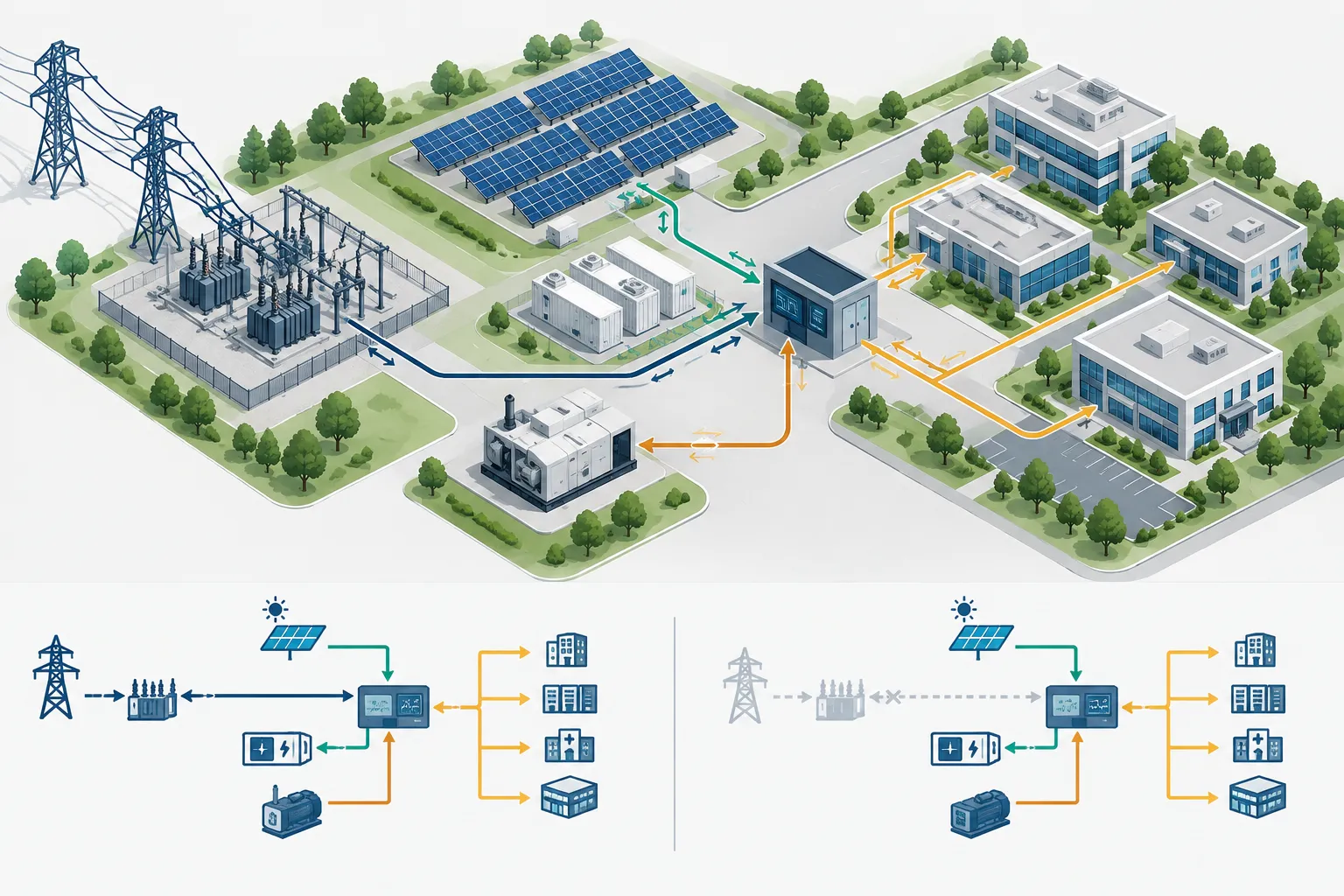
Distributed generation needs the right electrical design and controls to serve loads when the wider grid is down. A grid-connected solar array does not provide backup by default. A microgrid uses local resources and controls to isolate a defined electrical boundary and support designated loads. Name the boundary so operators know which campus buildings have protection.
Storage responds fast enough to bridge a grid interruption and generator start. Generation can replenish it over longer periods if fuel or renewable resources remain available, while load controls keep demand within the system's limits. The microgrid controller handles dispatch and the switch between grid-connected and islanded operation. For more on sizing and operation, see battery storage projects explained.
On a campus with a battery, solar and dispatchable generation, the battery may reduce demand peaks on ordinary days. If utility power fails, the controller isolates protected circuits, sheds nonessential loads and preserves enough charge for the transition. Solar can reduce fuel use when available; dispatchable generation carries demand as solar output falls. Those components have to operate together under the chosen failure scenario.
Grid planning belongs in the same design exercise. Examine feeder exposure, substation dependencies, protection settings, interconnection requirements and restoration procedures alongside the on-site equipment. A second connection offers little protection if it shares vulnerable upstream assets with the first. Discuss islanding and reconnection with the serving utility before the design is too far along to change cheaply.
Run time-series outage simulations alongside a peak-load check. Vary outage start times, demand, solar availability, storage state of charge and fuel constraints. For each scenario, record hours of critical load served and the probability of falling short. The DOE's REopt tool can evaluate system sizes, battery dispatch and how long a configuration sustains critical load during an outage. Include a component failure: equipment may fail when the site needs it most.
Avoiding a production shutdown may justify capital spending, but the avoided loss does not create revenue to repay a project lender. Present the benefit case separately from the payment case. The U.S. Department of Energy identifies another source of value:
"DERs can provide revenue streams while grid-connected, and these energy and cost savings may lower the overall cost of a microgrid and allow for the incorporation of additional microgrid components." - U.S. Department of Energy
| Value or cost | Evidence to build | How it enters the decision |
|---|---|---|
| Avoided outage losses | Lost output, restart costs, contractual penalties and safety impacts for specific outage durations | Compare expected avoided loss with the incremental resilience cost |
| Normal-operation savings | Tariff, load and dispatch modeling for demand reduction or self-supply | Include only savings the operating strategy can deliver while preserving backup reserve |
| Contracted or regulated revenue | Tariffs, service agreements, offtake or availability payments | Test whether enforceable receipts cover operating costs and debt service |
| Capital and operating costs | Engineering estimate, interconnection, fuel, maintenance, insurance and replacements | Stress-test overruns and ongoing obligations |
| Residual risk | Events beyond design duration, correlated failures and counterparty exposure | Decide what remains with the owner or requires other protection |
Estimate the cost of outages at different lengths and start times, then price the incremental design against a simpler alternative. A battery sized for demand management may save money but lack backup duration. Hold back a large emergency reserve, and less energy remains for normal-operation savings. The financial model needs to reflect both effects without counting the same stored energy twice.
Keep scenarios distinct from forecasts. Avoided-loss estimates depend on outage frequency, duration and the value of interrupted service. Financing payments still come due in a year with no outage. Lenders need to know whether the sponsor's balance sheet or contracted cash flows support those payments. An enterprise investment committee weighs the reduced disruption against lifecycle cost and residual risk.
Move from an operations requirement to an investable scope in stages:
The payer determines the funding route. A corporate owner with strong internal cash flow may fund continuity through its capital program; a project with a creditworthy service contract may borrow against contracted payments. Public or community infrastructure with broad benefits but no collectable revenue may need budget support or concessional capital. Avoided outages can justify construction, though lenders still need a debt-service mechanism. See energy project finance basics for payment and risk-allocation fundamentals.
Zero Circle helps project owners organize engineering and financial information for scoring and capital structuring, then match opportunities with investors whose mandates fit the geography, size and risk. That can get the right funding conversations underway sooner. Site engineering, utility approval and an identified payment source remain the owner's responsibility.
Choose the least costly configuration that meets a defensible service requirement under credible failures and has a clear path to operation and payment. Decide what must stay online and test the whole system under outage conditions before committing capital. With the continuity benefit and repayment plan documented, Zero Circle can help structure the case and connect the project with relevant capital providers.