

Renewable Energy Investment Opportunities
Explore renewable project finance opportunities by project stage, offtake risk and capital structure, with a practical guide to investor fit.

– 8 min read
Explore renewable project finance opportunities by project stage, offtake risk and capital structure, with a practical guide to investor fit.

Renewable project finance depends on a sponsor showing how future project cash flows will repay capital. A solar or wind label tells an investor little about the deal. Development rights need patient equity; a permitted asset may need construction financing; an operating portfolio can suit long-duration infrastructure capital. Investors need to know what is built, what remains uncertain, who buys the output and who absorbs a delay.
Project owners and enterprise teams can avoid pitching lenders a project whose development risk calls for equity. Capital providers, in turn, can narrow a broad energy transition mandate to deals they can underwrite.
Renewable energy infrastructure investment spans assets and transaction stages. An asset that suits a long-term owner may still lack the grid access and revenue contracts a construction lender needs.
The IEA projected substantial clean-energy spending for 2025. Its estimate includes grids, storage and other technologies alongside renewables:
"Around USD 2.2 trillion is going collectively to renewables, nuclear, grids, storage, low-emissions fuels, efficiency and electrification, twice as much as the USD 1.1 trillion going to oil, natural gas and coal." - IEA, World Energy Investment 2025
Opportunity |
What the capital pays for |
Principal uncertainty |
Likely investor fit |
|---|---|---|---|
Early-stage project development |
Site control, studies, permitting and interconnection work |
Whether the project becomes buildable |
Developer balance sheets, strategic partners, specialist development equity or development lenders with appropriate security |
Ready-to-build generation |
Equipment, civil works and connection costs |
Construction timing, cost and contract performance |
Sponsor equity alongside construction lenders, subject to conditions precedent |
Operating renewable assets |
Acquisition or refinancing of completed projects |
Output, operating costs and remaining contract life |
Infrastructure funds, long-term owners and lenders |
Storage and hybrid projects |
Storage alongside generation or as a standalone asset |
How dispatch and multiple revenue streams translate into dependable cash flow |
Specialist equity and lenders able to underwrite the contracted and merchant portions separately |
Portfolios and platforms |
Multiple projects or a development pipeline |
Correlation, uneven readiness and corporate-level obligations |
Platform investors, infrastructure funds and facilities that can fund projects in stages |
Grid and enabling infrastructure |
Networks, interconnection or other shared infrastructure |
Approval, interface and revenue-model risk |
Infrastructure and strategic capital whose mandate covers the relevant regulatory model |
Each route carries a different claim on the asset. An investment fund may buy operating assets, finance construction or back a developer platform. Its name alone tells a sponsor little about its appetite for permitting risk or a merchant battery.
Development investors fund work that may make a project bankable, even while site control, permits, grid studies or offtake remain open. A lender financing a completed facility asks whether cash left after operating costs can cover debt service. As the sponsor locks down those milestones, different investors can consider the asset. For the mechanics of asset-level borrowing, see renewable energy project finance basics.
Storage, hybrid assets and grid resilience widen the renewable infrastructure opportunity. They still need a clear path to revenue. For storage, separate contracted capacity or tolling revenue from exposure to power-price spreads or ancillary-service markets. For grid projects, identify the entity that pays for the asset and the approvals that allow that payment to start. A lender will focus on those details before the technology label.
In renewable energy project finance, lenders generally look first to project assets and cash flows for repayment. They therefore care about the project's readiness. Sponsor strength helps, but lenders still need an enforceable contract and a viable connection.
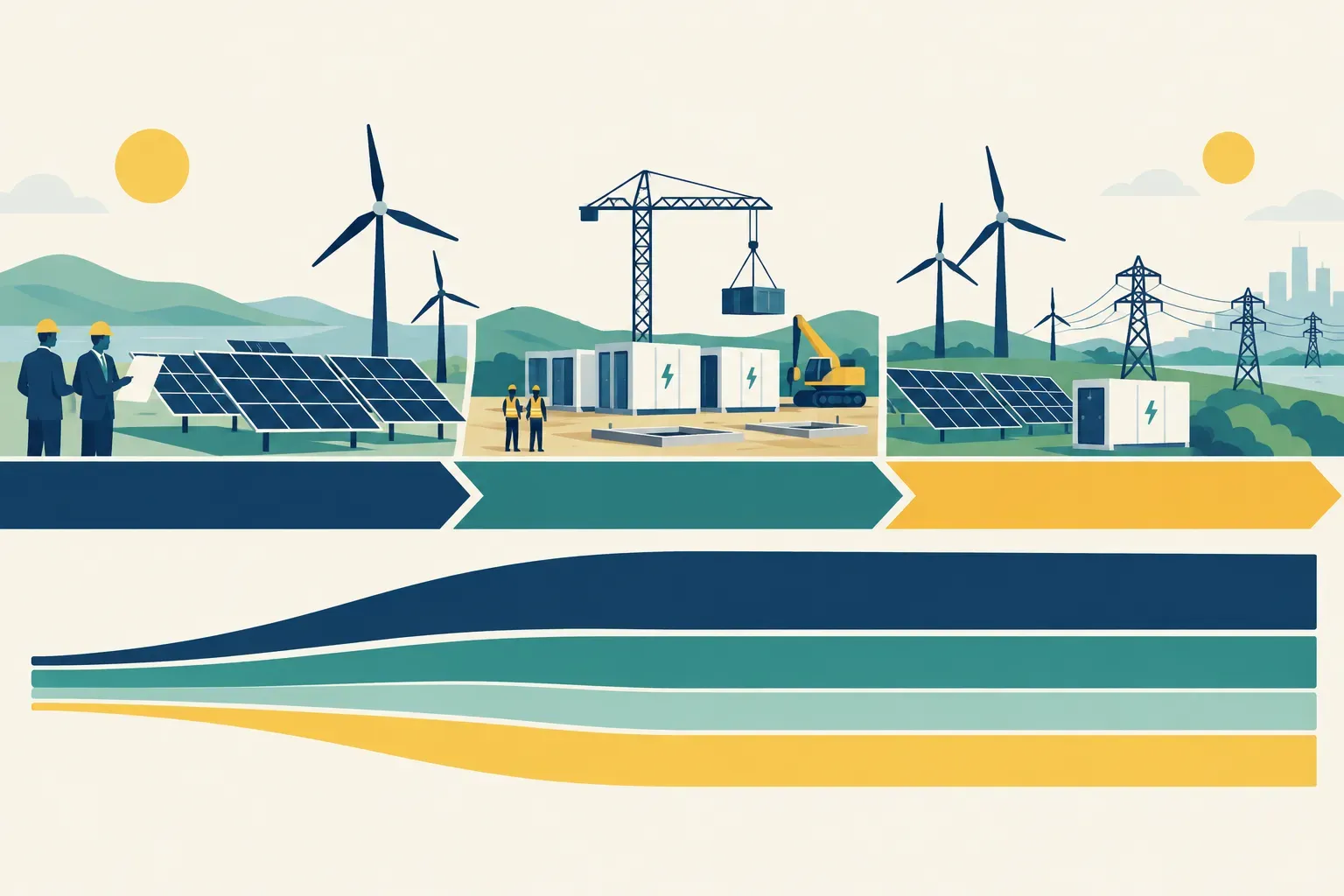
Stage |
Evidence a capital provider needs |
Capital better suited to the risk |
|---|---|---|
Origination |
Credible site and resource thesis, development budget, sponsor capability |
Sponsor funding, development equity or strategic capital |
Advanced development |
Site rights, permit progress, grid position, commercial plan and downside case |
Specialist development capital; some structured development lending where security and milestones support it |
Pre-construction |
Material permits, executable construction contracts, interconnection path, offtake terms and a tested model |
Construction equity and debt, with draws linked to closing conditions and progress |
Operation |
Completion evidence, operating data, remaining revenue contracts and reserve policy |
Long-term project debt, refinancing or asset acquisition capital |
Capital does not switch from development to construction on a single date. A project may have a signed power purchase agreement while interconnection upgrades remain unresolved. A merchant-risk equity investor might consider an asset without a full long-term contract, although lenders may advance less against it than against a contracted asset.
Suppose you have site rights and a promising grid application, but no final connection terms or executed offtake. The immediate renewable energy investment opportunity is funding the work that resolves those open items. Calling that request “construction finance” leaves the connection-cost risk where it was. With executable contracts, a realistic cost-to-complete and a credible downside case, you can then approach lenders on different terms.
Sponsors should map funding to the next value-changing milestone. A request for “the whole project” obscures whether the immediate need is development runway, construction funding or a refinance after commercial operation. Investors should ask which unresolved item could stop the next draw. Solar farm financing options offer an asset-specific view of those choices.
An offtake agreement, often a power purchase agreement (PPA), sets the terms on which a buyer takes a project's electricity or related output. Investors look past the headline price to volume obligations, contract length and the buyer's credit. They also consider who carries curtailment risk, when either party can terminate, and whether the contract lasts as long as the financing needs it to.
Revenue position |
What can support underwriting |
What still needs scrutiny |
|---|---|---|
Long-term contracted |
Defined commercial terms can make downside cash flows easier to model |
Buyer credit, contract tenor, delivery shape, curtailment and early termination |
Partially contracted |
The contracted slice may support some borrowing |
Exposure on the uncontracted output and whether debt service survives a weak-price scenario |
Merchant or variable |
Potential upside where market access is attractive |
Price volatility, dispatch assumptions, basis risk and whether equity can absorb downside |
A PPA still leaves delivery risk. A delayed connection can prevent delivery, and an inflexible construction schedule can turn a sound contract into an expensive obligation. Lenders also examine the engineering, procurement and construction contract, equipment supply, insurance, operating plan and reserve accounts.
A corporate buyer's offtake commitment can help finance a project. The buyer still needs to understand its exposure: price certainty may shift volume, timing or performance risk onto the enterprise. Model the commitment and the project's debt case together before treating the arrangement as financed.
A capital stack sets payment priority and allocates losses. Sponsor and third-party equity bear residual risk. Senior lenders get paid ahead of them and typically require security and controls over distributions. Hybrid capital can fill the space between senior debt and common equity, though the underlying project still needs to support its obligations.
Capital route |
Useful when |
Main trade-off |
|---|---|---|
Sponsor or strategic equity |
Development decisions need flexibility and alignment |
Ownership dilution or concentrated exposure |
Development equity or specialist development loan |
Funding is needed before construction debt is available |
Milestone, control or security requirements may be demanding |
Construction debt |
Contracts and approvals support defined construction draws |
Conditions precedent, completion risk and lender oversight |
Long-term senior project debt |
Operating or contracted cash flows can service scheduled payments |
Covenants and less flexibility under downside cases |
Preferred equity or subordinated debt |
A financing gap remains above senior debt |
Higher claim on cash or tighter control than common equity |
Portfolio or platform capital |
Multiple projects can be funded through a repeatable program |
Strong governance is needed to avoid masking weak projects inside a pipeline |
Renewable energy investment funds have different mandates. A fund may specify geography, technology, project stage, ticket size, return profile and concentration limits. Match those requirements to the project's cash flows rather than to the fund's climate branding. The choice between tax equity and debt in energy project finance adds a structuring question where tax-oriented capital is available.
Test the downside before optimizing leverage. If delay, higher construction costs, lower output and weaker merchant prices each force a lender waiver, the structure has too little room for setbacks. Keep equity committed to a project company separate from parent-level funding for a developer's broader pipeline: repayment and governance differ.
Start with who can manage each risk. A fixed-price construction contract may limit some cost overruns, depending on exclusions, contractor credit and completion tests. A PPA can limit price exposure while leaving the sponsor responsible for generation volume or connection delays. Reserves, insurance and sponsor support can absorb defined setbacks, provided the base case itself is credible.
For a portfolio financing, assess the assets individually before counting on diversification. A shared connection bottleneck, buyer or permitting regime can put several projects at risk at once. An acquisition of operating assets also calls for different underwriting from a commitment to fund the platform's future projects.
A useful data room shows the open risks alongside the strengths of the project. Start with:
Capital providers can use a screening memo to record both mandate fit and the conditions that still block financing. Sponsors can turn those conditions into a work plan: secure the contract, complete the study or seek development equity before construction debt. Enterprise teams need to make the same distinction between a decarbonization commitment and the vehicle that will own and finance the project. Energy transition financing for corporates covers that enterprise decision in more detail.
Project owners lose time when investors receive incomplete evidence or deal requests outside their mandate. Zero Circle's energy finance platform connects project owners, capital partners and enterprises around project readiness. It combines project scoring and standardized data with matching by mandate, geography and deal size. Underwriting support and human-reviewed outreach help the parties have a more useful first conversation; capital structuring guidance helps sponsors make the right funding request.
Sponsors still need permits and offtake where the deal calls for them, and investors still make their own approval decisions. The platform helps put unresolved risks in front of capital providers whose mandates allow them to assess those risks.
Investors should start with the deal's stage, revenue certainty and capital structure before comparing modeled returns. Sponsors bringing a renewable or adjacent climate infrastructure project to market can use Zero Circle to organize their readiness evidence and approach capital providers suited to the risk, including projects that still need development funding rather than senior debt.
Development investors fund work that may make a project bankable while site control, permits, grid studies or offtake remain open. A lender financing a completed facility asks whether cash left after operating costs can cover debt service. Matching capital to stage avoids pitching lenders a project whose development risk calls for equity.
An offtake agreement, often a power purchase agreement (PPA), sets the terms on which a buyer takes a project's electricity or related output. Investors look past the headline price to volume obligations, contract length and the buyer's credit. A PPA still leaves delivery risk, for example if a delayed connection prevents delivery.
A capital stack sets payment priority and allocates losses across the funders of a project. Sponsor and third-party equity bear residual risk, while debt is repaid first from project cash flow.
It should show open risks alongside the project's strengths. Start with asset and rights, remaining development and delivery milestones, who pays for the output and under which contracts, and whether the base and downside models hold up.