

Renewable Energy Development Guide
Plan renewable energy development from site control to financing readiness with practical steps for grid access, permitting, offtake and capital.

– 9 min read
Plan renewable energy development from site control to financing readiness with practical steps for grid access, permitting, offtake and capital.

Renewable energy development is the work of securing the rights, approvals, grid access, revenue and capital needed to build a project. A promising site is only the beginning. Before paying for detailed construction plans or approaching lenders, sponsors need to know which land, grid, permitting and commercial risks remain.
Before each new commitment, ask what the money will prove. A financeable project needs documented rights, a credible construction and connection plan, supportable revenue and a capital structure that survives downside scenarios.
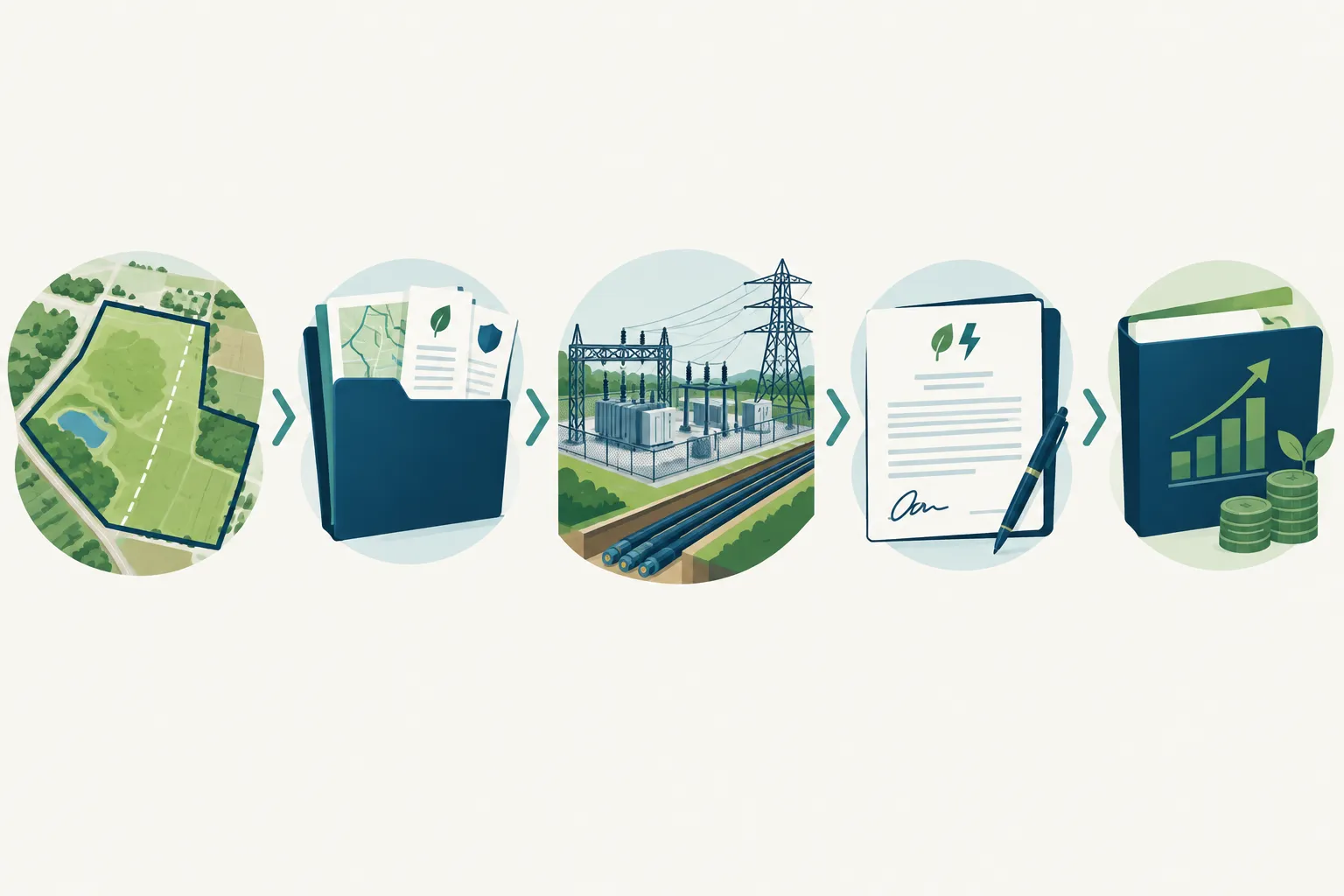
Renewable energy project development runs from initial market screening to construction financing. Teams often work on land rights, engineering, permits, interconnection, offtake and financing at the same time. A delay in one workstream can force changes to several others.
The documents and approval authorities differ across utility-scale wind and solar, distributed generation and projects paired with storage. An enterprise developing on-site generation may already control the property, yet still need to settle electrical design and internal purchasing commitments. A merchant project relies more heavily on price forecasts than contracted generation does.
If you plan to add storage, give charging, dispatch and revenue assumptions their own diligence. The battery storage project fundamentals explain the added work.
| Gate | Decision | Minimum evidence to move forward |
|---|---|---|
| Concept to controlled site | Is there a plausible project here? | Resource and market screen, usable land, preliminary grid route, fatal-flaw review |
| Controlled site to development spend | Can it be built and sold? | Executable land rights, permit map, interconnection pathway, early production and cost assumptions |
| Development to investment case | Can counterparties price the risk? | Study results, approval status, offtake strategy, defined scope, model with sensitivities |
| Investment case to financial close | Can capital commit on agreed terms? | Diligence package, financeable contracts, allocation of remaining risks and conditions to close |
Start with the likely buyer or power market and a possible point of interconnection, then screen parcels against the technology and resource. Solar needs usable exposure and buildable area; wind adds wind-resource and setback questions. Screen access and land use for either. Proximity to a transmission line tells you little about available grid capacity.
Keep the first screening memo short: proposed capacity and technology, site map, ownership, estimated generation, grid connection hypothesis, likely approvals, market or buyer, rough cost range and fatal uncertainties. If you cannot secure an essential right or viable connection, stop before paying for deeper engineering.
An option, lease or purchase agreement needs to cover more than the generating footprint. It may also need access roads, cable routes, easements, equipment areas and construction staging. Set rights and extension milestones against the expected permitting and interconnection schedule.
Record which land rights you have signed, which conditions remain and whether you can assign those rights to the project financing vehicle or a lender. Signed land rights alone do not give you permission to build. A title or access gap discovered late may require a redesign.
Refine the layout and yield estimate alongside geotechnical, environmental and civil studies. Separate equipment, balance of plant, grid upgrades, land, development costs and contingency in the preliminary budget. Deduct expected losses and operating costs before you model cash available to investors.
Run downside cases for production, schedule, capex, curtailment and realized price. Even a modest increase in grid-upgrade costs can undermine an attractive base case. Feed each new study into the financial model and the project assumptions register.
For the modeling and capital stack behind those assumptions, see renewable energy project finance basics.
List each approval authority, application, study, dependency, owner and possible appeal or consultation step. Depending on the site, you may need to address zoning, environmental impacts, water and wildlife, construction and decommissioning. Talk with host communities before the design hardens: access, drainage, noise and visual concerns can change the layout and schedule.
Distinguish an application from a conditional permit and a final effective approval. Capital providers need to know whether permit conditions could change costs, operating limits or construction timing.
An interconnection application offers no guarantee of a grid connection. Studies can change the connection point, require upgrades or shift the delivery date. Track study progress, security requirements, upgrade exposure, expected energization and dependencies on other network work.
"Only 13% of capacity that submitted interconnection requests from 2000–2019 had reached commercial operations by the end of 2024; 77% of that capacity had been withdrawn and 10% was still active." - Lawrence Berkeley National Laboratory, Queued Up: 2025 Edition
These figures describe requested capacity across the studied queues; they do not predict the outcome of any one project. Budget for grid studies early.
Use the actual delivery point and expected curtailment in the model. A material change in connection cost or timing calls for revisions to the construction budget, offtake milestones and site-control term. Behind-the-meter projects bring a different set of electrical questions, including utility requirements, export rules and the customer's load profile.
Depending on the project, revenue may come from a power purchase agreement (PPA), on-site customer payments, subscriptions or market sales. Name the payer, delivered product, delivery point, contract period and credit support. Then account for PPA terms on curtailment, environmental attributes, performance and termination, all of which affect the project's economics.
Enterprise teams balancing energy procurement with broader commitments can use an energy transition financing framework for corporates to align internal decisions with the project plan.
If a buyer has expressed interest but has not signed a definitive contract, say so. A signed letter of intent does not secure revenue, and merchant forecasts are not contracted income. Match model prices, volumes and delivery obligations to the proposed commercial terms.
As permits and grid studies mature, develop the design far enough to get usable contractor and supplier prices. Compare their delivery and performance obligations with those in the revenue agreement. Assign responsibility for delay, cost overruns, equipment faults and operating shortfalls.
Build the project data room with rights and title, studies, approvals, interconnection correspondence, generation estimates, contracts, budget, schedule, financial model and unresolved items. Debt and equity providers may price risks differently, but both need consistent numbers and a credible plan to resolve open conditions.
Construction, commissioning and operations follow financial close. The development handoff should preserve responsibility for grid energization, testing, safety, warranty claims and compliance rather than assuming these issues disappear when financing is signed.
These stages overlap. Put land-option expiry, interconnection studies, seasonal environmental surveys, public hearings, buyer milestones, equipment procurement and the planned commercial operation date on one critical path. Assign an owner and decision deadline to each dependency. If a grid study slips, assess whether site rights, permits and the proposed PPA still cover the new date.
The EPA renewable energy project development toolbox provides U.S.-focused resources for early project planning and interconnection work. Local approval and grid procedures still determine the actual sequence.
A sound design does not remove grid, permitting, revenue or financing risk. Resolve enough of each for a capital partner to price the remaining exposure.
| Risk | Common false comfort | Evidence that improves the case | Decision if unresolved |
|---|---|---|---|
| Interconnection | A queue application or a nearby substation | Study status, defined connection scope, upgrade exposure and credible energization assumptions | Rework capacity, location or timetable before locking in revenue obligations |
| Permitting | A favorable initial conversation | Permit register, submitted studies, issued approvals and analysis of outstanding conditions | Hold material construction commitments until the approval route is defensible |
| Offtake | Buyer interest or a headline PPA price | Credit analysis, agreed commercial terms, deliverable volume and allocation of curtailment and attribute rights | Reprice risk or pursue another contract structure |
| Capital plan | A model with a single attractive return | Uses and sources, contingency, funding milestones and downside cases | Raise risk capital for remaining development rather than presenting the deal as construction-ready |
These risks compound. A grid delay may push the commercial operation date beyond a PPA milestone; a permit condition may force a lower-yield layout. Update the linked assumptions, assign each exposure to an owner and decide whether to keep spending.
Financeability depends on the type of capital you seek. Development equity may fund unresolved studies; construction debt usually needs a much firmer account of rights, costs, revenue and timetable. Show a prospective partner the risks that remain and how you expect to allocate them.
Use the following readiness check before investor outreach:
| Workstream | Early idea | Stronger financing evidence |
|---|---|---|
| Site | Candidate parcel identified | Executed rights covering site, access and necessary easements |
| Resource and design | Desktop estimate | Documented production methodology, developed layout and identified losses |
| Grid | Connection point proposed | Formal study progress, cost and schedule exposure captured in model |
| Approvals | Likely permits listed | Studies and applications tracked, major conditions and dependencies understood |
| Revenue | Possible buyers or modeled market sales | Defined contract path, credit position and clear contracted-versus-merchant assumptions |
| Cost and delivery | Indicative equipment quote | Coherent capex, contractor scope, schedule, contingency and operating assumptions |
| Capital | Target raise announced | Sources and uses, development funding needs, proposed capital structure and sensitivity cases |
Use versioned documents and one assumptions register in the data room. Date each material right, study and contract, show its status and trace the model back to those records. Disclose the uncertain upgrade bill or conditional permit; investors need to price those exposures.
The financial model should reconcile annual energy sold to the production study, delivered price to the offtake terms, interconnection and contractor costs to the budget, and debt repayment to cash available after operating expenses. Include development spend already incurred, the cash needed to reach construction, a construction contingency and the timing of each funding draw. If incentives or tax equity are part of the plan, distinguish assumed eligibility from committed proceeds.
Three useful go/no-go questions before expanding spend are:
If the available capital does not fit the current risk, fund the next study or secure an anchor buyer before launching a construction-debt process.
Early-stage funding pays for land options, studies, applications, design and legal work. Construction capital pays for a defined scope once sponsors have resolved or allocated material development risks. Pitching an unfinished project as construction-ready wastes time for both sides.
The choice between development equity, construction debt and other instruments depends on which risks remain. A comparison of tax equity and debt in energy project finance can help frame distinct capital roles where those structures apply.
Tie each spending milestone to a deliverable and a financing decision. An interconnection study may tell you to commission detailed engineering, resize the project or exit the site. Show outstanding conditions in the term sheet so both sides can price them.
Zero Circle helps project owners assemble a financing case through AI-driven fundability scoring, standardized project data, investor matching and underwriting support. Its human-reviewed outreach and capital structuring guidance help sponsors approach capital partners by geography, deal size and stage. Investors get a structured starting point, while retaining responsibility for their own diligence. Sponsors still need site rights, an achievable grid connection and supportable revenue.
Once the evidence is organized, finding climate project investors becomes a question of matching the project's risk, geography and size to the right mandate.
Develop a project by documenting each decision before you fund the next one. Screen the grid and site first, keep permits and revenue tied to design changes, and seek capital suited to the remaining risk. Zero Circle can help organize the evidence and introduce relevant investors once the case is ready for a capital conversation.
For a developer, there is no single universal obstacle. Interconnection, permitting, offtake and financing can each stop a project, and they often compound one another: a delayed grid connection can undermine a revenue contract and the capital plan. Screen these risks together, then fund the next step only when its evidence justifies the spend.
Renewable energy development is the work of securing the rights, approvals, grid access, revenue and capital needed to build a project. It runs from initial market screening to construction financing, and teams often work on land rights, engineering, permits, interconnection, offtake and financing at the same time.
No. Studies can change the connection point, require upgrades or shift the delivery date. Lawrence Berkeley National Laboratory found that only 13% of capacity that submitted interconnection requests from 2000 to 2019 had reached commercial operations by the end of 2024. Budget for grid studies early.
No. A signed letter of intent does not secure revenue, and merchant forecasts are not contracted income. If a buyer has expressed interest but has not signed a definitive contract, say so, and match model prices, volumes and delivery obligations to the proposed commercial terms.
Ask three questions. Can the project legally and physically be built and connected on the proposed site? Does its revenue structure support the cost of construction and operation under a plausible downside case? Is there a capital source suited to the current stage of risk, not just the intended final asset?