

Adaptation Projects: How to Prove Investor Readiness
Improve adaptation projects investor readiness: document resilience outcomes, show repayable cash flows, and organize a data room for due diligence.

– 7 min read
Improve adaptation projects investor readiness: document resilience outcomes, show repayable cash flows, and organize a data room for due diligence.

To make an adaptation concept investor-ready, show the physical risk it reduces, how you will measure the improvement, who pays, and how you will repay capital. A flood barrier or cooling system may protect vital assets without earning revenue. Investors need a payment path as well as a case for protection.
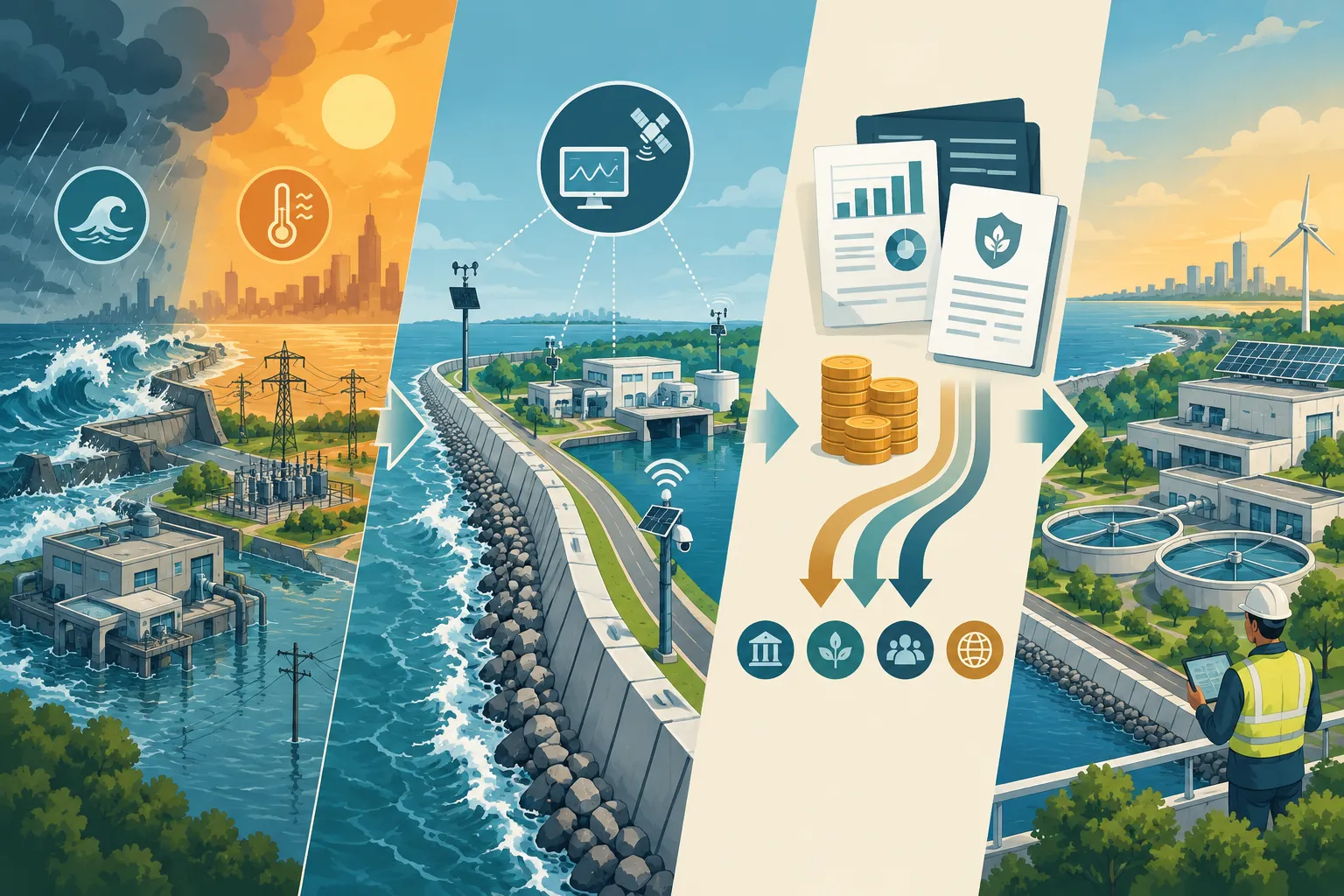
For adaptation projects, investor readiness rests on connected evidence: define the hazard and exposed assets, show how the intervention reduces risk, identify a payment mechanism, and give investors the documents to test the assumptions.
Mitigation projects can often point to an output, such as energy sold. Adaptation projects may prevent a loss under particular climate conditions. Avoided damage has value, but a borrower needs cash to service debt. Connect the benefit to a budget, contract, customer payment, insurance arrangement, or another source of funds.
"Across 320 evaluated investments, every US$1 invested in adaptation is expected to yield over US$10.50 in benefits over 10 years." - World Resources Institute
Those benefits do not necessarily reach the project's accounts. The UNEP Adaptation Gap Report 2024 estimates the annual adaptation finance gap for developing countries at US$187–359 billion. Public funding and credible private investments both have a role, provided the instrument fits the project's payment mechanism.
Start with a one-page investment thesis that answers six questions:
If the payer and repayment answers are blank, the project may still merit public funding or grants. Do not label an uncontracted avoided-loss estimate as revenue.
Project question | Evidence an investor can examine | Common weak answer |
|---|---|---|
Is the hazard material? | Asset-level exposure, historical records, climate scenarios and stated assumptions | A regional risk map alone |
Will the intervention work? | Engineering design, performance specification, baseline and monitoring plan | A general claim that the asset is resilient |
Who pays? | Identified counterparty, budget source and draft or executed payment terms | “Beneficiaries will save money” |
Can it be delivered? | Site control, permits path, procurement plan, cost estimate and delivery schedule | An indicative concept drawing |
Can capital be returned? | Model, financing terms and downside cases | An impact figure presented as cash flow |
Specify the location, assets at risk, hazard, current service level and period of analysis. A water project might track days of service interruption during drought; a grid project might track hours of critical-load continuity during an outage. Name the facilities or people served. A site-level asset cannot support a community-wide impact claim without evidence of that wider reach.
Describe what would happen without the intervention under the same hazard conditions. Separate today’s observed performance from modeled long-term exposure to climate change. Mark measured inputs, projections and areas of uncertainty so an investor can reproduce the baseline behind your climate resilience claim.
Select indicators that follow from the design. Include an operational measure, a measure of who benefits when relevant, and the method and frequency of measurement. A flood-control project could track inundation depth at specified assets, time to restore access, and facilities protected. These are candidate metrics, not promised results.
Indicator | Baseline to collect | Post-project evidence | Diligence question |
|---|---|---|---|
Service continuity | Outage duration and conditions before construction | Meter, operator or incident logs | Are hazard conditions comparable? |
Flood exposure | Site elevations and historical or modeled water levels | Sensors, surveys and event records | Does protection extend beyond the design event? |
Heat resilience | Indoor temperatures and critical operating hours | Sensor readings and maintenance logs | Was the improvement caused by the intervention? |
Before fundraising, assign responsibility for collecting and reviewing performance data. State the reporting frequency and how you will handle underperformance. Where uncertainty is material, show a range rather than treating model output as an observed result. Investors can then judge the target and the evidence they will receive after deployment.
For a portfolio of adaptation investments, use consistent definitions of hazard, baseline and beneficiary across sites. A classification framework can help asset managers and financial institutions identify what counts as climate change adaptation, but it does not prove that a particular asset reduces climate risk or generates cash. The project-level evidence still has to stand on its own.
Resilience can have economic value without producing income for the project. Identify the party that will pay for that value. Map the beneficiary, budget holder, contracting entity and investor separately; they may be different organizations.
The asset and jurisdiction determine the available structures. A utility or enterprise might pay under a service or availability contract; a public authority might procure a resilient asset; a property owner might fund improvements to protect its operations. Grant or concessional capital can support benefits without a payment stream. Include it in the financing plan only when you have a credible route to obtaining it.
For a closer look at the available instruments, see ways to fund climate adaptation. The financing choice still has to fit this project's payer and risk allocation.
For every proposed revenue line, document the payer, trigger, term, indexation if any, payment priority and counterparty credit risk. For each cost line, include development, construction, operations, maintenance, replacement and monitoring. Spell out who bears cost overruns, delayed commissioning, performance shortfalls and extreme events outside the design standard.
Give the investment committee a model it can reproduce, with a base case and downside cases. Stress-test construction delay, higher capital costs, lower contracted payments, slower customer adoption if applicable, and weaker-than-expected performance. Keep modeled avoided losses apart from cash receipts. Show pre-completion funding needs and when contracted inflows can cover operations and debt service.
A simple decision table keeps the model honest:
If the main benefit is… | Possible financing path | What must be evidenced |
|---|---|---|
Contracted service or capacity | Project debt or infrastructure equity, subject to risk allocation | Executable contract, creditworthy payer and robust forecast cash flows |
Public or shared avoided loss | Public procurement, grants or blended finance | Budget authority, procurement route and measurable public benefit |
Lower risk to a private asset owner | Owner-funded capital, corporate borrowing or a service agreement | Owner economics, payment commitment and operational performance |
Do not force commercial debt onto a project whose benefits are real but diffuse. The right capital stack follows the payment mechanism, not the size of the impact claim.
An investor should be able to open the data room and find the source for each claim in the investment memo. Give each file a version date and owner, keep an index of open questions, and separate signed documents from drafts and pending items. If the counterparty is missing or the design has not been tested, make that gap visible.
Folder | Documents to include | Question it resolves |
|---|---|---|
Investment case | Executive brief, use of proceeds, milestones and capital request | What decision is being requested? |
Risk and impact | Hazard assessment, baseline data, counterfactual assumptions and measurement protocol | How does the intervention reduce risk? |
Technical and delivery | Design, site information, cost estimate, procurement route, schedule and operations plan | Can it be built and operated? |
Commercial | Customer or offtake terms, procurement documents, payer authority and insurance terms where applicable | Who is obligated to pay? |
Financial | Linked model, sensitivity cases, proposed capital stack and funding schedule | Can the project repay capital? |
Legal and safeguards | Site rights, permits status, governance, environmental and social documents, and material contracts | What could stop or delay closing? |
Keep an assumptions register beside the model, with a source for each significant input and an owner for unresolved gaps. List the conditions precedent to investment, such as final site rights, a signed service agreement or a completed engineering study. If an item is still in progress, record who owns it and when they expect to finish it.
At concept stage, define the hazard, affected assets, intervention, plausible payer and initial delivery constraints. At development stage, develop the design and baseline alongside cost estimates, stakeholder commitments and payment terms. At investment-ready stage, tie model inputs to documents and list the remaining conditions to closing. You can approach early-stage capital before a project qualifies for debt, as long as investors know its current stage.
State the geography, asset type, project stage, amount sought, instrument, return mechanism, timing and main risks in the investor brief. Explain what the intervention changes in day-to-day operations and who pays for it. A development bank, private investor and commercial lender may reach different investment decisions from the same evidence because their mandates and risk tolerances differ. Adapt the financing request to each mandate, but keep the underlying facts consistent.
For outreach sequencing and mandate fit, use this guide to finding climate project investors. For the underlying debt and equity mechanics, see energy project finance basics.
Zero Circle can help developers present climate and energy projects in a format capital partners can assess. Standardized project information and a reviewable data room make the initial funding conversation more focused. Developers still need site rights and bankable contracts, and investors may require independent technical diligence.
Before outreach, hand the materials to someone unfamiliar with the project. Can they follow the trail from hazard data through design and outcome to payment and repayment? If they get stuck, the next task is to supply the missing evidence.
An adaptation project is ready for the right investor when the developer can measure the resilience outcome, name the payer, test repayment under a downside case and support the claims with documents. If the revenue path is undefined, seek development, public or blended capital instead of promising project debt repayment. Zero Circle can help you organize that financing case and take it to capital partners with the underlying evidence in order.