

Renewable Project Bankability: What to Assess
Assess solar bankability before seeking finance. Screen offtake, permits, grid access, construction risk and evidence to prepare an investor case.

– 6 min read
Assess solar bankability before seeking finance. Screen offtake, permits, grid access, construction risk and evidence to prepare an investor case.

Solar bankability means being able to show investors how a project will reach operation, earn revenue and handle setbacks. Before seeking finance, identify risks that could stop the project, assign an owner to each and gather evidence for the claims in your model. This sponsor assessment prepares you for investor conversations; lenders still make their own credit decisions.
Module quality is only part of the financing case. The project also needs a credible offtake route, usable land rights, permits, grid access, defensible energy estimates and a delivery plan whose costs make sense.
Bankability describes whether capital providers can understand a project's risks and expected cash flows, and who will bear those risks. Your early assessment identifies the work needed before financing discussions. A lender will conduct its own due diligence, apply its credit standards and negotiate terms. An internal score cannot replace that decision.
Be precise about stage. A promising site without secured land or a grid path may be worth developing, but it calls for a different investor conversation than a permitted project with an executed power purchase agreement (PPA). Mark what is signed, conditional or assumed. Even a high projected return cannot make up for missing building rights. For the wider financing context, see renewable energy project finance basics.
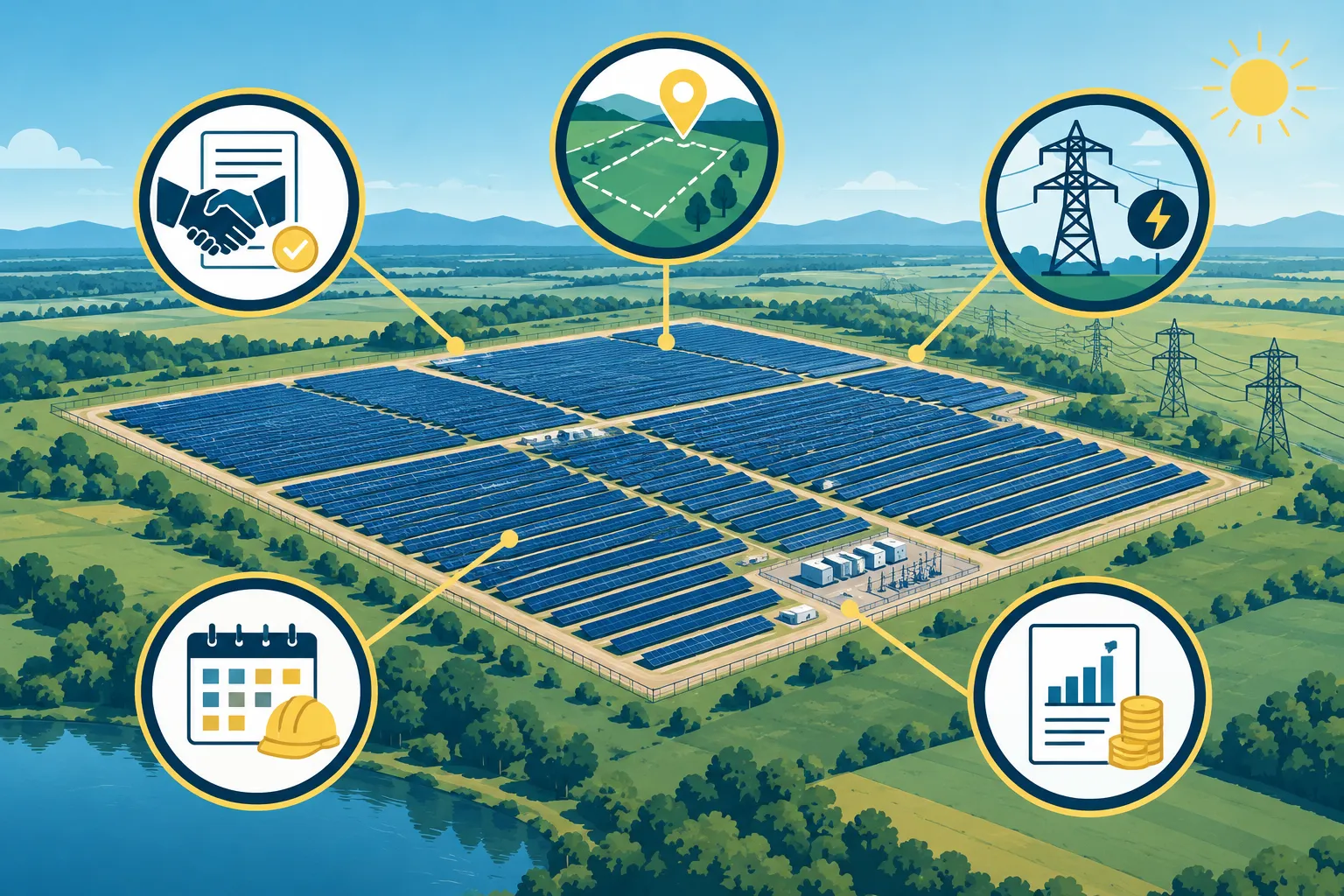
Before circulating a deck, use this screen to find the weakest link. Requirements differ by market, investor and financing structure, so treat the evidence column as a starting point rather than a closing checklist.
Risk area | Question for the sponsor | Evidence to assemble | If the answer is weak |
|---|---|---|---|
Revenue and offtake | Who pays for the power, on what terms and for how long? | Executed PPA or term sheet, tariff assumptions, buyer information, merchant-price case | Model a downside case and identify a credible route to contracting |
Site and permissions | Can the project legally occupy the site and reach construction? | Land rights, permitting register, approval status, outstanding conditions | Resolve title, land-use or critical permit blockers before presenting the project as ready |
Grid access | Can output be connected and delivered on the assumed schedule? | Interconnection application or agreement, studies, cost and schedule assumptions | Rework timing, export assumptions and connection budget |
Energy and design | Is the generation case technically defensible? | Resource assessment, layout, loss assumptions, equipment specifications | Reconcile production assumptions with the site and design |
Counterparties | Can the buyer and delivery parties meet their obligations? | Buyer diligence, EPC and O&M proposals, warranty and security terms | Seek stronger security or revise the proposed risk allocation |
Construction | Are cost, schedule and completion risks controlled? | Cost estimate, construction schedule, contingency, contract strategy | Reprice the project and expose the funding gap under delay |
Financial case | Does the project remain viable under plausible downside scenarios? | Linked model, sources and uses, sensitivities, financing assumptions | Change project scope or capital structure rather than relying on the base case |
Evidence quality | Can someone else trace material claims to current documents? | Dated data room, assumptions log, issue register | Fix missing, expired and conflicting records before outreach |
Separate an executed PPA from a letter of intent, an unsigned term sheet and a merchant-revenue forecast. Record the tenor, delivery obligations, pricing mechanism, curtailment allocation, termination rights and conditions that could delay effectiveness. An appealing headline tariff matters less if the buyer cannot pay or the project cannot deliver at the contracted point.
"Power Purchase Agreements (PPAs) specify the terms under which the off-taker purchases the power produced by the PV plant; this is the most important document to obtain financing." - World Bank Public–Private Partnership Resource Center
If revenue depends on merchant sales, test lower prices and lower output together. Find out whether your intended investor accepts that exposure before settling on a capital structure. Compare solar farm financing options against that risk profile.
Map the footprint against land rights, access and easements, then list the permits needed to build and operate. For each application or approval, record the issuing authority, status, expiry or conditions, and dependent milestones. A site or environmental constraint left unresolved can invalidate the schedule behind your model.
The IEA's Renewables 2023 assessment found that obtaining permits for ground-mounted solar PV projects could take one to five years. That is a planning warning, not a forecast for any particular site.
Give grid access its own schedule and cost case. An application, queue position, study result and signed interconnection agreement offer different degrees of certainty. Identify network upgrades, connection charges, export limits and dependencies outside your control. A later energization date delays revenue and may change when the project can service debt.
Trace forecast generation from resource data through layout, system losses, degradation and availability assumptions to the revenue line. Document each input and show which sensitivities change the financing case. If the project includes storage, account for dispatch, charging costs and constraints shared with the solar plant; those choices affect the economics described in the overview of battery storage projects.
Module and inverter supplier reputation matters, but assess the actual equipment commitments. Connect warranties, performance obligations, replacement arrangements and design compatibility to operating costs and forecast cash flow.
List the parties the project relies on: offtaker, equipment suppliers, engineering, procurement and construction (EPC) contractor, operator, grid utility and key guarantors. For each, ask what happens if the party is late, underperforms or fails. A name on a slide is not the same as an executed contract with a workable remedy.
The construction budget should connect to scope and schedule. Identify who carries cost overruns, interface risks, delay, performance shortfalls and force majeure exposure under the proposed contracts. Set out the contingency and any sponsor funding that would be needed if completion slips. This is an early stress test, not an attempt to pre-empt a lender's contract review.
In the model, reconcile capacity, generation, tariff, operating costs and construction spend with the documents behind them. Run a case in which the connection is delayed, capital expenditure rises and energy output falls. Identify when additional equity would be needed, whether the proposed debt remains serviceable and which assumption drives the largest change. Record any subsidy or incentive as an assumption with an eligibility condition, not unconditional revenue.
For example, a signed PPA does not solve a later-than-expected grid connection date. The sponsor should revise the commercial operation date, reflect any exposure under the PPA and show how carrying costs would be funded. The point is to reveal a decision before outreach, not to produce a lender-approved debt sizing.
Help investors distinguish commitments from intentions. In an evidence register, record each document's owner, date, status, material conditions and the model assumption it supports. Keep versions together. If interconnection correspondence gives a later grid date than the model, flag the conflict and update the case.
Organize the data room by the decisions a capital partner must make, not by whichever team produced the files:
Give each open issue an owner and a target resolution point. Label drafts as drafts. Investors can discuss a project with unfinished agreements if they can see what remains to be decided.
Sort issues by what you need to do next:
Status | Meaning | Next move |
|---|---|---|
Blocking | The project lacks a viable path to site control, permission, connection or revenue | Resolve the issue or revise the project before pitching it as finance-ready |
Conditional | The path exists, but a material agreement, study or cost is still open | Approach investors suited to the development stage and show the milestone plan |
Documented | The key case is supported, with risks and assumptions disclosed | Prepare targeted outreach and anticipate investor-specific diligence |
Match the funding request to the capital partner. Some investors accept development-stage risk; others require contracted cash flow and more advanced permissions. Give each prospect the geography, funding amount, use of proceeds, instrument sought, milestone plan and risks you will retain. A single optimistic model will not answer every mandate. For outreach beyond the project screen, see how to find climate project investors.
Zero Circle gives project owners a way to organize information before they approach capital. Its platform combines project scoring and standardized data with investor matching by mandate, geography and deal size. Human-supervised outreach and capital-structuring support help sponsors focus on partners who fit the project and see where evidence is still missing.
An explainable readiness score is a way to prioritize work and communicate the current case. It is not a financing commitment, a substitute for independent diligence or a guarantee that an investor will accept the project. The sponsor remains responsible for the underlying facts and for resolving the risks the assessment exposes.
Approach finance when you can support the revenue route, right to build, grid path, delivery plan and downside case with evidence. If a critical link is missing, resolve it or present the opportunity as development-stage. Zero Circle can help you organize the case, prioritize the remaining work and reach capital partners whose mandates fit.