

Energy Transition Strategy for Enterprises
Build an energy transition strategy that ranks enterprise projects, balances resilience and emissions, and matches ready assets with the right capital.

– 8 min read
Build an energy transition strategy that ranks enterprise projects, balances resilience and emissions, and matches ready assets with the right capital.

An enterprise energy transition strategy should tell operators and finance teams which assets to change, in what order, who pays, and what must be true before capital is committed. Begin with site-level demand and exposure, weigh cash flow alongside reliability, then move viable projects through investment gates. An emissions target will not tell a plant manager whether to electrify process heat before upgrading the substation, or tell treasury how to fund either project.
Build a decision record for each major site or asset group. Capture hourly or seasonal demand where available, fuel and electricity costs, equipment age, planned maintenance, grid connection limits, critical loads, outage history, and contracts that restrict changes. Keep direct fuel use, purchased energy, and material value-chain emissions separate so a site project receives credit only for reductions it delivers.
Finance, operations, procurement, sustainability, and facilities need to agree on the baseline. Finance needs cash-flow exposure, operators need uptime and shutdown windows, and procurement needs contract renewal dates. Record gaps in the data; a rough estimate should not become a precise return forecast.
A useful first output is a constraint map:
Question |
Evidence to assemble |
Decision it supports |
|---|---|---|
Where is energy consumed? |
Meter data, fuel bills, process loads, peak demand |
Which sites and systems merit detailed engineering |
What can interrupt service? |
Critical-load map, outage logs, backup arrangements |
Where resilience investment has operational value |
What can be changed soon? |
Equipment condition, permits, lease terms, contract expiries |
Which projects fit a near-term capital window |
What blocks a project? |
Interconnection, space, controls, supplier capacity, workforce needs |
Which enabling work must come first |
Simple payback hides the differences between an efficiency retrofit, a long-duration supply contract, and a storage installation. Each exposes the business to different risks and creates different value. Screen them on shared criteria, then build detailed financial models for the shortlist.
Score each candidate on six questions:
Show the dimensions separately so an aggregate score does not conceal a blocker. A solar project with attractive modeled savings and no viable interconnection needs more development before capital approval; a controls upgrade with an approved shutdown window may be ready now. A backup system with modest energy savings may still protect a process whose interruption is expensive. Record the basis for each decision.
Project type |
Typical role in a portfolio |
Main gating question |
|---|---|---|
Efficiency and controls |
Reduce demand before sizing new supply |
Can savings be measured against a credible baseline? |
Renewable electricity procurement |
Change the emissions and price profile of purchased power |
Do contract terms fit the enterprise's load and risk appetite? |
On-site generation and storage |
Add local supply, flexibility, or backup capability |
Are interconnection, dispatch, and critical-load needs clear? |
Process electrification |
Replace fuel use in a core operation |
Can the process, power supply, and site infrastructure support it? |
Grid and site upgrades |
Enable later electrification or generation |
Which downstream projects depend on the upgrade? |
Set the order of investments by dependencies and readiness. Buying a large asset against an outdated demand forecast, or before permits and contracts are in place, can lock the business into the wrong design.
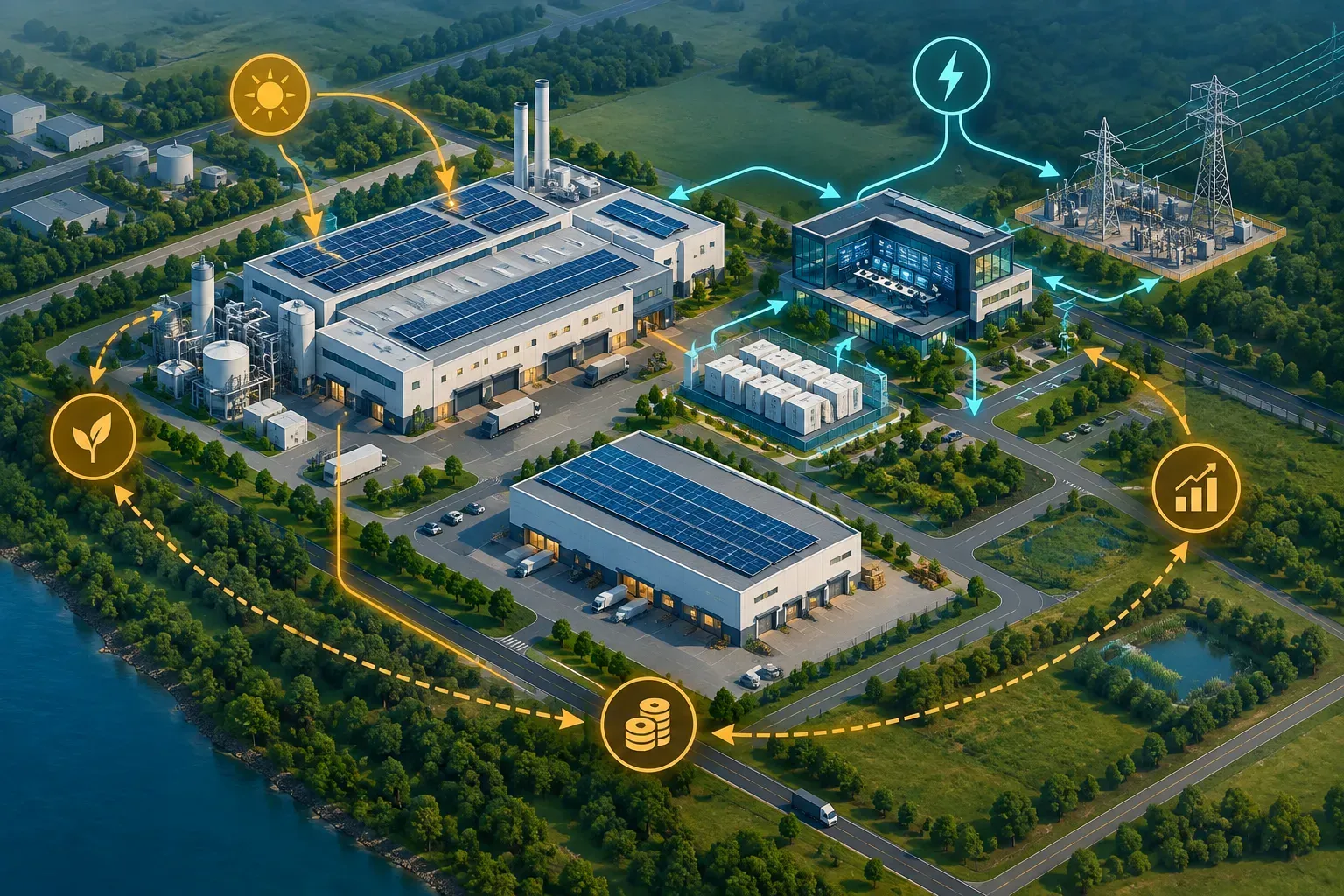
Fund metering and engineering scoping alongside controls, maintenance, or demand reduction with a defensible operational case. Identify procurement renewals and equipment replacements coming due. A planned replacement can be a better opening than a standalone retrofit: the business must make a capital decision anyway.
For each larger project, list the decisions required before notice to proceed: engineering design, connection study, site rights, offtake or supply arrangements, internal approvals, and an operating plan. Assign an owner and expected decision date to each dependency. If electrification raises peak load, model its grid and tariff implications as part of the heat project.
Compare a base case with cases for lower utilization, higher equipment costs, changes in power and fuel prices, and delayed commissioning. Show the effect on cash flow, emissions, and operational continuity separately. The investment committee should be able to see what breaks the case and which risk sits with the enterprise, a supplier, or a capital partner.
After deployment, track measured energy use, availability, costs, and project milestones. Release the next tranche based on those results and the readiness of follow-on sites. Re-rank the portfolio as load, tariffs, regulation, or business plans change.
Suppose a manufacturer is considering tighter process controls, electric heat, and a battery for critical loads. Fund the controls assessment first to establish the remaining heat and peak-power requirement. At the same time, scope the heat conversion and ask the utility about connection capacity. Size the battery for critical loads and outage duration, not the site's annual consumption. Approve heat investment once the equipment design and power supply are credible; advance the battery when its islanding controls, service requirement, and economics are specified. Both projects can use the same site data even if they reach approval on different dates.
Demand reduction can lower required backup capacity; distributed generation paired with suitable controls and storage may help sustain selected loads. Other choices involve a trade-off. A backup generator may improve continuity without reducing emissions. An electricity purchase agreement can reduce contracted emissions exposure but cannot keep a facility running through a local outage.
Define the service requirement first: which loads must remain available, for how long, and after what type of failure? Then test options against that requirement. A megawatt-hour of annual clean generation and a megawatt-hour delivered to a critical load during an outage are not interchangeable. Model the energy and resilience cases separately, and count overlapping benefits only once in the investment case.
For multi-site businesses, concentrate resilience spending where interruption costs and vulnerabilities are greatest. Standardize repeatable procurement and engineering where sites share conditions, but allow different solutions where grid quality, process loads, or physical risks differ. The distinction between grid resilience and reliability matters when defining the service a project must protect.
"The IEA estimated about USD 2.2 trillion in global clean-energy investment in 2025, roughly twice the USD 1.1 trillion expected for oil, natural gas and coal." - International Energy Agency, World Energy Investment 2025
Internal capital suits assets integral to operations, especially when benefits are hard to contract or control matters more than balance-sheet pressure. A commercial procurement structure can suit a business that wants an energy service without owning the asset. Project capital becomes more plausible when the cash flows and repayment contracts are defined, risks can be allocated, and the deal warrants transaction work.
Route |
Best fit |
Trade-off to price explicitly |
|---|---|---|
Corporate capex |
Core process changes and smaller site upgrades |
Competes with other uses of the balance sheet |
Energy service or power purchase agreement |
Contractable supply or performance outcomes |
Term, credit, performance, and exit obligations |
Lease or equipment finance |
Identifiable equipment with predictable use |
Payment obligations persist if operating assumptions change |
Project-level debt or equity |
Separable infrastructure with defined revenue or savings |
Due diligence, documentation, and transaction costs |
Prepare projects for financing before approaching lenders or investors. Give them a consistent package: site and asset description, engineering status, capital budget, schedule, permits and connection status, contract counterparties, cash-flow model, sensitivity cases, and the risk allocation requested. Without a description of grid delay and construction overrun risk, an investor has little basis for pricing either. Teams structuring a standalone asset can use the renewable energy project finance basics as a starting point.
Bring in advisory support when the enterprise has unevenly documented opportunities, needs a capital structure beyond its standard treasury playbook, or lacks a practical way to reach investors whose mandates fit the geography, stage, and deal size. The business should retain ownership of operating assumptions and the final investment decision. For a closer look at available structures, see energy transition financing for corporates.
Give each candidate an operating sponsor and a finance owner; someone must also maintain its project record. Set separate approval thresholds for development spending and final investment. Bring procurement, legal, and risk teams into decisions that affect their contracts and exposures. Review the portfolio as a capital program alongside its emissions results.
Use a compact scorecard at portfolio reviews:
If a metric cannot be measured yet, mark it as forecast. That distinction makes subsequent financing conversations more credible and keeps the team from presenting design estimates as operating results.
Zero Circle is useful when projects have enough substance to assess but still need a route to capital. Its platform brings together standardized project information, fundability scoring, investor matching, underwriting support, and human-reviewed outreach. Enterprises can organize site proposals into a financing pipeline; capital partners can work from comparable project materials. Complex projects may call for capital structuring and advisory support as well as an introduction.
Matching and scoring depend on site engineering, contracted economics, and the enterprise's own risk approval. Establish those inputs first, then use external support to sharpen the financing case and reach suitable capital partners.
Start with site facts and keep resilience and emissions benefits distinct. Clear dependencies and identify who carries downside risk before committing capital. If viable projects are stalled between the investment committee and the capital market, Zero Circle can structure their information and connect them with relevant capital, rather than leaving each site to find funding alone.
Start with the operating baseline. Build a decision record for each major site or asset group with demand data, fuel and electricity costs, equipment age and planned maintenance.
Simple payback hides the differences between an efficiency retrofit, a long-duration supply contract and a storage installation. Each exposes the business to different risks.
Gate 1 approves discovery and low-regret work. Gate 2 clears dependencies such as design, connection studies and site rights before major commitments. Gate 3 commits capital against scenarios, and Gate 4 reallocates as actual results arrive.
No. Some choices serve both, such as demand reduction lowering required backup capacity, but others involve trade-offs. Keep resilience and emissions benefits distinct when evaluating projects.