
Distributed Energy Project Finance: A Practical Guide
Explore distributed energy project finance for solar, storage and microgrids, from revenue contracts and capital stacks to lender diligence.

– 8 min read
Explore distributed energy project finance for solar, storage and microgrids, from revenue contracts and capital stacks to lender diligence.
Distributed energy project finance uses the cash flows of smaller, locally sited assets to pay for construction and operation. For a solar rooftop, battery or microgrid, equipment selection is only part of the work. You need to show who pays, when cash arrives and whether those payments still cover debt if the project underperforms.
A financeable deal connects a credible revenue contract to a buildable asset and a defensible operating forecast. Its capital structure must survive downside cases. For a portfolio, you also need rules for customer concentration, consistent documentation and delayed sites.
Distributed energy resources (DERs) include customer-sited solar, battery storage and controllable generation. A microgrid coordinates equipment and loads within a defined area. With the right design and permissions, it can run independently of the wider grid. An investor-owned project may use a special-purpose vehicle (SPV) to own equipment, hold contracts and collect revenue. Lenders look to its assets and cash flows for repayment, though they may also require sponsor support.
To finance a project, a developer needs site rights, permission to operate, a completed system and a customer who pays for the promised service. A corporate balance-sheet loan relies more on the borrower's overall credit. An asset-backed or project-level facility relies on enforceable project cash flows.
Asset | Common paying party | Underwriting question |
|---|---|---|
On-site solar | Host customer under a power purchase agreement (PPA) or lease | Will contracted output and collections support debt through the contract term? |
Battery storage | Host, utility, aggregator or market counterparty | Which payments are fixed, which depend on dispatch, and who controls the battery? |
Microgrid | Campus, community, utility or other host | What is actually paid for: energy, capacity, availability or resilience? |
Under a PPA, the host buys the system's electricity at agreed prices and delivery terms. Under a lease, the host pays to use the equipment. Bill savings can make either deal attractive to the host; the project company can count only what it can invoice. Its forecast must account for generation, curtailment, degradation, operating costs and payment risk.
Export payments and renewable energy certificates can bring in additional revenue where rules and contracts allow. Specify who owns each benefit before entering it in the model. If the developer sells a certificate, the host cannot claim the environmental attribute covered by that same certificate.
A battery can earn a contracted availability or tolling payment, reduce a host's demand charges under a shared-savings agreement, or participate in grid services through an authorized market route. Merchant revenues depend on actual dispatch and market prices, so a lender may lend less against them than against a firm contract. Charging costs, round-trip losses, degradation and battery replacement belong in the model. For a closer look at operating profiles, see battery storage projects explained.
If two services require the same battery capacity at the same time, the project cannot earn both payments. Set out which obligation takes priority, who controls dispatch and the penalties for missed performance. Keep possible grid-service income out of contracted cash.
A microgrid may sell electricity or availability. Some hosts also pay for service to critical loads. Avoided outage losses matter to the host, yet they become project revenue only when a counterparty agrees to pay for resilience. To substantiate islanding capability, provide engineering evidence, controls, protection design and operating protocols.
For mixed solar, storage and microgrid projects, map each modeled dollar to a contract clause, payer, meter or settlement record, and a date of receipt. That map exposes double counting and timing gaps before financing discussions begin.
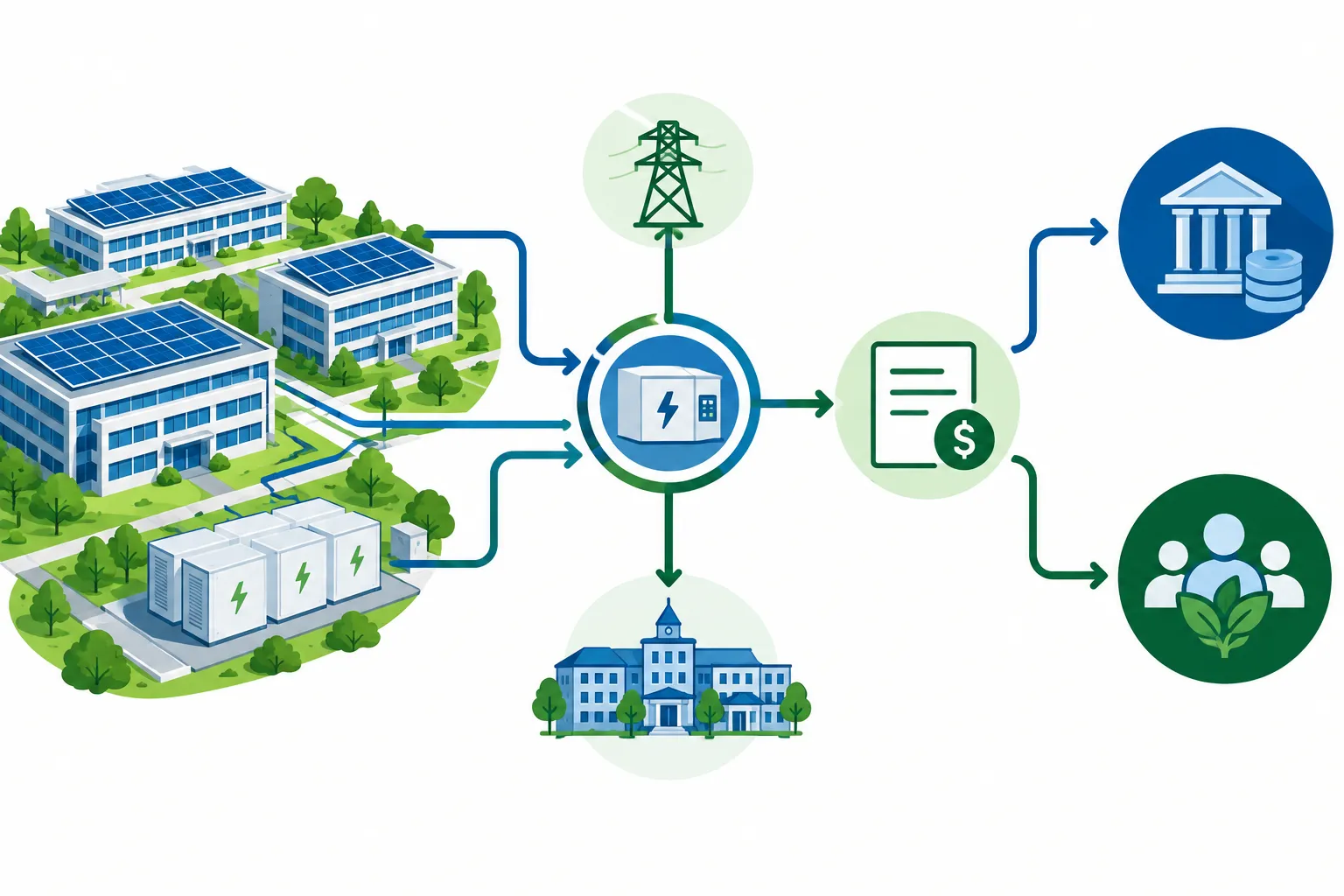
Capital needs change from development through construction to operations. Early equity carries site, permitting and interconnection risk. Construction funding pays contractors before the project earns revenue. At commercial operation date (COD), the project meets its contractual commissioning conditions and enters the agreed operating period. A term loan can then replace or convert construction debt if the project meets the loan conditions.
Stage | Typical funding role | Evidence that unlocks the next stage |
|---|---|---|
Development | Sponsor equity, development capital or a facility against an eligible pipeline | Site control, viable design, interconnection path, permits and an executable revenue contract |
Construction | Sponsor equity plus construction debt; possibly bridge or equipment finance | Final budget, EPC scope, schedule, contractor security and draw conditions |
Operations | Term debt, refinancing or portfolio facility alongside retained equity | COD certification, tested performance, signed service agreements and verified billing |
The capital stack can include senior debt, subordinated debt and sponsor equity. Senior lenders receive cash first and demand stronger coverage. Junior capital takes more risk for a different return. Grants and guarantees can ease financing pressure, but eligibility and payment timing matter as much as the headline amount.
In jurisdictions with clean-energy tax benefits, a sponsor may use tax equity, a credit transfer or another eligible monetization path. These are not interchangeable with cash revenue from a PPA. Their value, timing and eligibility require separate legal and tax analysis, and an uncertain incentive should not be treated as cash at financial close. See tax equity versus debt in energy project finance for the distinction between these instruments.
Ownership determines who raises capital and who receives project income. A host owner may use corporate debt or a lease; a third-party owner may raise SPV-level capital and sell the host a service. Base the choice on contract rights, customer credit, tax position, security and the right to replace a failed asset.
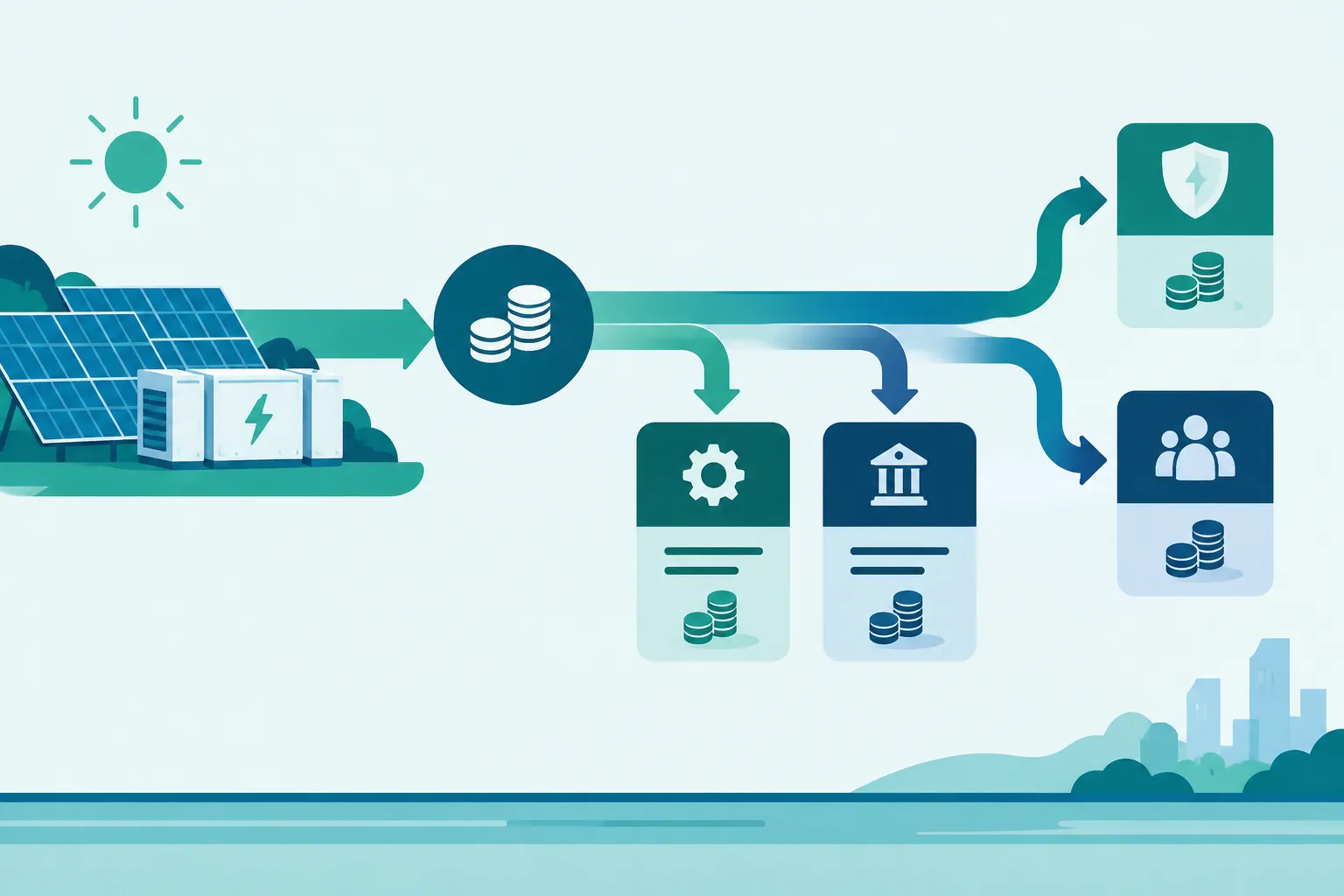
Lenders calculate cash available for debt service (CFADS) from receipts after operating costs, required taxes and other modeled expenses, before principal and interest. Debt service coverage ratio (DSCR) divides CFADS by scheduled debt service. A ratio above 1 means modeled cash covers that period's payment. The required cushion depends on the lender, contract and risk.
Suppose a project collects $180,000 in one period and spends $60,000 on operations and other modeled cash deductions. That leaves $120,000 in CFADS. Against $90,000 in scheduled principal and interest, DSCR is $120,000 ÷ $90,000, or 1.33x. A $30,000 drop in receipts, with other inputs unchanged, takes the ratio to 1.00x. These figures illustrate the arithmetic; they are not a lending threshold or a project quote.
Loan tenor matters too. If a PPA ends before the loan, the lender must account for recontracting or refinancing. Under the agreed waterfall, receipts may flow through a controlled account to operating costs, debt service, reserves and then equity. Lenders may block distributions after a coverage shortfall or contract default.
Stress the model where a distributed asset is vulnerable:
Put the base case next to the downside case. Mark when cash runs short and who supplies the cure, especially if the shortfall arrives before commissioning.
For each material input in the investment memo, a capital partner should be able to find the supporting document. Arrange the data room around the questions they need to answer.
Diligence question | Evidence to provide |
|---|---|
Can the project be built and operated at this site? | Executed site rights, permits, interconnection status, design package and operating restrictions |
Will equipment deliver the forecast service? | Independent production or dispatch assessment, equipment specifications, warranties, commissioning plan and operations contract |
Who pays and on what terms? | Signed PPA, lease, tolling or service agreement; price schedule; billing and termination terms; credit support |
What will it cost, and who bears overruns? | Itemized budget, EPC agreement, milestones, contingencies, performance security and insurance terms |
Can cash repay capital? | Auditable financial model, sources and uses, debt schedule, sensitivity cases, tax assumptions and reserve mechanics |
Who owns the rights and can enforce them? | SPV structure, lien and assignment analysis, land or roof access, step-in provisions and material consents |
Independent engineering helps reconcile modeled yield or dispatch with the physical system. Legal review tests whether the rights in the PPA, site agreement and interconnection documents can survive a customer default or lender enforcement. Investors also need a clear explanation of sponsor experience, construction responsibility and where the sponsor's own capital remains at risk. Developers preparing outreach can use the climate project investor search guide to narrow investor fit.
For a multi-site platform, use consistent asset IDs, document names and input definitions. A lender should be able to trace a portfolio total back to a site's contract, meter assumption and downside case without rebuilding your model.
Small projects often cost too much to finance one by one. Pooling assets can spread fixed diligence costs and reduce dependence on one site. UNDP notes that aggregation can reduce investor transaction costs and unlock finance, but diversification only works if the pool's risks are visible. A single dominant customer, utility territory or interconnection bottleneck can leave a seemingly broad portfolio exposed to one event.
"Small-scale energy assets can be aggregated into portfolios to achieve scale and attract larger investment ticket sizes." - UNDP Climate Aggregation Platform
A portfolio facility needs rules for admitting assets and replacing those that no longer qualify. Lenders can set concentration limits and vary advance rates with revenue quality: a signed, operating PPA supports a different borrowing-base value from an unsigned prospect. Track collections, outages, covenant coverage, COD delays and reserves for each asset and the pool.
Portfolio documents should also address substitution rights, security over contracts and equipment, and who can service the portfolio after a sponsor problem. Standardized contracts and data reduce the cost of underwriting, but they do not erase local permitting or counterparty differences.
Zero Circle helps project owners score readiness against capital-market criteria and find investors whose mandates fit the deal. The platform also supports underwriting, capital structuring and outreach that people review before sending. That can make investor conversations more focused. Developers still need signed contracts and engineering evidence, and lenders make their own decisions.
Start with revenue the project can collect under a contract. Size debt against downside cash flows, then give capital partners a way to trace each assumption to the underlying site. If you have a pipeline to finance, Zero Circle can help standardize that evidence and connect the projects with capital partners whose mandates fit.
Examples include rooftop or community solar, battery storage and controllable generators near the load they serve. A microgrid coordinates resources and loads within a defined electrical boundary; its financeable revenue depends on the contracts for energy, availability or other services.
COD means commercial operation date. It marks the point at which the project satisfies the applicable commissioning and contractual conditions to start its operating period, and often triggers conversion from construction financing to term debt.
The practical stages are development, construction and operations. Development capital funds readiness work, construction capital pays to build and commission the asset, and operating finance is repaid from project cash flow after COD.