
Battery Storage Finance: The Revenue-to-Debt Test
Assess battery finance for utility-scale storage: see how lenders stress contracted and merchant cash flow, dispatch, guarantees and debt coverage.

– 8 min read
Assess battery finance for utility-scale storage: see how lenders stress contracted and merchant cash flow, dispatch, guarantees and debt coverage.
Battery finance for a utility-scale storage project depends on cash left to repay debt after a lender discounts uncertain revenue and accounts for the cost of keeping the battery available. Lenders size the loan against contracted cash flows, a defensible share of merchant earnings, operating costs, and stressed debt-service coverage. A profitable base-case dispatch forecast can support the equity case while still failing the lender's test.
The practical test is to build the revenue stack, translate dispatch into cash available for debt service (CFADS), and then constrain scheduled principal and interest so coverage survives a downside case. The lender's answer may be far smaller than the project's modeled value.
Lenders advance project debt to a project company and expect repayment primarily from the asset's cash flows, with security over its assets and contracts. A battery manufacturer or software company raises equity against a business, while a sponsor may borrow against its broader balance sheet. Construction lenders also face completion and grid-connection risk before operating revenue begins. For the wider capital structure, see how energy project finance works.
For a standalone battery energy storage system (BESS), a lender has no fuel sales or generation output to rely on. The asset earns by making capacity and flexibility available, or by buying electricity at one price and selling at another. Its rights to operate, its contract terms and its dispatch limits determine what part of that earnings forecast can support a loan.
Funding question | Project debt | Technology-company funding |
|---|---|---|
Primary repayment source | Cash generated by a specific battery project | Cash flows or future value of the company |
Core diligence | Revenue contracts, dispatch, grid rights, operating costs, technical performance and downside coverage | Product, customers, intellectual property, company runway and enterprise economics |
Key risk for the financier | The asset cannot produce enough CFADS on payment dates | The business cannot grow or refinance as planned |
Equity investors may accept upside from future price volatility. A senior lender needs a repayment path when that upside disappoints.
A battery can earn from a tolling or availability arrangement, capacity commitments where the local market offers them, energy arbitrage, and ancillary or balancing services. The payment conditions behind each stream determine how much revenue a lender can use.
Revenue source | Underwriting question | Typical treatment in a debt case |
|---|---|---|
Toll or availability payment | Who pays, for how long, and what deductions apply if the battery is unavailable? | Model the enforceable payment net of performance deductions and counterparty risk. |
Capacity payment | What qualification, delivery and penalty conditions attach to it? | Count only eligible and supportable net payments during the relevant term. |
Energy arbitrage | Can the asset capture a spread after charging costs, losses and market fees? | Stress price spreads and dispatch opportunities rather than capitalizing a best-year forecast. |
Ancillary or balancing services | Is the asset qualified, and can prices and volumes persist? | Apply separate scenarios for saturation, eligibility changes and reduced dispatch. |
A contract can support more debt when its payment obligations hold through the loan term. The lender reads the term against the debt tenor, termination rights, credit support, curtailment allocation, settlement mechanics and liquidated damages. Stringent availability conditions can reduce the value of an otherwise fixed payment.
A capacity award needs its own line in the cash-flow model: qualifying capacity, obligation period, payment schedule, testing and nonperformance penalties. An expected future award is a forecast, not a contracted receipt. Where a market lets the battery sell capacity and energy, reserve enough charge and discharge capability to meet the capacity obligation before assigning the remaining hours to arbitrage.
Lenders can count merchant revenue when an independent price and dispatch case supports it under market-specific downside assumptions. They may use a lower merchant contribution than the sponsor's equity case, or require a hedge, floor or partial contract. If a contract expires before the loan matures, the lender must model the resulting merchant tail.
NREL's analysis of observed storage revenue reinforces the need for year-by-year stress cases:
"These year-to-year fluctuations can be substantial for some systems." - NREL, Revenue Analysis for Energy Storage
A battery committed to one service may lack the state of charge, discharge headroom or contractual freedom to perform another at the same hour. Model the dispatch hierarchy and the cost of missed obligations rather than adding each stream's standalone maximum. Capacity-market rules, ancillary-service access and settlement vary by jurisdiction; a UK balancing-market assumption or a US market-design assumption may not apply on another grid.
An optimized revenue schedule becomes less impressive once the model includes physical limits and cash costs. Reconcile those items for each operating period:
The independent engineer and market consultant must work from the same physical limits. If the market model assumes frequent deep cycling that the warranty excludes, the lender cannot rely on the warranty to protect that revenue. Document who controls dispatch, how the optimizer is paid, and who bears losses when its strategy conflicts with a contracted availability obligation.
For technology design and the associated diligence questions, see Battery Storage Projects Explained. For financing, the guarantee's thresholds, remedy, duration and guarantor must match the cash flows pledged to lenders.
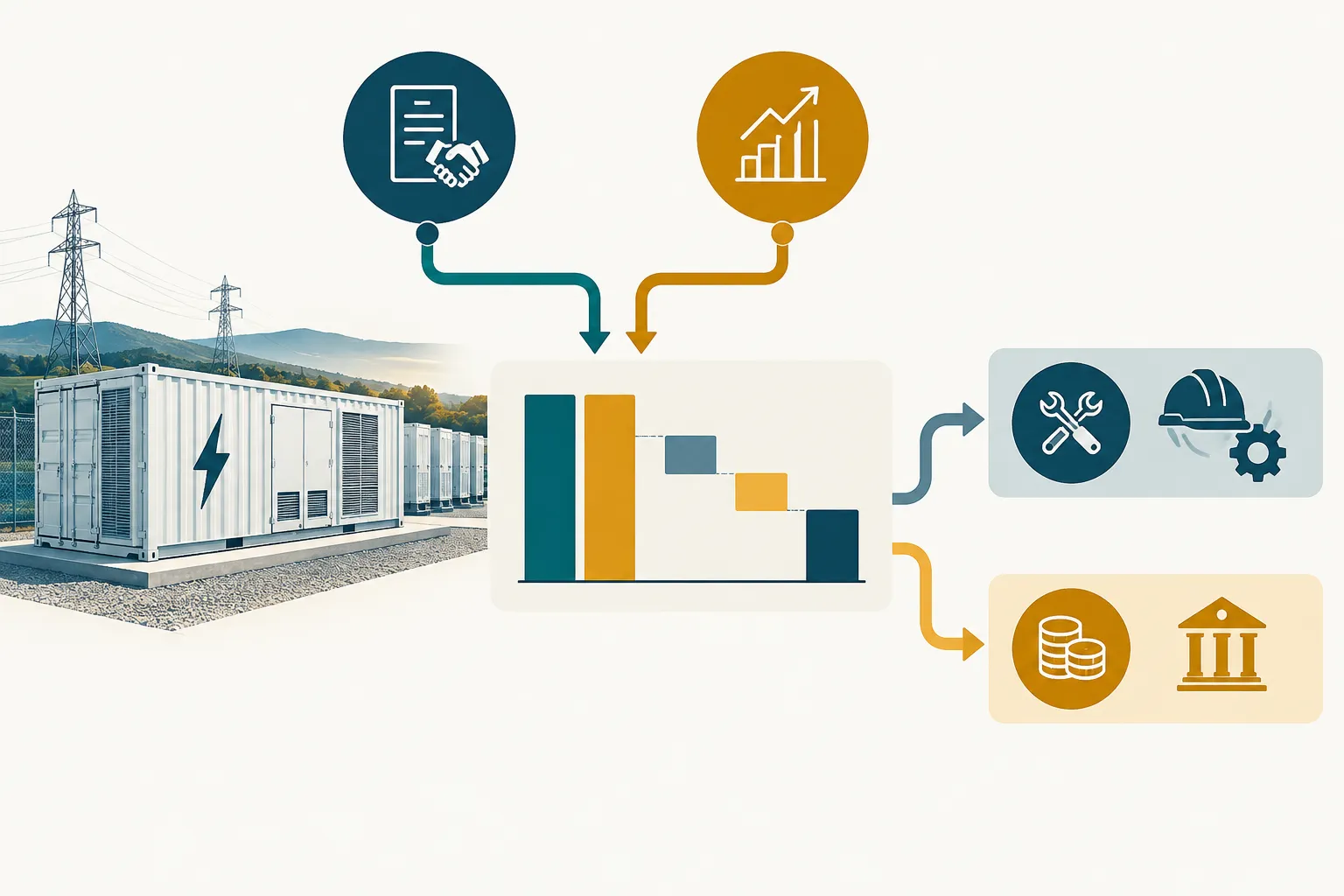
CFADS = cash revenue collected − cash operating costs − taxes − required operating and replacement cash outlays, adjusted to the particular loan agreement's definition. Debt-service coverage ratio (DSCR) = CFADS ÷ scheduled principal and interest. A lender sets its own minimum coverage tests and sizes debt so projected service fits inside them. This is a credit decision, not a universal industry threshold.
Take an illustrative, hypothetical battery project with a contracted payment and merchant dispatch revenue. The following amounts are annual and in millions of currency units; they are teaching assumptions, not market quotes or an actual financing offer.
Annual cash item | Sponsor base case | Lender downside case |
|---|---|---|
Net contracted receipts after modeled deductions | 7.0 | 6.5 |
Merchant and service receipts | 5.0 | 2.5 |
Charging, operating and reserve cash outlays | (4.0) | (4.5) |
CFADS | 8.0 | 4.5 |
Illustrative proposed annual debt service | 4.0 | 4.0 |
DSCR at proposed service | 2.00x | 1.125x |
Suppose this lender requires 1.30x in the modeled downside year. The proposed annual service fails: 4.5 ÷ 4.0 = 1.125x. At that coverage test, downside CFADS permits about 3.46 of annual debt service, since 4.5 ÷ 1.30 ≈ 3.46. The loan principal still depends on interest, amortization, tenor, fees, debt-service reserves, sculpting and any other binding constraints.
If merchant receipts go to zero while the other downside assumptions hold, CFADS becomes 2.0, and annual service at 1.30x falls to about 1.54. The difference shows how much of the proposed service relies on uncontracted cash. A lender need not assume zero merchant earnings, but the sponsor should explain the basis for a less severe case.
The test should be repeated period by period through the loan's life, not just for the first operating year. Model contract expiry, degradation, augmentation, price compression and refinancing or balloon risk. A strong average DSCR cannot repair a covenant breach in a single payment period.
To turn allowable service into an indicative loan amount, set an interest-rate case and repayment schedule, then solve for the opening principal whose principal-plus-interest payments never exceed the allowable service in each period. Run the same schedule against the base case, the downside case and any covenant or reserve test. The lowest binding amount controls, even if a higher leverage percentage looks acceptable on construction cost.
Performance guarantees need a cash-flow fit. A battery supplier might warrant capacity retention or availability, but the lender will compare the test procedure, exclusions, claim timing and remedy cap with the project's actual revenue loss. Equipment replacement after a prolonged outage may not replace the missed toll payments. An operations or optimizer agreement should likewise allocate responsibility for dispatch errors.
Counterparty strength and contract duration affect debt tenor. A signed agreement with a weak payer can require additional credit support. If contracted revenues stop before final maturity, the lender must either accept a merchant tail, accelerate amortization or require another takeout source. The same concern applies to a termination payment that is too small or too uncertain to retire outstanding debt.
Completion and operating permissions are separate gates. Grid rights, permits, land rights, construction contracts, safety arrangements and insurance affect whether the asset can start earning and remain operable. A project with attractive spreads but unresolved interconnection cannot simply borrow against its projected commercial-operation date. Lenders may tie construction draws to milestones and require completion support from parties able to provide it.
Debt documents control the upside too. Distribution locks, reserve accounts, minimum DSCR covenants and restrictions on changing the optimizer or revenue contracts can protect repayment but limit sponsor flexibility. The sponsor should model those restrictions alongside returns to equity rather than treating every projected surplus as distributable cash.
A useful financing package makes the revenue-to-debt bridge auditable. Supply an integrated model with separate sponsor, lender and downside cases, plus the underlying contracts and assumptions:
Present gross contracted and merchant receipts beside their deductions and the resulting CFADS under each case. Then show the debt the weakest relevant period can support. A bank or credit fund can trace each projected payment back to a contract or a dispatch assumption.
Zero Circle helps sponsors organize standardized project data, score fundability against capital-market criteria, identify investors by mandate, geography and deal size, and support underwriting and capital-structuring conversations. Its AI-assisted workflow and human-reviewed outreach can reduce the time spent preparing and routing a financing opportunity. For a broader approach to outreach, see how to find climate project investors. It cannot turn an unbankable revenue assumption into contracted cash or substitute for a lender's independent diligence.
A battery's borrowing capacity follows the CFADS that survives a lender's downside test. Contract quality establishes the floor, physically possible dispatch shapes the merchant case, and performance and operating obligations determine how much cash reaches debt service. Build those links in the model before asking for leverage. Zero Circle can help a sponsor package that case and approach capital partners whose mandates fit the project.
Battery arbitrage means charging when electricity is cheaper and discharging when it is more valuable. For project debt, the relevant figure is the resulting cash after charging costs, efficiency losses, fees and operating constraints, tested under weaker price spreads as well as the base case.