

Climate Adaptation Pipelines That Attract Capital
Build Climate Adaptation Pipelines That Attract Capital with five evidence gates, a sample pipeline, and clear grant versus investment review criteria.

– 7 min read
Build Climate Adaptation Pipelines That Attract Capital with five evidence gates, a sample pipeline, and clear grant versus investment review criteria.

An adaptation idea attracts capital when a sponsor can show the climate risk it reduces, who controls the asset, how a payer benefits, and what remains before funding. Record those answers for each project. A long list of worthy interventions gives investors little to screen.
Infrastructure sponsors need a way to move proposals through evidence and delivery gates while recognizing that some useful projects require public funding. Capital providers can use the same gates to separate transactions ready for diligence from concepts that still need development support.
A climate adaptation pipeline is a managed set of proposed interventions. Each has a named sponsor, a defined exposure, a route to implementation, and a next decision. Some projects have a credible payer; others need grant funding, policy action, or further preparation before investors spend time underwriting them.
"Developing countries will need US$310 billion to US$365 billion annually for climate adaptation by 2035, compared with US$26 billion in international public adaptation finance received in 2023." - UNEP, Adaptation Gap Report 2025
Start with a risk baseline: which asset or community is exposed, to what hazard, for how long, and with what likely disruption? A flood barrier around a facility and an urban tree program both address physical risk, yet they involve different asset rights, beneficiaries, and payment routes. Record those differences rather than grouping both under “resilience.” For grid assets in particular, resilience and reliability answer different planning questions.
Define each project as an intervention at a site instead of an ambition such as “improve coastal resilience.” Record the evidence, the gaps, and the person responsible for closing each gap. Reviewers also need a record of what changed between versions.
At each gate, decide whether to advance, hold, or redesign. Advance with enough evidence to make the next decision. Hold when a missing fact could change the intervention, budget, owner, or financing path. Redesign if the measure does not address the stated risk or the sponsor lacks delivery authority.
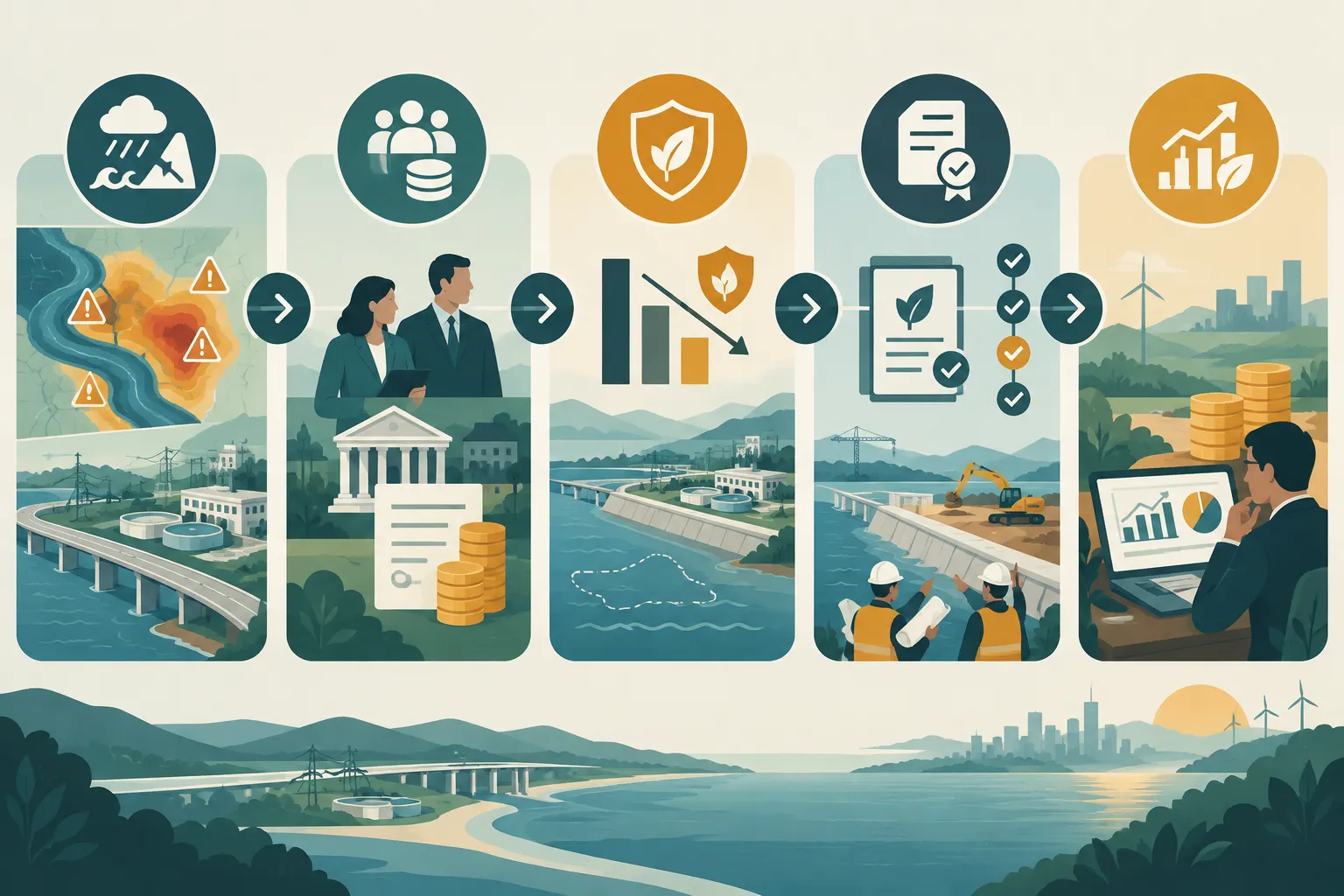
Identify the hazard, the exposed asset or service, who bears the loss, and the proposed measure. Record the baseline condition and the likely outcome without the intervention. Use location-specific hazard information, asset condition data, and operating history where available. Keep avoided-loss estimates separate from revenue.
Advance when: the hazard-to-asset link and the intervention are clear enough to scope a project. Hold when: the exposure is asserted but the site, asset, or expected disruption is undefined.
Name the asset owner, the party controlling the site, and whoever can procure works and sign contracts. They may not be the same entity. A utility may avoid outages while nearby businesses avoid downtime; a municipality may benefit from less disruption. The project entity can collect payment only where there is a way to capture that benefit.
Identify who will pay, under which authority or agreement, and from which budget or cash flow. A grant-funded public asset may have a strong resilience case with no revenue stream to repay a lender. Put that distinction in the project record before diligence begins.
Advance when: there is a credible sponsor with site or asset control and an identified funding or payment path. Hold when: consent, procurement authority, or the payer is unresolved.
Trace each estimate from hazard and disruption through the intervention’s expected performance to the resulting benefit. Keep three categories separate:
Show a range for assumptions that could change the financing decision. Name the baseline owner, the performance measure, and any payer committed to a contract. An avoided-loss model can justify support, but lenders still need a repayment source.
For each benefit estimate, record the exposure period, the loss event or disruption modeled, the probability assumption, and the source of asset data. Measure performance against the baseline in the investment case. If the measure reduces an event’s severity without eliminating it, show the remaining risk to the operator and capital provider.
Advance when: the benefits have a documented method, named beneficiaries, and a clear distinction between monetizable cash flow and social value. Hold when: the same avoided loss is counted as both sponsor savings and project revenue.
Lay out land rights, permits, procurement, engineering design, contractor capacity, environmental or community approvals, and the operating plan. Flag dependencies outside the sponsor’s control, such as a public agency approval or a connection to another asset. Give each near-term decision an owner and date, alongside the construction timetable.
Advance when: a delivery plan shows who secures each right or approval and when costs become firm enough for a financing decision. Hold when: the project assumes access, permission, or an operator that has not been secured.
Prepare an investment record covering use of proceeds, funding need, repayment source, development budget, schedule, major risks, and outstanding evidence. Then screen the opportunity against each capital provider’s mandate, geography, transaction size, risk appetite, and preferred stage. Send early concepts to project preparation or grant review; reserve deeper investment review for transactions with accountable cash flows and delivery rights.
Advance when: a reviewer can identify both the likely capital path and the conditions for a term-sheet discussion. Hold when: the requested financing assumes an unconfirmed payer or an uncosted design.
These hypothetical projects show how a portfolio manager can record progress while assigning each proposal a suitable review route.
Illustrative project | Current evidence | Gate and next move | Likely review route |
|---|---|---|---|
Flood protection at an industrial site | Site operator identified; recurring disruption documented; preliminary barrier concept | Gate 3: model downtime avoided, then determine whether the operator can fund or contract payments | Sponsor-funded or private finance review if a payment commitment and deliverable scope emerge |
Heat protection for a municipal bus depot | Asset and responsible agency identified; cooling intervention scoped; procurement authority unclear | Gate 2: secure agency mandate and identify budget holder | Public budget or grant preparation until the payment route is established |
Watershed restoration protecting several users | Catchment risk mapped; multiple beneficiaries identified; land access and benefit allocation unresolved | Gate 2: establish land rights and a coordinating sponsor before pricing benefits | Grant or project-preparation support while governance and payer arrangements are developed |
The industrial site reaches investment review after the sponsor documents the operator’s cost exposure, the intervention cost, and a payment path. The bus depot can proceed as a public project without becoming a commercial deal. The watershed proposal needs a delivery vehicle before detailed financial modeling. Each has a different next step.
Grant reviewers and investors ask different questions about the same climate benefit. A project may have strong exposure evidence, community benefit, and a capable public sponsor but no mechanism to capture cash flows. It may qualify for grant or concessional project-preparation support while remaining unready for debt. An asset-level project with a creditworthy payer, enforceable contracts, and a workable delivery plan may warrant commercial underwriting.
Question | Grant or preparation review | Investment review |
|---|---|---|
What is being funded? | Risk studies, design, enabling works, or public-benefit delivery | Defined works with a clear financing requirement |
What proves value? | Exposure baseline, public benefit, feasibility, and delivery capacity | The same risk case plus payment evidence and an underwritable cost and schedule |
What is the principal gap? | Capacity, data, permissions, or public funding approval | Repayment, counterparty, construction, and operating risks |
What moves it forward? | Funded studies and a responsible delivery entity | Contracts, cost certainty, permits, and an investment decision |
Some projects use both routes in sequence. Early support pays for studies or enabling work, which may later make a transaction possible. Others should stay publicly funded because their benefits are dispersed and no fair, durable payment mechanism exists. Adaptation and Resilience: A Project Finance Guide covers financing instruments and capital structure. First establish a payer before building a debt request around projected benefits.
A usable pipeline keeps a consistent record for projects under review and on hold. Standard fields let a capital partner compare opportunities while leaving room for different return models:
Link the supporting documents to each claim. A funder should be able to trace a summary figure to its model, contract draft, engineering scope, or approval. If assumptions change, update the record and log the change instead of sending a slide deck with no revision trail.
At portfolio level, sort projects by their next decision as well as estimated climate benefit. Track the date and owner of the next deliverable, the evidence needed to pass the gate, and the reason for any hold. An investment reviewer can then request a focused diligence package without asking the sponsor to reconstruct the project history. Where small interventions share an owner and procurement route, consider packaging them together while keeping separate risk and cost records for each site.
Zero Circle uses standardized project data, scoring, investor matching, and underwriting support to help sponsors bring prepared opportunities to relevant capital partners. Scores can expose missing evidence, but sponsors still need site rights, a payer, and investor diligence. Once the record supports a decision, human-reviewed outreach can target investors by mandate; see the practical steps for finding climate project investors.
Assign an owner to each gate and log decisions with dates. Give each project a status of identify, prepare, review, or hold. As design and costs develop, revisit the climate baseline. If the intervention changes, test it against the original exposure before updating the return case.
Adaptation pipelines attract capital when sponsors document risks, rights, payments, and delivery dependencies. Send financeable deals into investment review; route valuable work without a repayment source to public or grant capital, and fund the preparation needed to move projects between those states. Zero Circle can help structure the project information and connect prepared opportunities with capital partners whose mandates fit.