

Resilience vs Adaptation: How to Finance Both Goals
Compare resilience vs adaptation, measure climate project outcomes, and build a financing plan that links benefits to credible repayment.

– 19 min read
Compare resilience vs adaptation, measure climate project outcomes, and build a financing plan that links benefits to credible repayment.

For a project owner, resilience vs adaptation comes down to a distinction between action and performance. Climate adaptation refers to changes that reduce vulnerability to actual or expected climate change impacts. Climate resilience is the capacity of an asset, service or community to anticipate, withstand, recover from and adjust to disruption. Flood-proofing a substation is an adaptation measure; fewer service interruptions and faster restoration are resilience outcomes. To finance both, show the risk you address, who benefits, how you will measure the result and what will repay the capital.
An investor needs more than the promise of a resilient asset. Bring a hazard baseline, the proposed intervention, evidence of expected performance, a costed capital plan and a credible source of cash flow or committed support. Account for the infrastructure your energy asset depends on, too.
Adaptation is what changes in response to climate risk. Resilience is the capacity the system retains or gains when conditions change or a shock hits. The Grantham Research Institute's distinction between adaptation and resilience helps clarify the limit of “bouncing back”: recovery alone does not resolve future exposure. A climate-specific safeguard may leave a service exposed if a connected asset fails. Backup capacity may keep that service running during several kinds of disruption, yet leave it exposed to rising heat or flood levels over time.
| Lens | Climate adaptation | Climate resilience |
|---|---|---|
| Core question | What do we change to manage current or expected climate impacts? | Can the system continue, recover and adjust when stressed? |
| Unit of analysis | An action or adjustment, such as relocating equipment or changing design criteria | The performance of a connected asset, service, network or community |
| Project goal | Reduce exposure, sensitivity or vulnerability to a specified hazard | Preserve critical functions, limit losses and restore service |
| Typical evidence | Hazard assessment, design drawings, exposure map, implementation record | Service availability, outage duration, recovery time, avoided damage and stress-test results |
| Main blind spot | A protective measure can shift risk elsewhere or fail under a different hazard | A broad resilience claim can hide which action or climate risk it addresses |
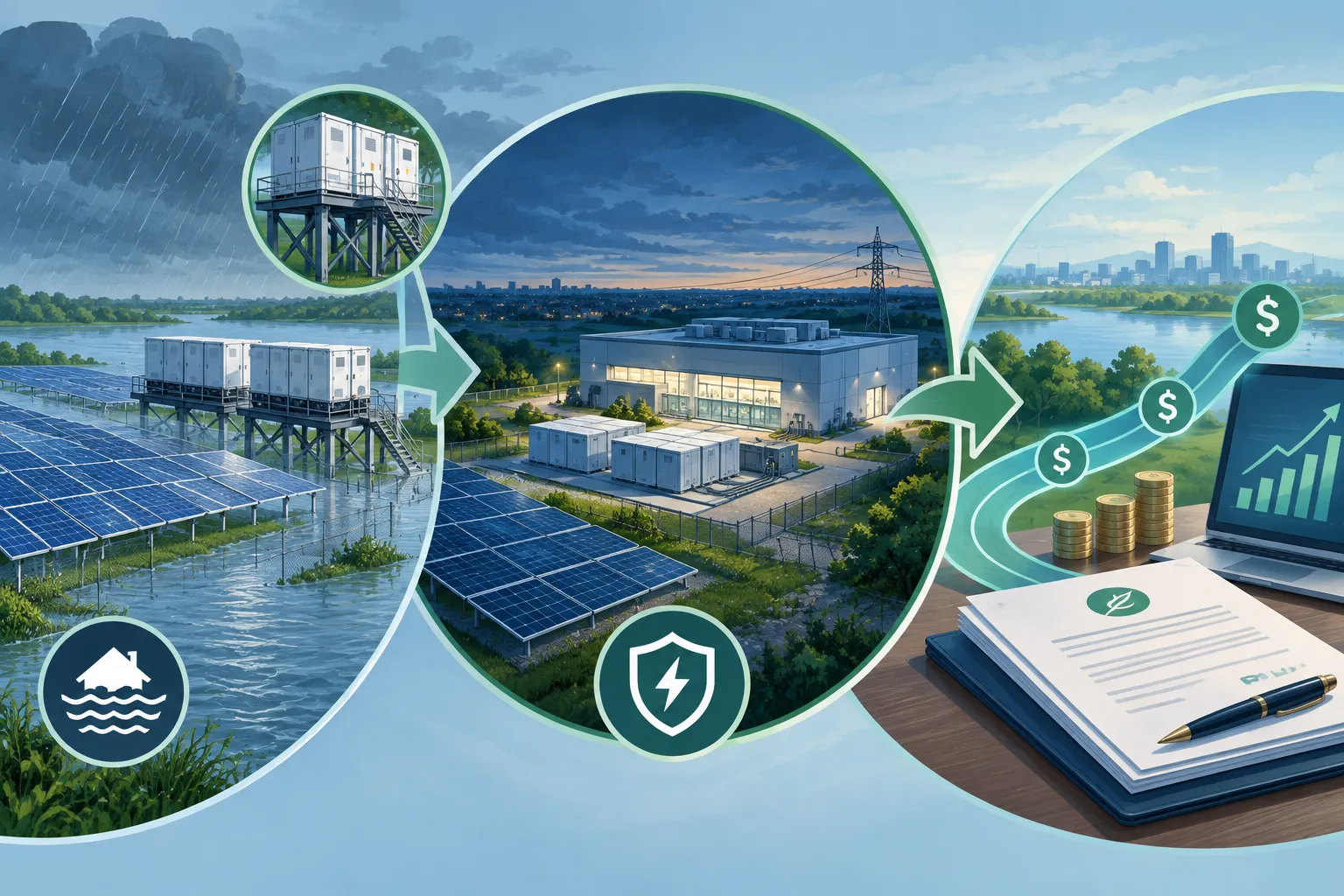
At a flood-exposed solar-and-storage site, raising inverters above the design flood level is adaptation. To keep power flowing during and after a flood, the operator also needs access roads, interconnection, communications, spare parts, operating procedures and a functioning grid. Resilience describes the performance of that connected system.
The distinction matters because an investor can pay for an adaptation measure without receiving a resilience outcome. Equipment may meet its design specification while the service fails through an unprotected dependency. Conversely, backup capacity may improve short-term continuity but become inadequate as the hazard changes. Ask whether you are financing a physical adjustment, an ongoing service standard or both. Then specify the evidence that would show the investment worked.
For developers, that means three connected reviews. A technical review tests whether the measure is feasible. A service review tests whether the asset and its external connections will deliver under a defined disruption. A financing review tests who benefits, who pays and when cash becomes available. A credible investment case answers all three rather than treating the word “resilient” as proof.
Mitigation reduces greenhouse gas emissions or increases their removal. Adaptation manages climate impacts; resilience describes capacity under stress. One energy project may contribute to all three. Show evidence for each claim separately: lower-emissions generation alone cannot guarantee emergency power, so a continuity claim needs an appropriate technical configuration and operating plan.
Building resilience means linking a specific adjustment to a measurable system outcome. Flood storage may reduce water exposure for an energy facility and help surrounding infrastructure function during extreme weather events. But a barrier that protects one site while redirecting floodwater onto its neighbors can increase flood risks elsewhere. Define the boundary of the system, identify affected parties and record any risk transfer before assigning benefits.
If the old design cannot handle the future climate, rebuilding it unchanged may restore service briefly and leave the same vulnerability in place. Plan for immediate coping and operational changes, with a system redesign where those measures fall short.
The asset boundary covers what the sponsor owns or controls. The service boundary includes the connections required to deliver the promised result, including infrastructure operated by utilities, transport providers, telecom companies or customers. A battery enclosure can sit above projected flood levels and still fail to supply a clinic if switchgear, controls or the customer connection becomes unavailable.
Draw both boundaries before pricing the project. Identify which dependencies are secured by design, which are addressed by contract and which remain unresolved. Assign a responsible party to each one. This makes it easier to distinguish a fundable upgrade from an attractive claim that depends on another organization's uncommitted investment.
Review effects beyond the project fence as well. A barrier may protect one site but redirect water toward its neighbors. A backup generator may keep operations running but introduce fuel-delivery and emissions concerns. State who gains, who remains exposed and whether the intervention shifts risk. Public funders and private investors alike need to understand these trade-offs before assigning climate benefits.
Start with the service at risk. “Protect the battery” gives a designer a task; “maintain critical load when a flood disables grid supply” gives an operator a testable goal and helps identify who might pay for that service.
Trace each claimed benefit through the project:
For a grid-connected project, test dependencies outside the project fence. A hardened generation unit offers little continuity value to an isolated customer if the distribution line delivering its power fails. Define whether the project includes islanding capability, an alternate feeder or only faster restoration of the generation asset. For the operational distinction, see grid resilience vs reliability.
“Flood risk” is not a complete design brief. Identify how water reaches the asset, how long it might remain and which components or access routes it affects. Record the scenario assumptions, their data sources and the date of the assessment. A river flood cutting off repairs creates a different financing exposure from surface water damaging inverters.
Use a planning horizon that reflects the asset's expected operating life, not only its initial loan term. If future hazards could exceed today's design, assess whether protection can be expanded, what would trigger an upgrade and who would pay for it. Compare more than one plausible scenario where projections are uncertain. Do not present a modeled scenario as a guaranteed future event.
Keep the baseline and proposed design on the same assumptions. A severe-flood baseline paired with a mild-flood project case would overstate the benefit. Compare like with like first, then test what happens when the hazard exceeds the design conditions. Make the limits visible: protection can reduce risk without eliminating it.
Compare a clearly defined without-project case with a with-project case under the same hazard assumptions. Record the location, assessment period, climate scenario, critical services and infrastructure dependencies. Explain gaps and uncertainty in the data. Use actual records where you have them and engineering models or scenarios for conditions you have not observed; modeled savings are not guaranteed revenue.
| Outcome to establish | Practical indicator | Evidence to prepare |
|---|---|---|
| Reduced exposure | Equipment or service points outside the modeled hazard footprint | Site survey, hazard map and design specification |
| Reduced damage | Expected repair costs under defined event scenarios | Asset inventory, engineering assessment and cost assumptions |
| Service continuity | Critical load served, availability or interruption frequency | Load profile, electrical design and operating protocol |
| Faster recovery | Time to restore an agreed service level | Restoration plan, access arrangements and maintenance contracts |
| Adaptive capacity | Ability to modify operations or expand protection as risks change | Monitoring plan, trigger thresholds and budget for future changes |
Keep outputs (raised equipment, installed drainage, commissioned storage) separate from outcomes (less damage, fewer interruptions, reduced recovery time). Use the same indicators at design, financial close and operation where feasible, so investors can see whether the promised service materializes. For community benefits, identify both the people who receive the service and those who remain exposed.
For every measure, record the data source, collection interval, responsible party and acceptable evidence. Sensors can document water levels, control logs can show power delivered to a critical load, and maintenance records can capture repairs and restoration time. If a customer owns the service data, address access and confidentiality before financing rather than assuming the sponsor will obtain it later.
Separate modeled results from observed performance. At financial close, an engineering model may be the best available evidence. During operation, inspections, drills and actual events can test the assumptions. An absence of major floods is not proof that the asset would perform during one. Equally, a successful drill may not reproduce prolonged grid failure or blocked access roads.
Define failure in terms that matter to the beneficiary. An outage lasting minutes may be critical for a healthcare customer even when annual availability remains high. For another project, the decisive indicator may be recovery time or replacement cost. Choose measures that match the contracted service and disclose what each one cannot show.
A credible target names an event and sets a performance threshold. Specify the critical load you intend to serve and for how long under an agreed outage scenario. Set the values from technical analysis and customer requirements for that asset. Account for flooding that prevents staff or fuel from reaching the site. If the model cannot meet the threshold, revise the design or narrow the claim.
Once the service target is set, compare solutions on more than upfront cost. Elevating equipment may reduce direct damage, while storage and controls may preserve power delivery; neither necessarily fixes an inaccessible road. Evaluate each option against the same hazard, service target, operating life and boundary conditions. Show the added construction cost, expected maintenance burden, residual failure paths and consequences for the capital plan.
Consider whether a lower-cost operational adjustment can address part of the risk before committing to a large physical upgrade. Spare-parts agreements, tested restart procedures and coordinated utility restoration may shorten downtime. They cannot substitute for flood protection where equipment would be destroyed, but they may complement it. Investors can then see why each component is included and whether removing one changes the claimed outcome.
Avoid optimizing only for the modeled event. A solution that performs well under one flood scenario but creates a single point of failure under heat or communications loss may not support a broad resilience claim. If the design addresses one named hazard, say so. If the business case depends on performance across several disruptions, test the system against each relevant failure pathway rather than assuming the benefits transfer automatically.
A monitoring plan should lead to action, not just reporting. Set triggers for revisiting the design or operating procedures, such as updated hazard maps, repeated near misses, changing critical loads or equipment running outside expected conditions. State who reviews the trigger, who approves the response and which reserve or new funding source could pay for it.
This makes adaptation an ongoing management process rather than a one-time construction line item. An initial drainage upgrade might later need to be supplemented by additional storage, changed operating protocols or better site access. Distinguish optional improvements from changes required to preserve a contracted service. Otherwise, a seemingly financed resilience promise can turn into an unfunded obligation.
An outcome may be valuable without generating repayments. Before approaching capital partners, identify the contract, tariff, budget, insurance arrangement or creditworthy buyer that captures its value. Sort benefits into three buckets:
| Benefit bucket | Example | Finance implication |
|---|---|---|
| Project cash flow | Contracted energy sales or a paid availability obligation | Can support repayment if the agreement and counterparty are bankable |
| Avoided project cost | Lower expected repair expenditure or reduced interruption losses | May improve downside analysis, but is not automatically cash available for debt service |
| Wider public or network benefit | Continued access to a critical service, reduced disruption beyond the project site | May need a public budget, grant, procurement contract or another payer to be monetized |
Give investors two linked views. The investment case covers the construction budget, operating costs, contracted revenue, counterparties, risks and downside sensitivities. The impact case records the hazard baseline, comparison scenario, beneficiary, performance indicator and reporting responsibility. Each resilience benefit should lead back to a design feature; each repayment assumption should lead to a payment mechanism.
Treat avoided-loss estimates as a reason to invest in protection or a way to analyze downside exposure, rather than as an invoice. Document event assumptions, probability treatment, asset values, downtime costs and who bears the loss. Run sensitivity cases for a more severe hazard, a less frequent event and weaker-than-planned protection. If the financial model counts both avoided loss and an insurance payout for the same damage, explain how the accounting avoids double counting.
Make a benefits register with five fields: outcome, beneficiary, measurement method, payment or cost line, and performance-risk owner. Reduced repairs might lower the sponsor's expenses; fewer outages might save the customer's operating costs; emergency power might earn a service payment if a buyer contracts for it. Wider economic continuity may matter greatly without appearing in the project's accounts.
Mark an uncontracted benefit as unmonetized, not projected revenue. This helps direct the case to the appropriate capital source. Commercial lenders need assessable repayment; customers can buy defined services; public or catalytic capital may support measurable benefits that lack a private payer. A project can combine all three, provided each source is tied to a real use and an identified obligation.
Timing matters as well. Avoiding a rare repair bill is not the same as receiving regular cash to pay debt. A project can improve its expected lifetime economics and still face a liquidity shortfall in a weak year. Model reserves, payment delays and covenant exposure alongside long-term benefits. Check the terms and timing of insurance claims or public reimbursements before relying on them.
A high-impact project is not automatically creditworthy; a profitable asset is not automatically resilient. Credit diligence tests construction, operations, counterparty quality and repayment capacity. Climate diligence tests hazard exposure, effectiveness, residual vulnerability and the distribution of benefits. Combining these views strengthens underwriting, but collapsing them into a single claim can hide the obstacle to financing.
For example, a facility may withstand its design flood but depend on a buyer that cannot commit to a long-term service contract. Another may have a solid customer agreement but an unvalidated islanding design. The first needs a stronger payment mechanism; the second needs technical validation. Identify the binding constraint before seeking capital to solve it.
The beneficiary and buyer are not always the same party. A hospital may rely on emergency power while a utility controls the connection; local businesses may benefit from faster restoration while the sponsor sells electricity to a single offtaker. Identify who has procurement authority, who can sign a multi-year agreement and whose budget can support payments through the financing term.
Ask whether the proposed service can be defined and verified without exposing the sponsor to unlimited obligations. “Keep the community powered” is too broad if the project serves only one feeder or a defined set of loads. A narrower obligation, such as making agreed capacity available to specified facilities under stated conditions, gives counterparties something they can price and monitor. The contract should state how performance is measured, which events qualify and what happens when an external dependency fails.
Where no one buyer captures the full value, separate the components rather than expecting a single contract to solve everything. The sponsor may finance generation through energy sales, obtain a paid service arrangement for defined backup capacity and seek public support for broader access benefits. This approach does not guarantee funding, but it prevents a valuable outcome from being mistaken for a bankable receivable.
Adaptation and resilience do not each require a separate financial product. Choose capital by mapping construction risk, available revenue and the distribution of benefits.
The scale of unmet adaptation funding makes the distinction between useful benefits and repayable cash flows consequential. UNEP estimates the annual gap for developing countries as follows:
"the adaptation finance gap, which is estimated at US$187-359 billion per year." - UN Environment Programme, Adaptation Gap Report 2024
| Project situation | Possible capital approach | What the sponsor needs to show |
|---|---|---|
| Revenue-generating infrastructure with a resilience upgrade | Project equity and debt supported by contracted cash flows | Revenue agreement, cost of upgrade, engineering case and downside impact |
| Essential service with an identifiable public or utility payer | Procurement or availability-based payment alongside private capital | Payment obligation, service standard, performance verification and counterparty strength |
| High public benefit but little direct revenue | Grant, concessional capital or public capital blended with repayable finance | Additionality, beneficiaries, measurable outcomes and a realistic remaining funding gap |
| Unproven design or difficult-to-price hazard | Development funding or risk-sharing before long-term capital | Feasibility work, risk allocation, technical validation and a path to bankability |
These structures do not guarantee eligibility. An asset may need sponsor equity to absorb first-loss construction risk, a grant for uncompensated community benefits and senior debt against contracted service revenue. Keep unpaid social value out of the debt-sizing calculation. For funding structures, see ways to fund climate adaptation and renewable energy project finance basics.
Not every funding need belongs in a single round. Development capital can cover hazard studies, site surveys, design alternatives and customer negotiations. Construction funding can follow when the design, permits, contracts and risk allocation are credible. Longer-term financing or refinancing may become more accessible once the asset operates and its performance can be assessed.
The sequence matters when resilience depends on another institution. A utility feeder upgrade or a municipality's service commitment may need to be a condition before full construction funding. Otherwise, investors may be asked to absorb a risk the sponsor cannot control. Show which milestone unlocks which funding source, what evidence will confirm completion and who owns the task.
Grants and concessional finance can address a real mismatch between public value and project revenue. They may support feasibility work, absorb difficult-to-price early risk or pay for uncompensated community benefits. Specify what the support enables and whether it is committed. A grant that closes an upfront gap will not fix a recurring operating deficit unless a lasting payment plan also exists.
Ask who controls the risk being financed. A project company can upgrade its equipment; it cannot promise an external road or feeder will remain open without an agreement with the responsible party. Assign design and construction risks to those who can manage them, and payment obligations to those authorized to pay. If public emergency use is central to the case, secure a written service arrangement rather than assuming a public body will value it later.
For capital partners, show the base case and the stress case side by side: cash available for debt service, repair and replacement costs, outage effects, insurance assumptions and reserve needs. For impact-focused funding, show how the resilience indicator will be verified without treating that indicator as revenue unless the contract explicitly pays for it.
Turn the scenario analysis into a responsibility matrix. Who pays if relocation raises construction costs? Who inspects drainage, tests backup controls or replaces a degraded battery? Who responds if the customer changes its critical-load requirement? Contract terms and reserves should reflect those answers rather than relying on a general promise to deliver resilience.
Performance-based payments require a measurable service, a testing process and clear treatment of events outside the sponsor's control. If the project depends on a separately owned feeder, coordinate an upgrade or contract for a narrower obligation the sponsor can deliver. Insurance can aid recovery, but deductibles, exclusions and payment delays mean it cannot replace sound design or adequate liquidity.
An adaptation upgrade can reduce expected losses while raising construction cost and annual maintenance. Show the financed case both with and without the upgrade under the same revenue assumptions. Then stress the financing for delayed commissioning, lower output, larger repair expenses and a missed service payment. Investors need to know whether the resilience investment protects cash flow or whether its debt burden creates a different vulnerability.
Separate costs by timing. Some are paid before operation, such as engineering, land preparation and equipment. Others recur, including inspections, controls maintenance, insurance and periodic component replacement. Map each cost to a funding source and budget period. A grant that pays for installation will not cover ongoing tests unless the sponsor or customer accepts that obligation.
Look at the capital stack from each participant's perspective. Senior lenders focus on predictable debt service and downside protection. Equity investors consider construction risk and upside after debt obligations. Concessional or public funders may prioritize additionality and benefits that commercial revenues cannot capture. A credible structure explains why each participant is needed, what risk each bears and what must happen before their capital is released.
Investors comparing projects need a consistent set of fields: location, hazard, baseline, intervention cost, residual risk, service standard, test method, beneficiary, payer and cash-flow sensitivity. That does not remove the need for site-specific engineering. It reveals which assumptions are comparable and where specialist diligence is essential.
For sponsors, standardized information also improves early investor matching. A provider whose mandate excludes development risk should know the project's stage immediately. A public-capital partner should be able to see which benefits have no commercial payer. Clear data can narrow conversations by geography, deal size, stage and mandate before either side invests in full underwriting.
Imagine a sponsor developing solar and storage for a critical facility in a flood-prone area. The design includes elevated electrical equipment and drainage changes. The sponsor also proposes an operating configuration intended to supply an agreed critical load when the grid is unavailable. This is an illustrative structure, not a forecast.
| Claim | Intervention or test | Evidence and finance treatment |
|---|---|---|
| Adaptation | Move vulnerable equipment above modeled flood levels and design drainage | Show site hazard assessment, drawings, added cost and residual exposure |
| Resilience | Keep the defined critical service powered during an agreed outage scenario | Show load profile, storage dispatch model, islanding design if applicable, test plan and service contract |
| Mitigation | Generate lower-emissions power when operating | Calculate generation and emissions impact separately from continuity benefits |
Separate energy sales from any contracted continuity payment in the financing file. If no customer pays for continuity, the sponsor can explain the reduction in its own risk or seek a grant for public value. It cannot add a resilience revenue line without a payer. The technical case needs to cover site access, grid interfaces, maintenance, battery performance and post-event recovery. Compare actual service and repair records with the baseline during operation.
The feeder may change the investment plan. If someone else owns it, uninterrupted power requires a coordinated network investment, a technically viable on-site supply arrangement or a narrower service promise. Scope the funding request to what the asset can deliver.
Begin with the facility's ordinary energy agreement, if one exists. That may finance solar generation independently of any continuity claim. Isolate the added cost of elevation, drainage, storage, controls and switching required to serve critical load. Which items protect the sponsor's revenue, which deliver a paid service to the facility and which create wider public value?
If the facility signs an enforceable continuity agreement, show the payment schedule and technical conditions for earning it. A lender can examine that income alongside energy sales, subject to counterparty and performance risk. Without an agreement, treat continuity as a commercial opportunity rather than contracted revenue. The sponsor could seek a public procurement route, negotiate with the beneficiary or reduce the funded scope.
Test the full delivery chain against a defined flood and grid outage. Can storage supply the agreed load for the promised period? Will switchgear and controls remain usable? Can the system isolate safely if required? Can operators reach and restart it? Distinguish what engineering demonstrates from what commissioning and operating tests must confirm.
Finally, prepare separate downside cases for construction overruns, flooding beyond design conditions and a delayed feeder restoration or customer payment. State who bears each loss and how the cash-flow model responds. This is more useful to an investor than an unsupported assertion that the site is climate-proof.
Suppose the critical facility wants backup service but cannot sign a long-term payment agreement. The technical design may remain attractive, yet the financing case changes. The sponsor can still assess whether flood protection preserves its own electricity revenues and reduces repair exposure. It should not assume that the additional storage and islanding costs will be recovered from a service fee that does not exist.
The next step is to identify a party with both an interest in continuity and authority to procure it. That could involve a different customer arrangement or an eligible public process, depending on the project and jurisdiction. Until such an arrangement is real, the sponsor could finance only the commercially supported scope, use development funding to pursue the service agreement or seek nonrepayable support for the uncompensated benefit.
If the service contract arrives later, revisit the engineering assumptions before expanding the financing request. Customer load, outage duration and testing obligations may differ from the initial concept. Update costs, risk allocation and repayment sensitivities together. Contracting a benefit is not merely adding a revenue line; it creates a performance obligation that the asset must be able to meet.
Use a compact, reviewable package before sending a broad financing request:
Add an assumptions register alongside these materials. For each material climate input, engineering dependency, contract or third-party action, record its source, owner, validation step and potential financing impact. This allows a reviewer to distinguish an outstanding document from a design issue that could change the deal.
At first contact, lead with the investable proposition: asset, stage, capital sought, payment sources and the evidence supporting the climate claim. Avoid opening with a large avoided-loss figure if nobody has agreed to pay for that benefit. Share enough information to establish mandate fit, then provide detailed engineering and financial materials during controlled diligence.
During diligence, answer three questions directly. What is being built? Name the adaptation measures and operating capabilities. What will improve? Present the baseline, service threshold and verification plan. Who pays? Separate signed contracts and committed budgets from possible future support. If an answer remains open, give the milestone and funding needed to resolve it.
Before closing, ensure financing documents reflect the claimed outcome. Where continuity drives the investment case, address performance tests, data access, maintenance and remedies. Where public benefit supports a grant, establish a reporting method that shows delivery. The goal is not to eliminate every climate uncertainty but to make material risks reviewable and assign decisions to those able to act.
Approach investors whose mandate fits the geography, deal size, risk profile and stage. A climate claim alone is not a substitute for project readiness. Standardized data lets capital partners compare a flood-protected energy asset with other opportunities without guessing what “resilient” means in each deck. The next step is finding climate project investors whose mandate matches the case.
Zero Circle helps project owners turn that package into an investor-ready process: its platform combines project scoring, standardized project information, investor matching, underwriting support and human-reviewed outreach, with capital structuring guidance for complex energy and climate projects. For investors, the same discipline makes pre-qualified deal flow easier to assess. Keep the climate-benefit evidence visible alongside the financial model so neither an AI score nor a compelling narrative replaces diligence.
In resilience vs adaptation, adaptation is the change you make; resilience is the capacity you can demonstrate afterward. Finance the two together by linking climate hazards to design choices, design choices to service outcomes, and service outcomes to contracts or other credible sources of capital. A resilience benefit without a payer can still justify public or concessional support, but it cannot quietly become debt-service revenue.
If your energy or climate project has a strong technical case and a complicated capital path, bring its risk baseline, performance measures and financing assumptions to Zero Circle. Its scoring, matching and structuring workflows can help put the right evidence in front of relevant capital partners.