

Energy Storage Projects Explained
Get clarity on energy storage projects: compare project types, revenue models, grid uses, and the evidence investors need before funding.

– 8 min read
Get clarity on energy storage projects: compare project types, revenue models, grid uses, and the evidence investors need before funding.

Energy storage projects are worth developing when a grid or site need can produce durable, measurable cash flow. A battery's technical specifications tell you only part of the story. Dispatch rights, interconnection, operating limits, and revenue contracts determine whether anyone can finance it. Developers, investors, and enterprise energy teams need to know what the project can deliver, to whom, and under what terms.
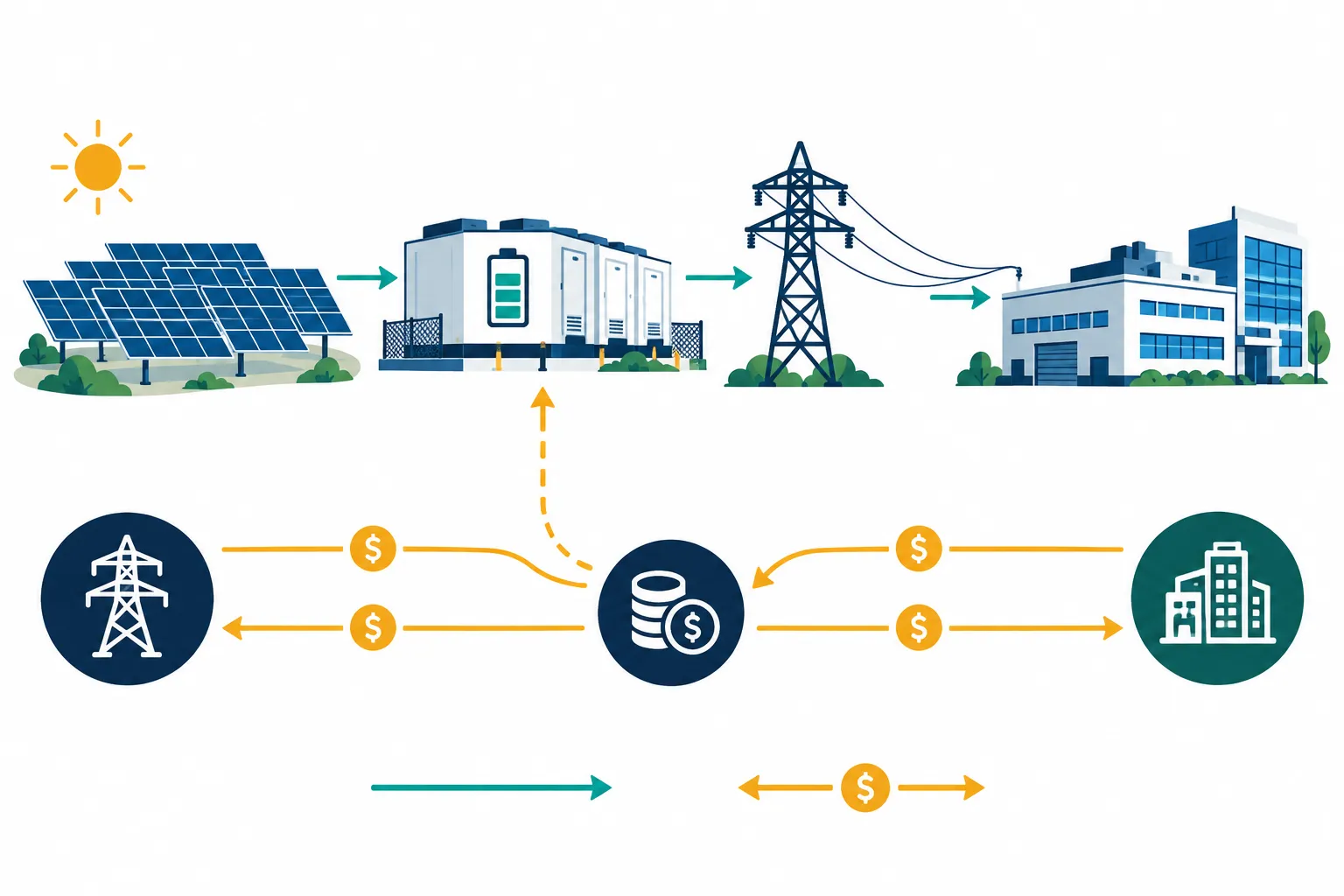
A storage asset absorbs electricity and releases it later, or holds capacity ready to respond on demand. A project needs an identifiable customer or market, such as a grid operator buying flexibility, a utility procuring capacity, or a facility managing peak demand and outages.
EIA recorded 10.4 GW of utility-scale battery additions in the US in 2024. A developer still needs to prove the economics of each site.
Two measures frame the project. Power, measured in megawatts (MW), describes the rate of charge or discharge. Energy, measured in megawatt-hours (MWh), describes how much can be delivered over time. Both figures, along with expected operating duration, show whether a design can meet the obligation being sold. Two systems with the same MW rating may serve different needs because their MWh capacity, operating windows, or state-of-charge requirements differ.
Start with four questions before choosing equipment:
Energy storage systems come in several project structures. Batteries often suit fast response and daily cycling; longer-duration options serve different delivery windows. Compare the service each design can provide before comparing technology labels.
| Project model | Typical buyer or counterparty | Core value proposition | Underwriting focus |
|---|---|---|---|
| Standalone, grid-connected storage | Utility, grid operator, or wholesale market participant | Capacity, balancing services, and energy shifting | Interconnection rights, market access, dispatch economics, and contracted floor |
| Solar-plus-storage or wind-plus-storage | Utility, corporate offtaker, or market participant | Shift renewable output and shape delivery | Shared interconnection, charging rules, curtailment, and allocation of revenue between assets |
| Behind-the-meter commercial storage | Enterprise, campus, or facility operator | Manage demand charges, resilience, or on-site energy use | Tariff exposure, load shape, operating priorities, and credit quality of the host |
| Long-duration storage | Utility or large energy buyer | Deliver across extended periods of tight supply | Demonstrated performance, construction risk, delivery duration, and long-term offtake |
A standalone energy storage battery may earn from wholesale price spreads and grid services where local rules permit. Location matters: a forecast based on market-wide prices may miss what happens at the project's node. Congestion, dispatch restrictions, and cycling costs can erode even an attractive spread, especially without a dependable revenue floor.
Pairing storage with solar or wind can shift output toward higher-demand hours and use a shared site or grid connection. Co-location still requires careful commercial design. The parties need rules for grid charging, allocating interconnection capacity, and paying each asset under the offtake agreement.
For the physical and commercial role of pairing these assets, see why battery storage matters for renewables.
For an enterprise project, the facility's bills and exposure to interruptions usually matter more than wholesale prices. A battery managing demand charges needs to be ready for the host's peaks. One reserved for backup must retain enough energy for an outage. If it serves both purposes, the operator needs a priority rule and a way to account for the revenue sacrificed when it holds energy in reserve.
A longer-duration system can cover a delivery window beyond a short daily discharge. Its buyer must define what counts as firm delivery, while the developer must substantiate performance. The operating case needs to account for charging time, site requirements, and repeated periods of tight supply.
Storage moves electricity across time and makes flexibility available. Its revenue model must reflect the service it can deliver under actual operating conditions.
| Revenue arrangement | How cash comes in | Main financeability question |
|---|---|---|
| Fixed availability or tolling payment | Counterparty pays for access to a defined amount of available capacity, subject to contract terms | Are payment, dispatch rights, performance tests, and deductions clear? |
| Contracted energy or capacity delivery | Buyer pays for specified output or dependable capacity | Can the system meet duration and availability obligations after degradation? |
| Merchant arbitrage | Operator buys or charges at lower-value hours and sells at higher-value hours | Do spreads remain after losses, fees, congestion, and cycling costs? |
| Ancillary or balancing services | Market pays for response, regulation, or reserve capability | Can the asset qualify, sustain the response, and earn the modeled price? |
| Behind-the-meter savings | Customer avoids eligible bill components or interruption costs | Does the host's actual tariff and load profile support savings? |
Revenue stacking can improve asset utilization, provided the operator does not commit the same MW and MWh to overlapping obligations. Investors need a dispatch model that resolves those conflicts and a contract map assigning price, volume, curtailment, and performance risk. Several volatile merchant streams may offer more ways to earn while leaving lenders exposed to uncertain cash flow.
Suppose a battery must reserve part of its output for evening delivery. It might earn from midday balancing services too, provided it retains enough charge and power capacity for the evening commitment. A forecast that claims maximum income from both services in the same hours cannot be dispatched.
Show gross revenue, charging purchases, round-trip losses, market and network fees, operating costs, augmentation or replacement allowances, and debt service as separate lines. Gross trading revenue is not free cash flow. Stress the model with lower spreads, reduced availability, a delayed connection, and higher cycling costs before setting the capital structure.
Solar and wind projects produce when the resource is available, which may not match the buyer's delivery hours. Storage can shift output, reduce curtailment, support a shaped supply agreement, and provide grid flexibility. The operator must leave room to charge and keep enough energy for the promised delivery window.
There are three commercially distinct designs:
An enterprise buyer may choose a power purchase agreement with shaped delivery, an on-site battery, or a separate storage service contract. Compare the hours covered and the risks each arrangement transfers. A single cost-per-MWh figure obscures those differences.
A financing package needs to connect the physical design to enforceable cash flow. Banks, infrastructure investors, corporate buyers, and specialist climate funds will all need evidence for the following steps, even if they accept different risks.
Put site control, permits, interconnection status, technical studies, and safety requirements in the project file. A lucrative revenue forecast cannot rescue a late grid connection or an unsuitable site. Schedule the development milestones alongside the cash needed to reach each one.
Model hourly or sub-hourly charging and discharge against contract terms, export limits, operating reserves, and expected degradation. Identify the source and cost of charging energy, then subtract efficiency losses to reach a net margin. A battery with several prospective buyers for its flexibility needs a schedule that works for all its commitments.
An offtake, toll, or availability agreement helps only if its term, payment mechanics, counterparty strength, termination rights, and performance penalties support the financing tenor. Model merchant upside separately from contracted income.
The distinction matters when choosing debt, tax equity, and other energy project finance structures.
Capital expenditure is only the starting point. Include equipment integration, commissioning, insurance, operations, degradation, augmentation, warranties, end-of-life responsibilities, and the cost of maintaining promised performance. Ask which party pays if the battery needs additional capacity to continue meeting a contracted duration.
Check where the construction and operating contracts meet. The equipment supplier, engineering and construction contractor, operator, and offtaker may each promise a different level of availability or performance. Set those promises beside the delivery obligation, then assign responsibility for any gap. Insurance terms, lender step-in rights, and a funded contingency deserve the same attention as the equipment warranty.
"NREL's mid-case projection for a complete four-hour utility-scale battery system is $321/kWh in 2024 dollars, not a quoted project price." - National Renewable Energy Laboratory
Bring the technical design, commercial model, permissions, financial sensitivities, and use of proceeds into one consistent evidence set. Investors accept different development stages and risk profiles. Zero Circle's project scoring, investor matching, underwriting support, and capital structuring workflows help owners standardize the opportunity and reach partners whose mandates fit the deal.

For a broader capital-readiness checklist, see energy project finance fundamentals and how to find climate project investors.
| If you are... | First decision | Evidence that moves the decision forward |
|---|---|---|
| A developer | Is there a buildable site with a monetizable service? | Site and interconnection status, dispatch case, contract strategy, and development budget |
| An investor | Is downside cash flow sufficient for the proposed risk and capital structure? | Contracted versus merchant revenue split, technical independent review, sensitivities, and counterparty diligence |
| An enterprise energy buyer | Which hours and operational risks do you need covered? | Load profile, tariff or procurement economics, resilience requirement, and a clear performance obligation |
Early development spending on site control and interconnection needs a credible route to a customer or market. Before financing, bring together a reconciled technical design, executed or priced commercial terms, construction budget, downside model, and risk allocation. In procurement, compare bids using the same delivery hours, availability terms, and remedies. A battery price alone will not tell you what the buyer receives.
Do not choose energy storage capacity by taking an annual energy figure and guessing a battery size. Size the system around the limiting service: MW for response and peaks, MWh for delivery duration, plus operating reserves and anticipated performance changes. Then test whether each extra unit of capacity earns enough to justify its cost.
In the US, local market participation rules, utility tariffs, and interconnection procedures can change the same physical design's economics. A portable investment memo should therefore separate the technical case from the jurisdiction-specific revenue and permitting assumptions.
Storage merits investment when a buyer's need leads to a buildable project and a dispatch plan supported by contracts and realistic economics. Standalone batteries, renewable-plus-storage, enterprise systems, and long-duration assets place performance and price risk with different parties. When the technical and commercial evidence is in place but the capital path is unclear, Zero Circle can help structure the financing case and connect it with relevant investors.
There is no single project cost: installed price depends on power rating, discharge duration, site work, interconnection, equipment scope, and the market where it is built. Compare proposals on a consistent basis that includes construction, operating costs, degradation allowances, and the service the system must deliver, not just a quoted battery price.