

Flood Resilience Projects: Finding Investors
Explore Flood Resilience Projects: Finding Investors by matching repayment sources, intermediaries and avoided-loss evidence to suitable capital.

– 6 min read
Explore Flood Resilience Projects: Finding Investors by matching repayment sources, intermediaries and avoided-loss evidence to suitable capital.
For flood resilience projects, finding investors starts with evidence of reduced flood losses and a credible source of repayment. A levee, restored wetland or protected substation may prevent expensive damage. Investors still need to know where their payments will come from. Identify the asset owner and payment obligation before approaching capital providers by geography, deal size and risk appetite.
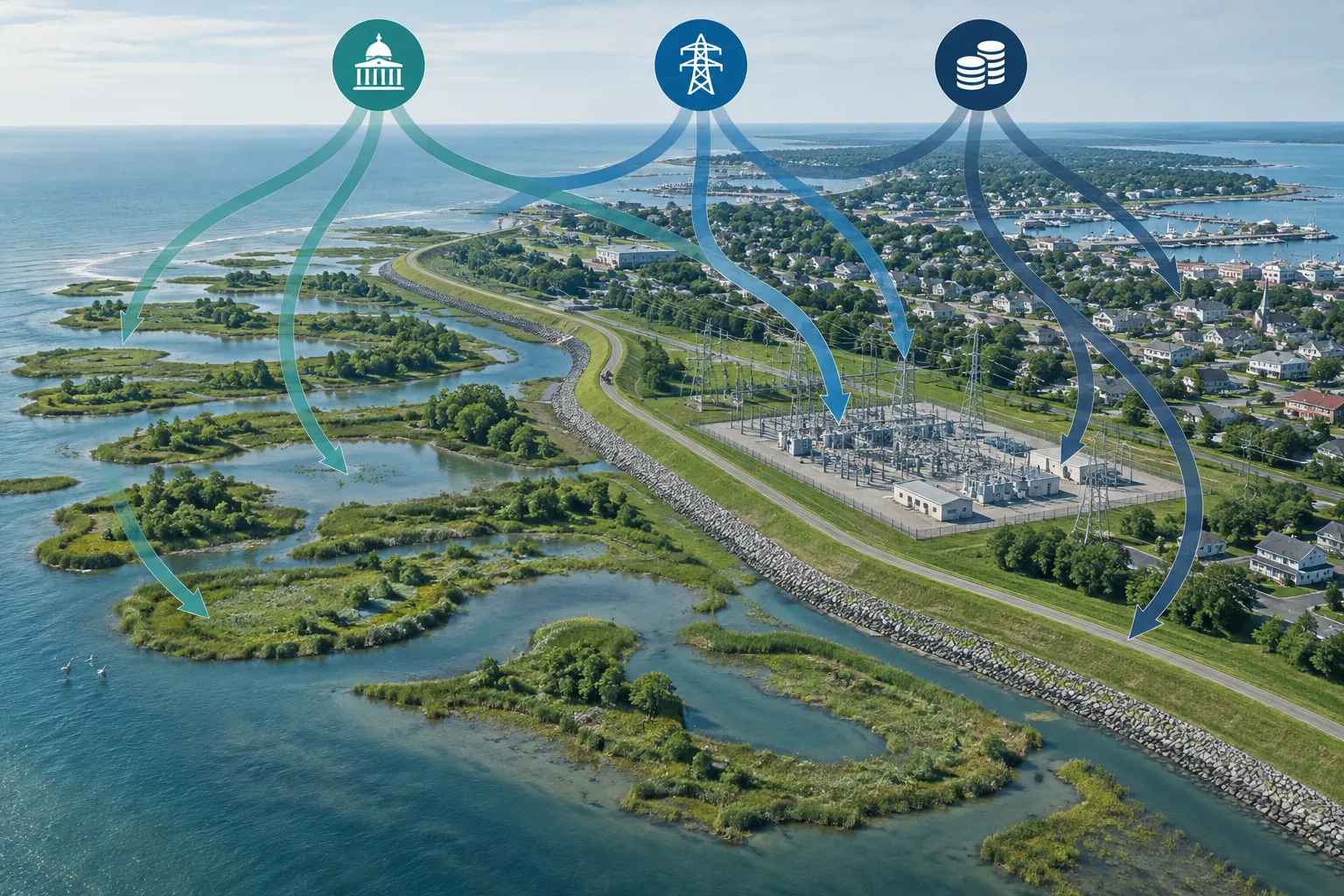
Before sending a deck, identify the party with authority over the site, the beneficiaries of protection and the party obligated to pay. Without a payer, work on a public appropriation, tariff, customer contract or other funding mechanism before expanding an investor list.
Grants cover eligible costs without requiring repayment. Loans and bonds advance capital against future payments, while equity investors expect distributions and take ownership risk. Development banks and public lenders can supply financing, technical assistance or risk sharing. Their participation alone does not make a project suitable for private investment.
Floodplain restoration with diffuse community benefits and no dedicated revenue may call for a grant or municipal budget. A utility stormwater program with approved charges may support debt. An industrial facility might pay for its own protection or contract for a resilience service. Similar engineering can lead to very different financing.
Consider the District of Columbia Water and Sewer Authority's environmental impact bond. DC Water issued a $25 million bond in 2016 to finance stormwater green infrastructure and share performance risk with investors. The utility was the issuer, with a defined financing structure. Avoided damage did not, on its own, service the bond.
Project and payment path | Likely first route | Potential investor or lender | Intermediary that can help | Main hurdle |
|---|---|---|---|---|
Public flood defense, paid from an approved government budget | Grants and public borrowing | Municipal bond buyers or public infrastructure lenders | Municipal advisor, bond counsel and public finance team | Authority to borrow and a credible budget commitment |
Utility drainage or green infrastructure, paid through authorized customer charges | Utility borrowing or structured debt | Infrastructure debt funds, banks or bond buyers | Utility finance adviser and arranger | Tariff authority, capital plan and operating responsibility |
Private site protection, paid by the property owner or contracted users | Corporate capital, lease or project debt where cash flows permit | Banks, credit funds or infrastructure investors | Project finance adviser or specialist placement agent | Creditworthy payer and enforceable contract |
Nature-based protection with no dedicated payer | Grants and catalytic public or philanthropic funding | Private capital only after a payment mechanism is created | Conservation finance adviser, public agency or community partner | Land rights, maintenance and a bankable payment stream |
Portfolio of smaller upgrades with recurring borrower payments | Aggregation and a financing facility | Banks, impact credit or specialist funds | Aggregator or program administrator | Repeatable contracts, underwriting data and servicing |
The table shows where to begin, without promising that any investor will fund a site. Municipal advisors work on public borrowing; arrangers structure debt; placement agents approach eligible capital providers under applicable securities rules. Aggregators combine smaller projects to spread diligence and transaction costs. Hire for the transaction you can execute rather than for the size of a contact database.
Grants can pay for design, permitting, community engagement and protection for people who cannot afford a project charge. Public or development-bank support can reduce risk through subordinated capital, guarantees or co-financing, subject to program terms. In a blended structure, spell out when the commercial tranche gets repaid and where it sits in the payment order.
Insurance payouts cover specified losses after an event, so they cannot usually support regular debt payments. Lower premiums can strengthen the business case when the beneficiary commits the savings to the project. A premium forecast without that commitment gives a lender little to rely on.
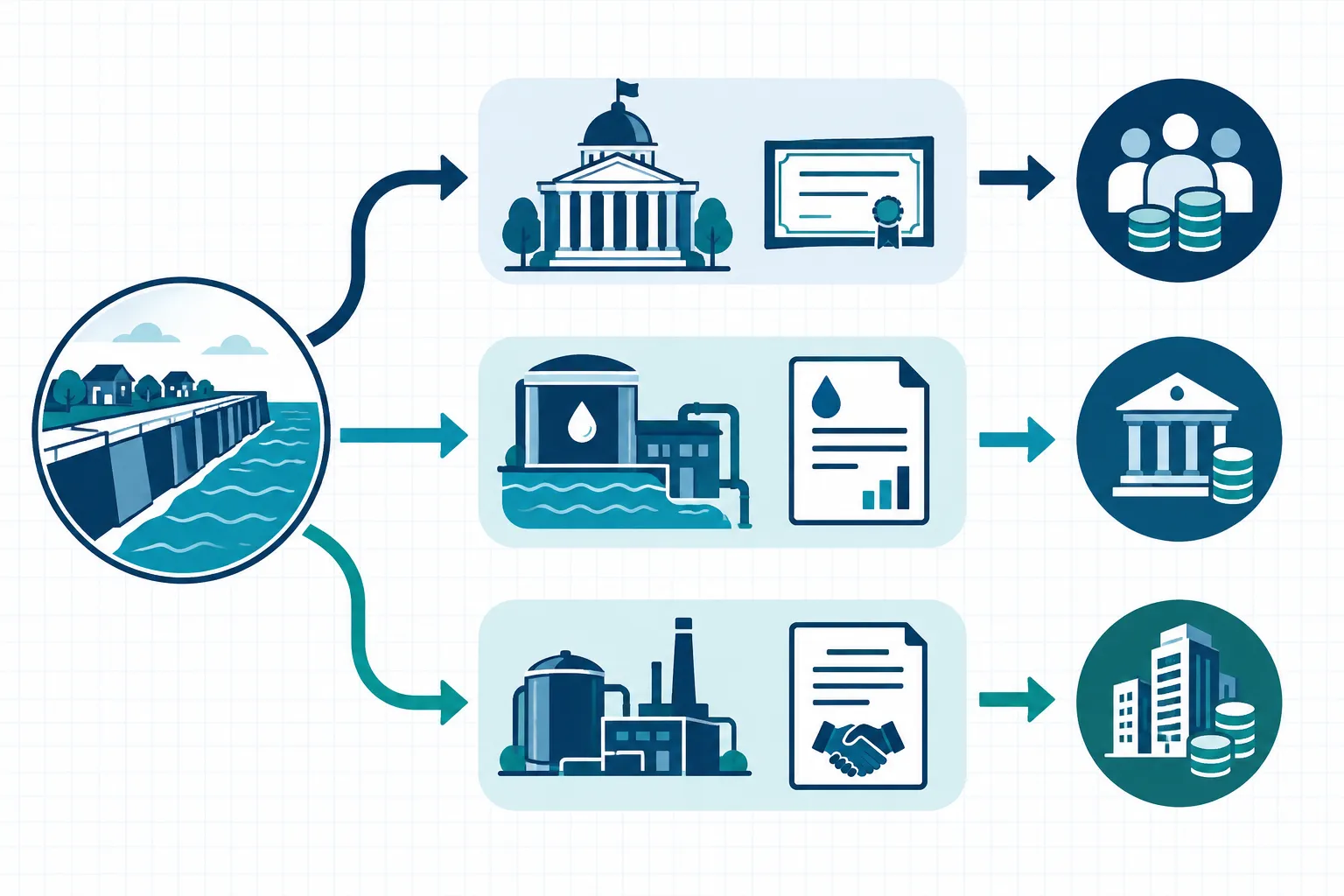
You can begin targeted conversations before negotiating every term. The first package should still let investors see the principal risks.
Compare a baseline flood scenario with a with-project scenario using the same assumptions. Identify exposed assets and people, modeled hazards, project life, climate assumptions, damage and service-disruption effects, and the producer or independent reviewer of the analysis. Show the uncertainty range and the plan for measuring performance after construction. This benefits case can support a public allocation or corporate decision even if investors receive no direct return from avoided losses.
"The average BCR across the sample projects is approximately 7:1." - National Institute of Building Sciences, riverine flood-mitigation grants
The estimate applies to sampled federally funded projects. It says nothing about the repayment rate of a new deal, and a new project's benefits could differ.
Keep cash flow separate: sources and uses, committed and uncommitted funds, payment schedule, operating and maintenance costs, reserves, and debt-service sensitivities. Distinguish a budget allocation from a forecast fee and a signed contract. Model late construction, weak collection and a severe flood before completion.
Document land access or easements, permits and approvals, asset ownership, procurement route, design stage, contractor responsibility and maintenance funding. Unresolved land rights for a wetland or unfunded upkeep for a barrier can stop conventional project finance. Address community consent and who bears the effects: protecting one property can push water toward another.
For more on preparing the financing case, see Adaptation and Resilience: A Project Finance Guide. Sponsors assembling multiple assets can use how to find climate project investors as they build a coherent pipeline.
Put the location, asset type, total capital need, requested tranche, stage, target close, sponsor, owner, payer, payment authority, anticipated instrument and tenor, secured funds, and main risks on the opening brief. Attach the benefit study and financial model. An email that merely says “seeking climate investors” makes recipients reconstruct the deal.
Measure progress by the quality of the shortlist and the reasons for declines. Each prospective capital provider should have a mandate that fits a transaction the sponsor can deliver.
Zero Circle is an energy and climate project finance platform for sponsors seeking relevant capital partners. Project scoring, standardized data, mandate-based matching, underwriting support, capital structuring guidance and human-reviewed outreach help sponsors focus investor conversations. Capital partners can screen structured project information without starting from an unformatted pitch.
Sponsors still need site control, an authorized payment source and independent flood-risk analysis. A match does not commit an investor to finance the project. Zero Circle fits flood-resilience opportunities within its broader climate-infrastructure remit when they have a credible investment structure; it is not a dedicated flood-finance product.
Identify the payer before pitching a flood resilience project. Grants and public programs suit benefits that cannot be monetized; borrowing and private investment require documented ownership, repayment and risk allocation. With those pieces in place, Zero Circle can help a climate infrastructure sponsor standardize the opportunity and reach capital partners whose mandates fit the deal.