
EPA Greenhouse Gas Reduction Fund: Project Finance
Explore green bank financing for energy projects, the EPA fund's current status, intermediary lending routes, and where private capital fits.

– 7 min read
Explore green bank financing for energy projects, the EPA fund's current status, intermediary lending routes, and where private capital fits.

Green bank financing for energy projects remains an option if you can find an institution with an active product. The EPA Greenhouse Gas Reduction Fund (GGRF) is not open to new project applicants. EPA says a 2025 law repealed its GGRF authority and rescinded funding. Subsequent court rulings affect existing awards; they neither open a new application window nor commit money to your project.
An independent state or local green bank may belong in your capital plan. Put a GGRF recipient in a different category until you know it can lend under its grant terms and the court rulings. A 2024 award announcement is not a financing offer.
No. New applicants have no open federal GGRF funding round. EPA says it terminated $20 billion of National Clean Investment Fund (NCIF) and Clean Communities Investment Accelerator (CCIA) grants in March 2025. A law enacted that July repealed the program’s authorizing provision and rescinded funding. In August 2025, EPA said it would stop implementing the $7 billion Solar for All program.
"President Donald J. Trump signed the Working Families Tax Cut into law on July 4, 2025, which repealed Section 134 of the Clean Air Act and rescinded the funding for the Greenhouse Gas Reduction Fund (GGRF)." - US EPA
In August 2026, the en banc D.C. Circuit affirmed a preliminary injunction that constrains EPA’s termination of previously awarded NCIF and CCIA grants. In September 2026, a federal district court vacated EPA’s decision to eliminate Solar for All, while declining to add another injunction in that case. The cases concern existing awards. Neither decision establishes a new federal award process or guarantees that a recipient can fund your project today.
Route | Original role | What a sponsor should assume now |
|---|---|---|
NCIF | National financing through selected nonprofit recipients and their partners | Existing awards are contested; there is no new EPA application round to rely on. |
CCIA | Capital and capacity for community lenders | Existing awards are contested; local lender products require their own current terms and available capital. |
Solar for All | Residential solar access through selected recipient programs | Termination has been challenged successfully in court; do not assume a local offer is active or funds are available. |
Independent state or local green bank | Financing from that institution’s own sources and products | A separate prospect from GGRF; assess its actual mandate and live offering. |
Keep historical GGRF awards out of the base-case sources and uses until a financing counterparty offers your project an executable commitment.
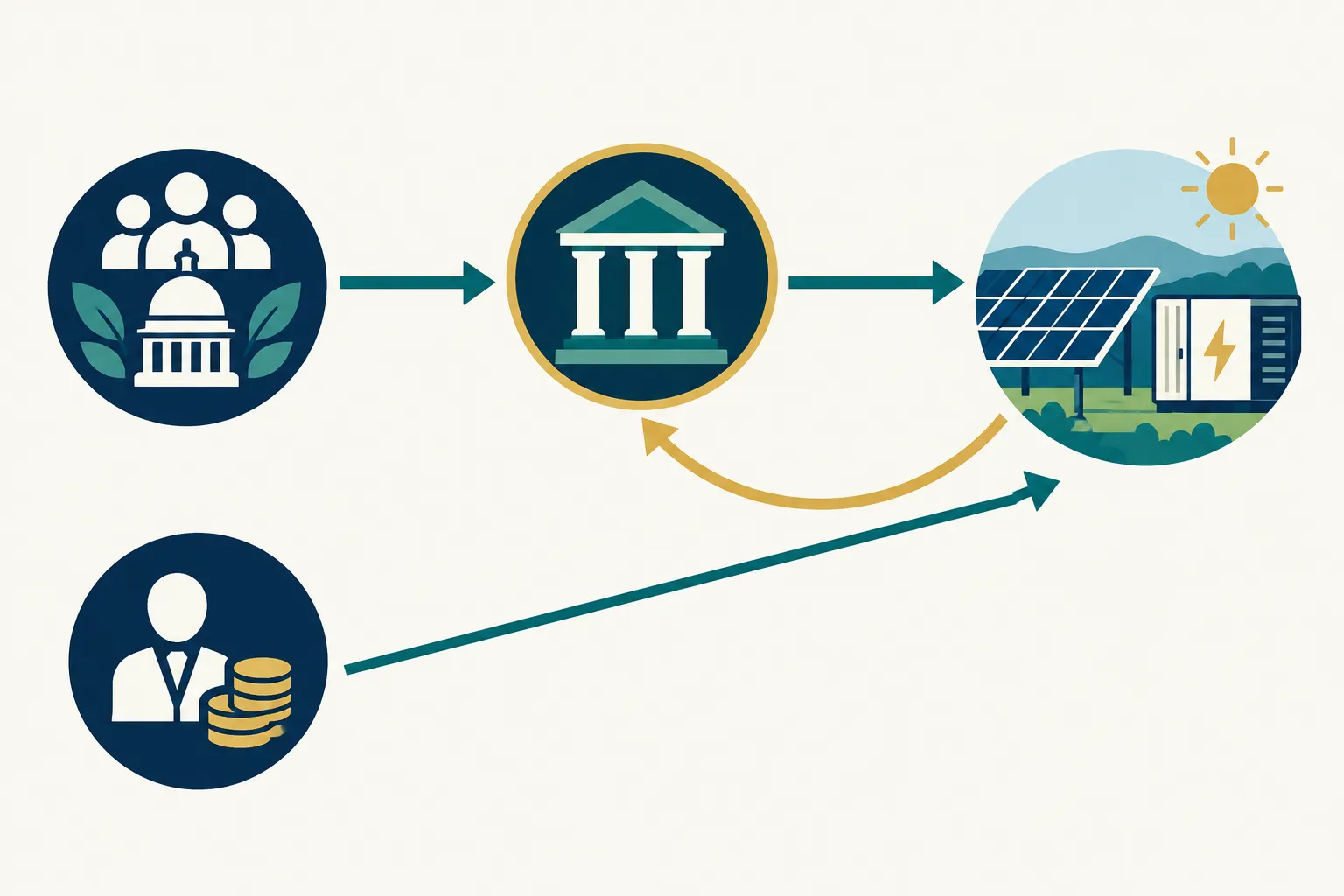
A green bank is a public, quasi-public, or nonprofit institution that finances clean energy. It need not take deposits, and its loans are not necessarily cheap. State programs, ratepayers, loan repayments, and private co-investors can supply its capital. Each institution sets its own terms.
Follow the money from the institution to the project:
The National Governors Association’s account of green-bank mechanisms describes direct lending, co-lending, guarantees, warehousing, and C-PACE. These mechanisms do not require GGRF money. A local program can finance a project while federal GGRF deployment remains disputed.
You repay a loan; a guarantee assigns losses if you default. A grant generally carries no repayment obligation if you meet its terms. Green banks can invest alongside private lenders, but they still look for a credible repayment source. That can make an efficiency upgrade backed by contracted savings suitable for a loan even when an early-stage technology demonstration is not.
At the state level, NY Green Bank’s product offerings include lending and other investment structures for New York clean-energy markets. Its geography and terms are separate from the disputed EPA awards. If your project falls outside its mandate, seek another institution or a private lender.
EPA awarded GGRF grants to organizations that would deploy or support clean-energy financing. Developers seeking project loans would approach an awardee or its partners, rather than apply to EPA. The program had three components: NCIF, CCIA, and Solar for All.
NCIF was designed to capitalize selected national nonprofit financing entities. They and their partners would assess projects or portfolios and finance deals that could draw in private capital. Developers would approach a recipient or its lending network, where the mandate, underwriting, and authority to deploy funds would determine the response. The size of an EPA award said nothing about whether an individual project qualified for a loan.
CCIA focused on intermediaries serving communities and smaller borrowers. Its intended path ran from EPA to selected awardees, then to community lenders financing local projects. A sponsor would work with the lender, not apply to EPA for a project grant. Community lenders also use other sources of capital, so a loan product can remain active without GGRF money flowing into it.
Solar for All targeted residential solar access through selected state, local, tribal, and nonprofit recipients. Utility-scale developers and standalone grid-storage sponsors cannot treat it as a general project-finance facility. A residential portfolio still needs an offer backed by enforceable funding from a recipient. EPA’s selection alone cannot support a closing.
Green-bank capital can address a defined financing gap in a project with credible repayment prospects. That gap might be construction risk, a lender’s short loan tenor, or small assets that need pooling. It does not replace sponsor equity, contracted revenue, or a commercial financing plan.
Tool | Gap it can address | Private capital alongside it | Main structuring issue |
|---|---|---|---|
Direct or co-lending | A senior or parallel debt shortfall | Bank debt, credit-fund debt, sponsor equity | Align lien, tenor, covenants, and intercreditor rights. |
Subordinated debt or guarantee | Risk that blocks senior lending | Senior lender and sponsor equity | Define loss allocation, triggers, and who bears first loss. |
Warehouse or aggregation facility | Many small assets that lack portfolio scale | Takeout lenders or portfolio investors | Standardize contracts, performance data, and takeout assumptions. |
C-PACE where offered | Eligible property improvements with long repayment needs | Mortgage lender, property owner capital | Address assessment priority and mortgage-lender consent. |
Imagine a commercial rooftop solar and storage portfolio with contracted site hosts. A private lender agrees to finance operating assets but will not fund each site during construction. A green-bank co-lender or warehouse facility could fill that gap, leaving development risk with sponsor equity. This is a structure illustration, not an available GGRF offer. The institution’s program, geography, credit terms, and eligibility rules govern any real transaction.
For the rest of the stack, see Clean Energy Financing Options and the distinction between tax equity and debt in energy project finance.
Begin with a project package an investor or green-bank underwriter can evaluate:
Look for the institution that can fill your specific gap. An independent green bank may lend, provide a guarantee, administer C-PACE, or partner on a portfolio. A community lender may have a loan program of its own. Keep a legacy GGRF recipient in the contingent column until it can demonstrate authority to deploy capital and give you terms. Run a private-capital process in parallel rather than let litigation set your closing date.
Zero Circle’s project scoring, standardized deal information, investor matching, underwriting support, and capital structuring workflows help sponsors present a consistent case to lenders and investors. They cannot make a contested GGRF grant available. The energy project finance framework can help you map contract and capital risks before outreach.
The GGRF’s intermediary model explains how federal capital was intended to reach projects. It is not an open project-finance program now, and court decisions about existing awards give new sponsors no right to funds. An independent green bank is worth approaching when its product fits your financing gap. Build the stack around offers you can secure, with a private-capital alternative. Zero Circle can help you organize the deal and reach investors whose mandates fit.
State and local green banks may offer solar lending, co-lending, or property-based financing, while commercial banks and community lenders may finance eligible projects under their own programs. The right lender depends on the project’s location, borrower, size, repayment source, and development stage; an old GGRF award does not establish that a lender has funds available now.
Sponsors typically combine equity with debt supported by contracted revenues or other credible cash flows. A green bank may add a loan, guarantee, warehouse facility, or other instrument to fill a specific gap, subject to its mandate and underwriting.
There is no open EPA GGRF application route for a new project sponsor. Other grants depend on the technology, applicant, location, and currently open program; a green-bank loan is financing to repay, not a grant.