Sustainable Agriculture and Food Security in Africa
Explore the importance of sustainable agriculture in Africa for food security and economic development, along with current initiatives and challenges faced in the agricultural sector.
Sustainable agriculture improves soil productivity while limiting harm to climate, soil, water and biodiversity, and it matters in Africa where about 250 million smallholder and subsistence farmers make up the sector. Initiatives such as Songhai in Benin and the World Bank's Kenya Climate Smart Agriculture Project show progress, while climate impacts, conflict, weak policy and poor infrastructure hold back food security.
Sustainable agriculture and food security are critical issues in Africa, where a large portion of the population relies on agriculture for their livelihoods and food supply. With a substantial segment of the population reliant on agriculture for sustenance and livelihoods, the continent must adopt sustainable practices to ensure long-term food security while safeguarding the environment.
In recent years, a growing acknowledgment of the significance of sustainable agriculture has underscored its pivotal role in shaping the future of food production in Africa.
Exploring Sustainable Agriculture in Africa
This blog embarks on a journey to unravel the multifaceted landscape of sustainable agriculture in Africa, delving into its challenges, opportunities, and transformative impact on food security across the continent. By navigating through the intricate web of sustainable agricultural practices, this exploration aims to shed light on the profound implications of sustainable agriculture on the socio-economic of African communities.
The Importance of Sustainable Agriculture
Sustainable agriculture focuses on meeting the needs of the present without compromising the ability of future generations to meet their own needs. In Africa, sustainable agriculture is crucial for addressing food security challenges, reducing poverty, and promoting economic development. Farmers can improve soil fertility, conserve water resources, and enhance biodiversity by adopting sustainable practices, increasing productivity and resilience to climate change.
Here are some aspects of sustainable agriculture:
Environmental Conservation: Sustainable farming methods help prevent and mitigate environmental issues such as soil degradation, water pollution, and biodiversity loss. By maintaining soil quality, reducing erosion, saving water, and increasing biodiversity, sustainable agriculture contributes to preserving ecosystems and habitats.
Food Security: With a growing African population, sustainable agriculture is vital for ensuring food security. Sustainable food helps meet the increasing demand while protecting natural resources for future generations.
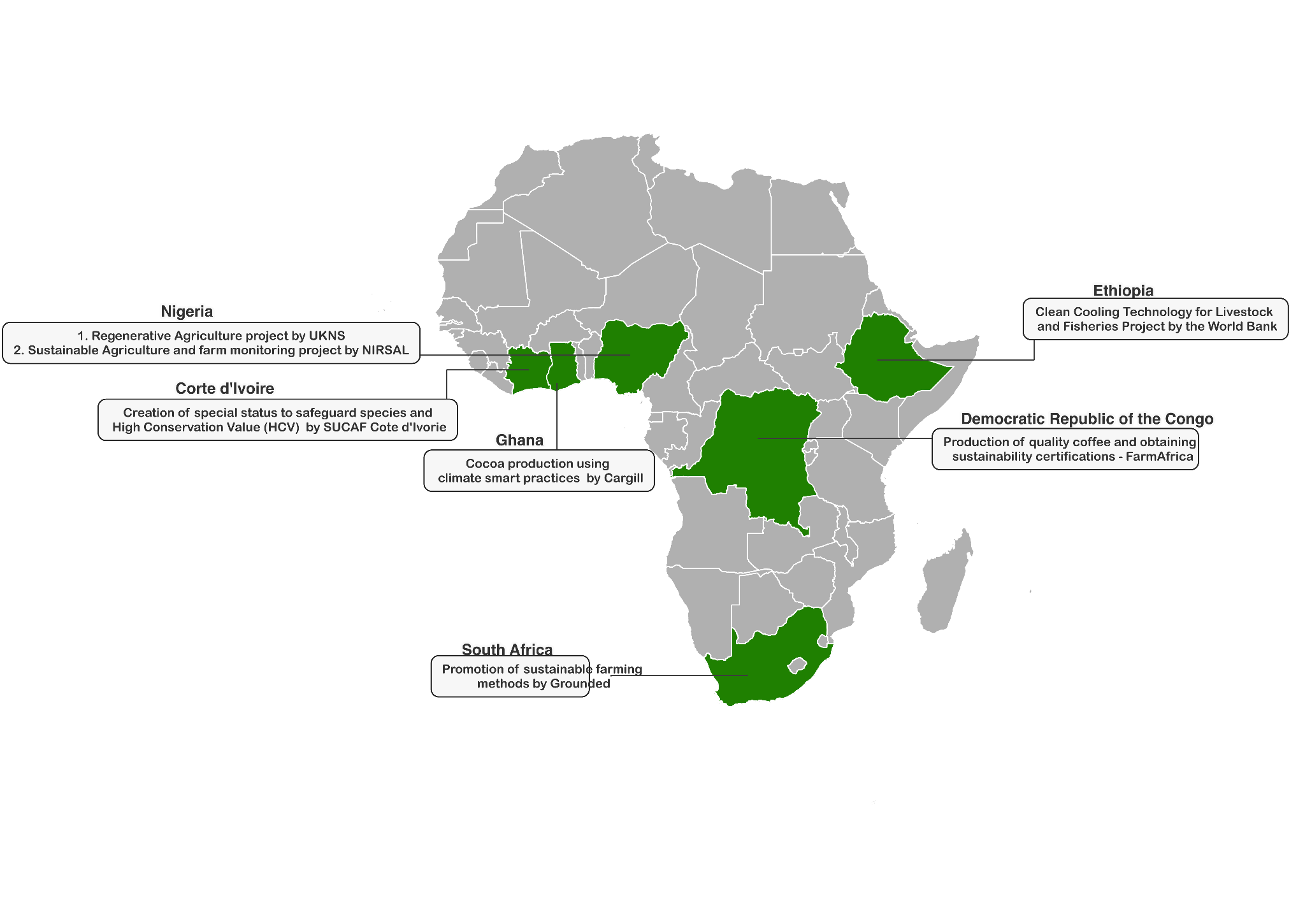
Map showing an overview of some Sustainable Initiatives across Africa
Economic Viability: Sustainable agriculture can benefit economically by promoting efficient resource use, reducing energy consumption, and enhancing soil health. This can lead to improved livelihoods for farmers and communities in Africa.
Social Equity: Sustainable farming practices promote fair working conditions, competitive salaries, and humane treatment of workers. This contributes to social equality by ensuring that those in the agricultural sector have access to decent living conditions and safe work environments.
Climate Change Mitigation: Sustainable agriculture plays a role in combating climate change by reducing greenhouse gas emissions, conserving energy, and promoting carbon sequestration. These practices help in building resilience to climate change impacts in Africa.
Current Initiatives in Sustainable Agriculture
A significant shift is happening on the sustainable Agriculture front across Africa. According to the German Federal Ministry for Economic Cooperation and Development report, Sustainable Agriculture emphasizes methods and processes that improve soil productivity while minimizing harmful effects on climate, soil, water, air, biodiversity, and human health. Around 250 million smallholder and subsistence farmers across Africa make up the agricultural sector. Substantial efforts are needed to improve the sustainable agriculture landscape in Africa. Certainly, progress is happening slowly but gradually. Some of the current initiatives in sustainable agriculture across Africa are:
Zero-Waste Agriculture in Africa - In 1984, a Nigerian, Father Godfrey Nzamujo, created a sustainable Zero-waste farm, ‘Songhai’ in Porto-Novo, Republic of Benin, designed to mimic the natural ecosystem. Songhai is now being implemented in several African countries, including Nigeria.
Advocating for sustainable agricultural practices in South Africa—In Cape Town, South Africa, Grounded teams up with farmers to enable them to transition towards regenerative agriculture in a way that business makes sense.
Artificial Intelligence for Supply Chains (Ghana)—Farmerline, through its platform Mergdata, has digitized over 1 million farmers through partnerships across 26 countries, employed over 200 people in Ghana, and evolved into a reliable AI-powered platform for supply chain intelligence, such as crop yield prediction, fertilizer demand forecasting, and credit scoring for agribusiness.
Kenya Climate Smart Agriculture Project—The World Bank is working in Kenya through The Kenya Climate Smart Agriculture Project to increase agricultural productivity and build resilience to climate change risks in smallholder farming and Pastoral communities.
Reduce-Reuse-Recycle Rice Initiative for Climate Smart Agriculture in Uganda and Kenya - The Reduce-Reuse-Recyle Rice initiative for climate-smart Agriculture R4iCSA project funded by IKEA Foundation and implemented by Kilimo Trust in Uganda and Kenya. It has made rice farming more integrated with their related business models, which are being tested by using products such as biochar and super charcoal produced by heating rice husks anaerobically.
Over the past two years, this initiative has been implementing sustainable rice cultivation techniques, including intercropping with leguminous plants and managing crop residues. The project aims to impart practical knowledge on regenerative agriculture in rice-based farming systems to 5,000 farmers across both countries. The utilization of rice farming by-products has played a significant role in preserving and restoring food and farming systems in Uganda and Kenya, while the integration of rice and legumes has enhanced soil health overall.
Challenges Encountered by African Agriculture
Africa faces various challenges that hinder sustainable agriculture and food security, including climate change impacts like erratic rainfall patterns, increased pest outbreaks, and extreme weather events, limited access to climate-resilient farming practices and resources, the need to produce more and better to feed the growing population, promoting human capital within smallholding farms, managing employment, food-related problems, conflicts, exoduses, and desertification, implementing sustainable development efforts, addressing unequal access to resources, climate constraints, lacking infrastructure, and competitive markets, as well as difficulties in obtaining loans for farmers.
Sustainable Agriculture Solutions
Sustainable agriculture in Africa is being promoted through several key strategies:
Adoption of sustainable farming practices: African countries encourage conservation agriculture, agroforestry, climate-smart agriculture, integrated pest management, efficient water management, and farmer education to develop more sustainable farming systems.
Leveraging digital technologies: Partnerships between organizations like IFC and Microsoft are delivering digital agriculture solutions to African agribusinesses to improve supply chain efficiency, boost production, promote traceability, and increase access to finance and advisory services. Tools like the Microsoft AgBot provide smallholder farmers with information on weather, crops, pests, and markets. M-Farm, eProd solutions, Hello Tractor, Esoko, and FarmDrive are other tools used.
Improving soil health and environmental protection: Sustainable farming methods like crop rotation, polyculture, and regenerative agriculture maintain soil quality, reduce erosion, sequester carbon, and preserve biodiversity and ecosystems.
Promoting social equity: Sustainable agriculture ensures fair wages, safe working conditions, and adequate living standards for farm workers.
Impact on Food Security
A report on African agriculture in 2023 states that digital technology will be crucial. Empowering Africa's food systems for the future will empower Africans to overcome the three most significant problems in African agriculture - inefficiencies, exclusivity, and the lack of sustainability.
Sustainable agriculture indicates that conflict remains the dominant driver of Africa's food crisis, with an estimated 82% of the record 149 million Africans facing severe food insecurity living in conflict-affected countries. Some key factors contributing to food insecurity in Sub-Saharan Africa include:
Constant political instability and crises, brief or protracted civil conflicts, and wars
Pervasive and persistent corruption
Incorrect economic policies and mismanagement
Lack of committed political leadership
Lack of clear financial and economic investment in the region
Extreme poverty poses the greatest danger to food security
Inadequate agricultural policies, poor infrastructure and transportation, insufficient marketing strategies
Frequent extreme weather conditions and a rising disease burden
Weak financial support schemes and insufficient safety net systems
As a way to improve food security sustainably, Sub-Saharan African countries should:
Guarantee food accessibility in both quality and quantity to improve health status
Effectively utilize natural resources and focus on supporting smallholder farmers
Invest in agricultural research, markets, infrastructure, and institutions
Develop good macroeconomic policies, ensure political stability, and create sub-regional strategies
Enhance agricultural productivity by improving farm management techniques
Promote efforts to maximize regional food trade and reduce inefficiencies in global markets
Conclusion
Sustainable agriculture is essential for ensuring food security in Africa while preserving the environment and promoting economic development. By investing in sustainable practices and supporting smallholder farmers, African countries can improve food production, reduce poverty, and build resilience to climate change. Governments, organizations, and individuals must work together to promote sustainable agriculture and food security in Africa for a more prosperous and sustainable future.
Frequently asked questions
What is sustainable agriculture?
Sustainable agriculture meets present needs without compromising future generations. It emphasizes methods that improve soil productivity while minimizing harm to climate, soil, water and biodiversity.
Who makes up Africa's agricultural sector?
About 250 million smallholder and subsistence farmers make up the agricultural sector across Africa.
What are examples of sustainable agriculture initiatives in Africa?
Songhai in Porto-Novo, Benin, designs farms to mimic natural ecosystems and has spread to other countries. The World Bank's Kenya Climate Smart Agriculture Project aims to raise productivity and resilience for smallholder and pastoral communities.
What are the main challenges for African agriculture?
Climate change impacts such as erratic rainfall, political instability and conflict, inadequate agricultural policies, poor infrastructure and transport, and a rising disease burden.